
Shuja Nawaz, arguably the most authoritative expert on the Pakistani military, assesses the US-Pakistan strategic dialogue.
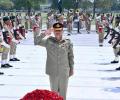
Sections in the US State Department and Pentagon have always felt more comfortable dealing with all powerful Pakistani generals instead of elected civilians, points out Rana Banerji, who headed the Pakistan desk at RA&W.
'I don't see any relationship between them and ex-army or ex-ISI as has been happening in the past,' says strategic analyst Shuja Nawaz, who is convinced the Pakistan army and its intelligence wing, the Inter-Services Intelligence, are not complicit in the Mumbai terror attacks.
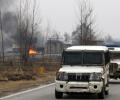
'This is in its own interest.' 'Only the State must have the monopoly of power in the country.'
'Militias have no place in democracies,' says Shuja Nawaz, Distinguished Fellow at the Atlantic Council, the Washington, DC-based think-tank.

The plan hinged on two critical assumptions: India would not be able to replenish supplies quickly to launch a counter-attack. India could not respond in enough strength to dislodge the Pakistanis. Both assumptions would be proved wrong due to the ferocity of the Indian response, reveals former RAW officer Tilak Devasher in his new book, Pakistan At The Helm.

What drives Pakistani men to join its military, despite the toll it takes on them?
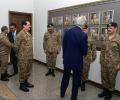
'Both India and Pakistan are now, for the first time in history, very closely allied and connected with the US -- economically and politically.'

But the ISI chief did not retire giving the impression that he has won General Asim Munir's trust, notes Rana Banerji who headed the Pakistan desk at RA&W.

Several retired and serving military officers attend Pervez Musharraf's funeral prayers.
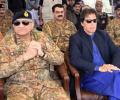
'Any conventional conflict could trigger a nuclear war with results that neither India nor Pakistan could survive easily.' >A revealing excerpt from Shuja Nawaz's The Battle For Pakistan: The Bitter US Friendship And A Tough Neighbourhood.

These are obviously not 'organic' desertions but brought about under intense military pressure, post the 9/5 arrests. It seemed as if the party was being dismantled the same way it was brought into power!, notes Rana Banerji, who headed the Pakistan desk at RA&W, India's external intelligence agency.

His disqualification to participate in future elections may follow, notes Rana Banerji, who headed the Pakistan desk at RA&W, India's external intelligence agency.
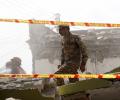
Pakistan's Punjab province Home Minister Shuja Khanzada was on Sunday assassinated along with eight others when a suicide bomber blew himself up at his house in Shadi Khal village in Attock district.

General Asad Durrani's disclosures could leave considerable egg on the face of those currently wielding the stick in Pakistan, notes Rana Banerji, who headed the Pakistan desk at the Research and Analysis Wing, India's external intelligence agency.
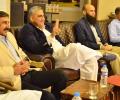
'Over the last year, Bajwa has created the environment to support bold moves on India. The ball is in India's court,' a senior Pakistan military officer tells Ajai Shukla.

By weakening Sharif, the corps commanders could have a final say in important matters like relations with India, dealing with Taliban militants, interacting with Americans and once again achieving strategic depth in post-NATO Afghanistan. Which is why they may be behind the unrest in Pakistan led by Imran Khan and Dr Tahirul Qadri, says Shahzad Raza.

'We will have to wait till the snows melt in June/July 2016 before we can get a clearer idea of whether Pakistan intends to get serious about ending support for cross-border terrorism,' says G Parthasarathy, India's former high commissioner to Pakistan.

'A close look at the time-lines tells you that exactly as the back-channel negotiations were in their most crucial stage, "somebody" was planning the 26/11 attacks in Mumbai,' says Shekhar Gupta questioning Khurshid Mahmud Kasuri's account of a peace deal with India.

The brutal Tehrik-e-Taliban Pakistan assault has claimed 141 lives, including 132 school children, six terrorists and three armymen.
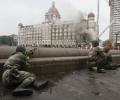
Through its early days to the 1980s, Pakistan sought to expand its sphere of Islamic influence through Afghanistan to Central Asia and got Pakistani citizens recruited in the Afghan government institutions in the 1990s when the Taliban were power. Now, it is looking eastward through India to Bangladesh and Myanmar to establish an imaginary caliphate.
