
The Supreme Court has questioned the 'arbitrariness' in the consideration of 'criteria appointment' for Short Service Commission (SSC) women Army officers seeking permanent commission, compared to their male counterparts. The court is hearing a plea from women officers challenging the denial of permanent commission.

The Supreme Court has refused to entertain pleas against the Kerala High Court order dismissing petitions challenging the Travancore Devaswom Board's decision to conduct a global conclave of Ayyappa devotees.

The NDA in Bihar, led by Chief Minister Nitish Kumar, strategically countered the Mahagathbandan's moves by implementing similar policies and announcements, effectively neutralising the MGB campaign promises and maintaining their political advantage.
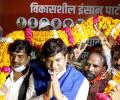
'Without our support Nitish Kumar wouldn't have become chief minister.' 'After the government was formed we became ministers, but our agenda remained the same: Amit Shah had promised reservation for Nishads.' 'He wouldn't listen, so we went to UP and contested 52 seats in the 2022 elections. He didn't like the idea of rebellion.' 'He saw that this man, coming from Bombay, is very sharp. He's made four MLAs now, tomorrow he'll make 40. A time will come when they will make it 125.' 'They bought our MLAs and ousted us from the government.'

The Jan Suraaj Party announced its second list of candidates for the Bihar assembly elections, covering 65 constituencies. The party has kept its choice for the Raghopur seat, where founder Prashant Kishor is expected to contest, under wraps. The list includes candidates from various sections of society, including the extremely weaker sections, Other Backward Classes, and Muslims.

The Supreme Court refused to stay a provision barring the declaration of tribal lands as waqf properties, upholding key provisions of the Amended Waqf Act.

The Supreme Court acknowledged a clean chit from a special investigation team (SIT) regarding the Vantara zoological rescue and rehabilitation centre in Gujarat's Jamnagar, following allegations of irregularities.

Reliance Foundation's Vantara has pledged full cooperation with the Supreme Court-appointed SIT investigating allegations of legal non-compliance and animal acquisition irregularities.

The Supreme Court of India has emphasized the importance of conducting day-to-day trials, especially in sensitive cases, to ensure speedy justice as guaranteed by Article 21 of the Constitution. The court has directed high courts to form committees to address trial delays and revert to the practice of continuous trials.

Mohammedan SC held Odisha FC to a goalless draw to break their five-game losing streak in the Indian Super League in Kolkata on Friday.

A 19-year-old engineering student allegedly died by suicide in Hyderabad, following a financial dispute with friends over sharing the cost of a party bill, police said on Monday.

The Supreme Court on Friday adjourned to September 22 the hearing on bail pleas of activists Umar Khalid, Sharjeel Imam, Gulfisha Fatima and Meeran Haider in the Unlawful Activities (Prevention) Act (UAPA) case related to the alleged conspiracy behind the February 2020 riots in Delhi.
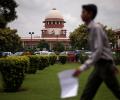
The Supreme Court is scheduled to pronounce interim orders on key issues related to the Waqf (Amendment) Act, 2025, including the power to denotify properties declared as waqf.

The Jharkhand Mukti Morcha (JMM) has announced it will contest the Bihar assembly elections independently and review its alliance with the Congress and RJD in Jharkhand after the Bihar elections.

Kerala Blasters FC produced a scintillating second-half performance to secure a commanding 3-0 victory over Mohammedan SC in the Indian Super League in Kochi on Sunday.

The Supreme Court has ruled that a bank's one-time settlement (OTS) scheme cannot be invoked as a matter of right and that borrowers must strictly comply with its mandatory conditions, including upfront payment of a specified portion of dues, to avail themselves of the benefits of the scheme.
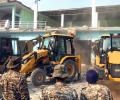
'The implementation of the judgment has largely been left to the discretion of the very executive authorities it sought to restrain.'
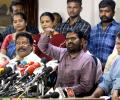
The Supreme Court has suggested Tamil film director and politician Seeman tender an unconditional apology to an actor who accused him of rape in 2011. The court is hearing Seeman's plea to quash the case against him.
The Supreme Court has raised concerns about discrimination against persons with disabilities in employment, questioning the Centre on the lack of 'upward movement' for meritorious candidates. The court also ordered nationwide monitoring of care institutions for persons with cognitive disabilities.

The Supreme Court of India has emphasized the importance of aggressive sterilization programs to control the growing population of stray dogs, balancing animal rights with public safety concerns.

A 12-year-old Dalit boy in Shimla district allegedly died by suicide after being harassed by upper caste women for entering their house. The incident has sparked outrage and calls for justice.
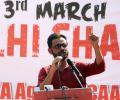
The Supreme Court on Monday sought the Delhi police's response on the bail pleas of activists Umar Khalid, Sharjeel Imam, Gulfisha Fatima and Meeran Haider in the UAPA case related to the alleged conspiracy behind the February 2020 riots in Delhi.
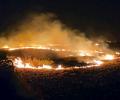
The Supreme Court has expressed concern over the increasing pollution levels during winter and has suggested that the Punjab government arrest farmers who engage in stubble burning. The court believes that this action would send a strong message and help curb air pollution.

'What is the urgency? It's a match, let it be. Match is this Sunday, what can be done?'

The Supreme Court has directed the Maharashtra State Election Commission to complete the stalled local body polls by January 31, 2026, criticizing the commission for non-compliance with previous orders.
The Centre told the Supreme Court that governors are not indefinitely sitting on bills passed by state legislatures, and that barring a few exceptions, most have acted in a way which the apex court would have perhaps desired. Solicitor General Tushar Mehta argued that a Governor is "not a rubber stamp" and has a duty to preserve, protect, and defend the Constitution.
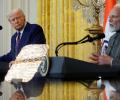
The Trump administration has told the US Supreme Court that it imposed tariffs against India for purchasing Russian energy products as part of its strategy to address the war in Ukraine.
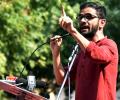
Activist Umar Khalid has appealed to the Supreme Court against the Delhi High Court's decision to deny him bail in a case under the Unlawful Activities (Prevention) Act (UAPA) related to the alleged conspiracy behind the February 2020 Delhi riots.
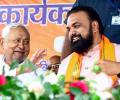
Jan Suraaj Party founder Prashant Kishor alleges Bihar Deputy Chief Minister Samrat Choudhary escaped a murder trial by falsely claiming to be a minor. He demands Choudhary's dismissal and threatens to expose further financial irregularities.
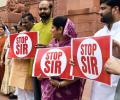
The Supreme Court has warned that it will set aside the special intensive revision (SIR) of electoral rolls in Bihar if any illegality is found. The court is reviewing the validity of the Bihar SIR and its potential impact on a similar exercise across India.

Issuing notice to the ED on the plea filed by the Tamil Nadu government and Tamil Nadu State Marketing Corporation (TASMAC), a bench comprising Chief Justice B R Gavai and Justice Augustine George Masih told Additional Solicitor General S V Raju, appearing for the anti-money laundering probe agency, that "Your ED is crossing all the limits."

"Considering the importance of the matter, subject to the order of the Chief Justice of India, the matter be placed for final hearing on July 22," the bench said.
The Supreme Court criticizes an accused in a CTET proxy exam case, referencing the movie 'Munna Bhai MBBS' and emphasizing the damage to the public examination system. The court seeks a response from Uttar Pradesh regarding the denial of bail to the petitioner.

Three first half goals handed Punjab FC a comfortable 3-0 victory over Gokulam Kerala FC in the Group C opener of the Super Cup in Bambolim, Goa, on Monday.
The Supreme Court of India has formed a Special Investigation Team (SIT) to investigate allegations of non-compliance with laws and irregularities at Vantara, a Green Zoological Rescue and Rehabilitation Centre in Gujarat. The SIT will examine the acquisition of animals, compliance with wildlife protection laws, and other related issues.

The Madhya Pradesh High Court dismissed a petition seeking a stay on the release of the Hindi film 'Haq', which is inspired by the life and legal struggle of Shah Bano Begum. The court found the petition devoid of merit, clearing the way for the film's release.
The Supreme Court has raised concerns about the preliminary report on the Air India crash and has asked for a more independent and thorough investigation.

The Supreme Court told actor and BJP MP Kangana Ranaut that she had "added spice" to a retweet during the 2020-21 farmers' protest, leading her to withdraw her plea for quashing a defamation complaint.
A five-judge Constitution bench of the Supreme Court is scheduled to consider the Presidential reference on whether timelines could be imposed by judicial orders for the exercise of discretion by the President while dealing with bills passed by state assemblies.

Activist Sharjeel Imam has moved the Supreme Court challenging a Delhi High Court order denying him bail in a case linked to the 2020 Delhi riots. The High Court had denied bail to several individuals, emphasizing that conspiratorial violence under the guise of protests cannot be allowed.
