
A preliminary government report reveals that devastating flash floods in Nepal have affected over 32,000 people, caused 1,295 deaths, and severely damaged infrastructure including roads, bridges, schools, and healthcare facilities. Senior Nepali Congress leader Arjun Narsing KC has criticised the government's coordination of rescue and relief operations and called for international action on climate justice.

Nepal's Rastriya Swatantra Party is surging ahead in the general elections after Gen Z protests ousted the previous government, signaling a potential new era in Nepali politics.

Rapper-turned-politician Balendra Shah's Rastriya Swatantra Party (RSP) is poised to form the next government in Nepal after a decisive victory in the general election, significantly impacting established political parties.

Rapper-turned-politician Balendra Shah's Rastriya Swatantra Party (RSP) is on track for a significant victory in Nepal's general elections, potentially reshaping the country's political landscape.

The 76-year-old Nepali Congress president, who has served as the prime minister for a record fifth term, defeated his challenger party general secretary Gagan Kumar Thapa by 39 votes, officials said.

Nepal's Prime Minister Balendra Shah addressed parliament on the ongoing border dispute with India, stating both countries have agreed to seek resolution through diplomatic means and expert consultation. Shah's remarks about Nepal also encroaching on Indian territories have sparked controversy.

Former Nepalese Prime Minister K P Sharma Oli and ex-Home Minister Ramesh Lekhak have been released on personal recognisance bail after being arrested in connection with the Gen Z protests of September 2023.

Former Nepal Prime Minister K.P. Sharma Oli has been arrested in connection with the deaths during the Gen Z protests last year, following the implementation of a probe commission's report.
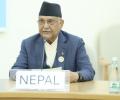
Oli stepped down shortly after hundreds of demonstrators entered his office shouting anti-government slogans.

Nepalese citizens are voting in the general election, the first since protests toppled the previous government. Over 18.9 million are eligible to vote for the 275-member House of Representatives.

For a team that once struggled for basic infrastructure, the T20 World Cup is being viewed as a defining leap rather than just another appearance for Nepal.

At least 19 people were killed and dozens injured on Monday as violent protests by youths rocked the Nepalese capital and certain other areas over the government's decision to ban social media sites, prompting authorities to deploy the army in Kathmandu to control the situation.

A profile of veteran Nepali politician K P Sharma Oli, detailing his rise to power, his various stints as prime minister, and his impact on Nepal's political landscape.

The Nepali Army and heads of security agencies have jointly appealed for restraint and dialogue as protests escalate following the Prime Minister's resignation. Demonstrations have turned violent, with protesters targeting government buildings, political figures' homes, and private property.
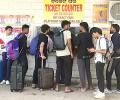
The Odisha government has constituted a fact-finding committee to investigate the circumstances surrounding the death of a Nepali student at KIIT University and the subsequent protests by students. The three-member panel will investigate the institute's handling of the situation, including the suspension of students seeking justice. The incident has sparked outrage and raised concerns about the safety of international students at the institute. The Nepal government has threatened to stop issuing no objection certificates for students studying in Odisha if the situation is not resolved.

The leader of Nepal's largest communist party was appointed as prime minister on Sunday by President Ram Chandra Paudel to lead the coalition government with the Nepali Congress (NC), the largest party in Parliament, apart from other smaller parties.

The exit of CPN-UML may not immediately affect the Prachanda-led government, which is supported by the Nepali Congress which has 89 lawmakers in the House.

The protesters shouted slogans such as KP Chor, Desh Chhod (K P Sharma Oli is a thief, quit the country), "Take action against corrupt leaders".
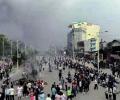
'They mean business, but business as usual is unacceptable to them'


With the support from eight political parties, 78-year-old Poudel's victory was certain. His rival Subas Chandra Nebmang had support of former prime minister KP Sharma-led CPN-UML.
Nepal political parties on Friday night agreed to extend the term of Constituent Assembly by one year as part of a crucial deal under which Prime Minister Madhav Kumar Nepal agreed to step down.
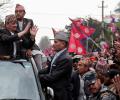
One fact is irrefutable: Nepal's recent political history tells us that the route to a return of monarchy cannot go through India despite friends in high places, asserts Aditi Phadnis.
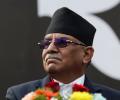
In a dramatic turn of events, Communist Party of Nepal-Maoist Centre chairman Pushpa Kamal Dahal 'Prachanda' was appointed as the new prime minister of Nepal by President Bidya Devi Bhandari on Sunday.

A day after premier K P Oli resigned, Nepal President called on all the political parties to elect a new prime minister within a week

Prachanda took the oath of office and secrecy from President Bhandari at an official ceremony at Shital Niwas.
"The Prime Minister's unilateral move to conduct fresh election by allowing to dissolve the most representative Constituent Assembly was aimed at capturing power and this has created frustration in the minds of the general public," said a joint statement issued by five parties.
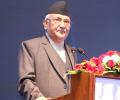
Nepal's political crisis deepened on Friday as both embattled Prime Minister K P Sharma Oli and the Opposition parties staked a claim for the formation of a new government by submitting letters comprising signatures of lawmakers to President Bidya Devi Bhandari.
Nepal's major parties on Wednesday failed to break an impasse over the formation of a new government as efforts to strike a deal on sharing of power proved futile. During crucial talks in Prime Minister Girija Prasad Koirala's residence here, the Maoists rejected a proposal from Nepali Congress and the CPN-UML to amend the interim constitution to remove a provision requiring two-thirds majority for forming or unseating the government.

'Gyanendra back on the throne would be bad news for the Nepali people. He may not have learnt from his experience, but we have.'
A day before the declaration of abolition of monarchy, the Maoists in Nepal agreed to the provision of a ceremonial president with executive powers to prime minister. Initially, the Maoists wanted a presidential system and a ceremonial prime minister. However, other major political parties--Nepali Congress and UML-- wanted the prime minister with executive powers and a ceremonial president.

The 75-year-old veteran politician and Nepali Congress President took the oath of office and secrecy from President Bidya Devi Bhandari during a swearing-in ceremony which was delayed by over two hours.

The pact was to run the government on a rotational basis until elections to the parliament are held.

Maoist leader Dr Baburam Bhattarai was on Sunday elected Nepal's new prime minister defeating his Nepali Congress rival R C Poudyal, with the Terai-based Madhesi alliance extending crucial support to the former rebel leader.
Bollywood actress Manisha Koirala's father Prakash Koirala, who was \nexpelled from the Nepali Congress party for openly supporting the royal takeover, has been made a minister after his induction into the cabinet by King Gyanendra.
The elections, which are set to usher in democracy ending the 40-year monarchy, saw the first seat going to Prime Minister Girija Prasad Koirala's Nepali Congress party, whose candidate Prkash Man Singh won one of the constituencies in Kathmandu. Maoist chairman Prachanda, Maoist war time strategist Ram Bahadur Thpa (Badal), its spokesman Krishna Bahadur Mahara and two female Maoist leaders Pampha Bhushal and Hisila Yami are leading in their respective constituencies.
Prime Minister Oli secured 93 votes in the lower house of parliament during a special session convened on the directives of President Bidya Devi Bhandari.

'If this is true, the Election Commission should come forward with data and officially confirm it.'

Nepal witnessed political turbulence in 2022 that dramatically turned rivals into allies and throned former guerrilla leader Pushpa Kamal Dahal 'Prachanda' as the prime minister for a third time, as Kathmandu made efforts to balance ties with immediate neighbours India and China with high-profile talks and visits.
