Facing difficulty in procuring large quantities of rice required to fulfil its poll guarantee, the state government on Wednesday decided to pay cash into the beneficiaries' accounts at the rate of Rs 34 per kilo, for the additional 5kg of rice under the free rice scheme.

Irrigation woes have contributed to the problem of stubble burning in the state, reports Sarthak Choudhury.

Union Agriculture Minister Narendra Singh Tomar has held a series of meetings with MPs and Union ministers from Punjab and Haryana and surrounding states, and virtual interactions with state agricultural ministers of all BJP-led National Democratic Alliance ruled states where he briefed them about the merits of the two bills, the sources said.
Though the Bills of Punjab and Rajasthan have a lot of similarities, the one approved by the Chhattisgarh Assembly is structurally different. None of the three has tried to address a key demand of the agitating farmers in full, which is to make all payments below the MSP, within and outside mandis, illegal.
Under Urjit Patel, the then RBI Governor, the central bank had a habit of making complete about-turns on various issues, including electoral bonds and digital payments, former finance secretary Subash Chandra Garg said in his book titled 'We Also Make Policy: An Insider's Account of How the Finance Ministry Functions.' Citing some instances of about-turns by the then RBI Governor Patel, Garg in his book said, RBI had done so on the electoral bond issue and it had so in case of setting up of Payments Regulatory Board (PRB). RBI also made unilateral decisions like ordering complete data localization for participation in the payment system, Garg wrote in the book which will hit the stands on October 1.

The announcement came after the protesting farmers received a letter from the central government, with promises of forming a committee on minimum support price (MSP) and withdrawing cases against them immediately.

He also said that train services will resume after the state government and protesting farmer unions assure the safety of the tracks. Tomar and Union Food, Commerce and Railways Minister Piyush Goyal held a day-long meeting with representatives of various farmer unions at Vigyan Bhawan in New Delhi.

Modi had clearly not come to terms with the limits to a prime minister's powers, any prime minister's powers however strong numbers he may have in Parliament, observes Virendra Kapoor.

Tikait says PM Modi was supporter of MSP law when he was CM

In a series of tweets, the Delhi Traffic Police said Tikri and Dhansa borders are closed for traffic movement, while Jhatikara border is open only for two-wheelers and pedestrians.

'The Modi government is not listening to us. So now we are coming to Delhi to talk with the central government.'
Opposition parties have alleged that the two agriculture Bills will undermine the safety net provided to the farmers by the MSP system and will lead to their exploitation by big companies.

This form of government, where secrets and major decisions are kept from the Cabinet itself, appears to be continuing, which is why the speculation around this special session, asserts Aakar Patel.
The MSP was introduced to the services recognising their unique service conditions and hardships.

"They did business of temple, religion and feelings. Now, they want to do the business on hunger," Tikait alleged.
Political parties, agriculture experts and progressive farmers demanded such agri reforms for long, he said and attacked the opposition for misleading cultivators on the issue of MSP (minimum support price) and APMCs.
"Our call of tractor march to Parliament still stands. A final decision on the future course of the agitation and MSP issues will be taken in a meeting of the SKM at Singhu Border on Sunday," farmer leader and SKM core committee member Darshan Pal told PTI on Saturday.

Bhartiya Kisan Union (BKU) leader Rakesh Tikait exhorted farmers to be ready for a massive nationwide agitation over their demands as a 75-hour sit-in by the Samyukta Kisan Morcha in Lakhimpur Kheri seeking the removal of Union minister Ajay Kumar Mishra and a law on minimum support price (MSP) entered the second day on Tuesday.
Modi also said that presently a 'new trend' is being seen in the country where protests are based on creating doubts through misinformation while union ministers urged farmers not to have any misconceptions about the three agriculture reform legislations.
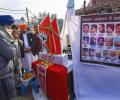
Prime Minister Narendra Modi should for once express grief in Parliament over the death of around 750 farmers during the months-long anti-farm law protests at Delhi's borders, Bharatiya Kisan Union (BKU) leader Rakesh Tikait said on Saturday.

Priyanka Gandhi urged people to stand with the farmers' struggle and to take the movement to the villages.
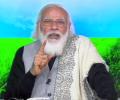
He said the parties rejected by the electorate are pushing their own political agenda by misleading farmers.

'If our demands aren't met, then, we will hold tractor march on January 6 and also on January 26'

Questioning the relevance of the minimum support price regime in the politically sensitive farm sector, the Economic Survey on Wednesday recommended a broad-based agricultural development programme.
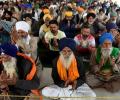
Eleven rounds of talks have been held over the contentious farm laws but the impasse continues as the farmer unions remain firm on their demands -- the repeal of the three laws and legal guarantee for Minimum Support Price.
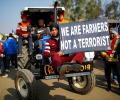
As far as possible, investment in the agriculture sector must be from the government, and not the private sector, states Santushti Raj Thapar.

Where do the four members of the Supreme Court appointed panel to interface with farmers stand on the Modi government's farm laws?
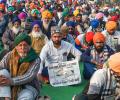
On the completion of two years of the Pradhan Mantri Kisan Samman Nidhi, Prime Minister Narendra Modi on Wednesday said his government ushered a historic increase in the minimum support price (MSP) for crops and was doing everything possible to double the income of farmers.

India's wheat exports could touch a new record of 10 million tonnes in 2022-23, up from a record seven million tonnes in the current financial year, if global market conditions remain choppy and no curbs are imposed on outbound shipments. That is the bullish estimate by officials from global trading firms and market watchers who say the Russia-Ukraine crisis has not only attracted global buyers to India but also pushed the price of Indian wheat from around $320 per tonne (FOB) to over $360 per tonne in less than 10 days. Food secretary Sudhanshu Pandey told reporters that wheat exports till February-end have already reached 6.6 million tonnes and by the end of March, outbound shipments will reach seven million tonnes.
Despite the prime minister's surprise announcement, farmer leaders have maintained the protesters won't budge until the three contentious laws are formally repealed in Parliament.
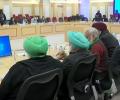
The sixth round of talks between the two sides are being held after a considerable gap. The fifth round of talks was held on December 5.

The Centre will promote Kisan Drones, chemical-free natural farming, public-private partnerships for the delivery of digital and high-tech services to farmers across the country during the financial year 2022-23, Finance Minister Nirmala Sitharaman said on Tuesday. Presenting the Budget 2022-23 in Parliament, Sitharaman said the inclusive development is one of the four priorities of the government moving forward. As part of the inclusive development, the government will promote the use of 'Kisan Drones' for crop assessment, digitisation of land records and spraying of insecticides. The government will also facilitate a fund with blended capital raised under the co-investment model through Nabard to finance agri start-ups and rural enterprises, she said.
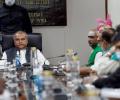
"While there is a protest against reforms, lakhs of farmers are also gathering to express support for bills. Today, thousands of farmers gathered in Gwalior for it," said Tomar while addressing an ASSOCHAM session via video conferencing on Wednesday.

Addressing a press conference at the Singhu border protest site, farmer leaders warned of multiple actions if their main demands are not met. They said that only five per cent of the issues raised by them have so far been discussed in meetings with the government.
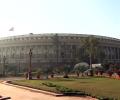
In the all-party meeting on Tuesday, Opposition parties demanded discussions on price rise, unemployment and Economically Weaker Section (EWS) quota among other issues, sources said.
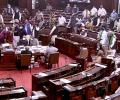
Leader of Opposition Mallikarjun Kharge sought to raise the issue of inflation and price rise and demanded a discussion on it. The deputy chairman said it cannot be entertained as the Question Hour was on.

The protesting farmers dubbed the three laws as "anti-farmer" and claimed they infringe upon their basic right to sell their produce at MSP.

Another farmer leader and SKM member said the agitation is likely to be called off on Wednesday as there have been some positive responses from the government side on the farmers' demands.

'The SJM has requested the government to bring a change in the law which will ensure MSP as the floor price for all farmers below which nobody should buy anything from them.'
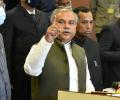
The government and farmer unions have held 11 rounds of talks so far, the last being on January 22, to break the deadlock and end the farmers' protest. Talks have not resumed following widespread violence during a tractor rally by protesting farmers on January 26.
