
Pakistan is determined to safeguard its nuclear assets which are a guarantee of national security, Lt Gen (retired) Khalid Kidwai, who heads the organisation that safeguards the country's nuclear arsenal, said on Monday.
The country's institutionalised command and control systems includes 10,000 soldiers who are guarding storage and production facilities for nuclear weapons, said Lt Gen (retired) Khalid Kidwai, the chief of the Strategic Plans Division that is responsible for the security and development of the arsenal.

'Fears in Washington began to intensify when it was realised that subsequent Pakistani and Indian attacks on major military facilities -- which were significant in terms of geographic scope and intensity -- could rapidly take both sides to where neither actually wanted to go.' 'The US objective was to stop the fighting as soon as possible. Everything else was secondary.'
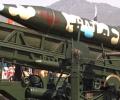
'The Indian gung-ho leadership may like to think about it, there should never ever be a doubt in anyone's mind, friend or foe, that Pakistan's operationally ready nuclear capability enables every Pakistani leader the liberty, the dignity and the courage to look straight into the Indian eye and never blink.'

'Pakistan's only concern has been while they were on the FATF watch list was to distance their State institutions and organs from any direct connection with the actual execution of militancy inside Kashmir.'

'Pakistan's security establishment, despite its appallingly immoral approach to conflict, has worked with limited resources to maximise its national defence resources to continue bleeding India,' says Ajai Shukla.
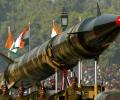
'We have worked to create road blocks in the path of those who thought that there was space for conventional war despite Pakistan's nuclear weapons.' 'Pakistan's nuclear weapons programme is not open-ended and aligned with India only.' 'In this unstable regional environment, one nuclear power is trying to teach lessons to another nuclear power through the medium of small arms and mortar shells on the Line of Control, and bluster.' 'A historic opportunity of a lifetime beckons the leaderships of India and Pakistan to grasp, sit together and explore the possibilities of conflict resolution.'
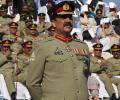
The recent postings and promotions of three-star generals in the Pakistan Army have propelled some of former chief Ashfaq Parvez Kayani's favourites to traditionally important positions

DRDO's latest test towards developing an anti-ballistic missile shield, to protect Indian targets against nuclear-tipped ballistic missiles fired from Pakistan or China will provide a technology that is akin to striking a bullet with a bullet, say Ajai Shukla

Indian policymakers must incorporate in their nuclear doctrine a realistic response to tactical nuclear warheads, says Ajai Shukla.
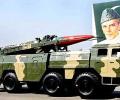
Pakistan military has appointed Lt Gen Zubair Mahmood Hayat as the new chief of the Strategic Plans Division, which manages and secures the country's nuclear arsenal.
'After General Raheel Sharif took on the Tehrik-e-Taliban Pakistan, some sections of the military establishment may have felt unease as to whether the crackdown could be extended against friendlier 'non-State' actors like the Lashkar-e-Tayiba.'

For the world and India, one of the most enduring challenges of the times is for Pakistan's nukes to be neutralised, before they are ever used by the State, their sponsored non-State actors or any rogue elements from the many terror tanzeems dotting Pakistan's unstable landscape, says Lieutenant General Kamal Davar (retd).
Rasheed Kidwai unearths little-known stories from the Dadasaheb Phalke awardee's past as Amitabh Bachchan celebrates 50 years in the movies this month.

'Diplomatic engagement will continue even as India keeps all its options open with respect to discretely targeting the Pakistani military and its terrorist proxies.'
