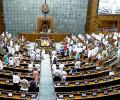
The dramatic postponement came while members were voting on the committee's five principal recommendations, making it an unprecedented moment in the functioning of a parliamentary committee.

A Joint Committee of Parliament has deferred the adoption of a draft report on a bill proposing the suspension, not permanent removal, of the prime minister, Union ministers, and chief ministers if detained for 30 days on serious criminal charges, opting for more consultations.

The government plans to introduce three bills in Parliament to address the removal of a prime minister, Union minister, chief minister, or minister of a Union Territory when arrested or detained on serious criminal charges.

The Centre has notified the implementation of the Women's Reservation Act 2023, providing a 33 per cent quota for women in legislatures, Jammu and Kashmir, and Union Territories, with the provisions set to come into force on April 17, 2026.

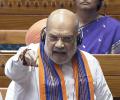
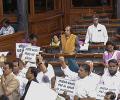
Union Minister Amit Shah on Wednesday introduced three Bills in Lok Sabha for the removal of prime minister, chief ministers and ministers arrested on serious criminal charges for 30 days, drawing fierce protests from the Opposition as the draft laws were referred to a Joint Committee of Parliament. Three House marshals formed a protective ring around Shah. Even after the House was adjourned, the Opposition members continued with the sloganeering.

Watch all the debates and discussions in Parliament.

He has contended that the Presidential order which had amended Article 367 is unconstitutional and void as it resulted in the scrapping of Article 370 that could not have been done in the manner in which it was done.

Six bills, including the one to amend the Jammu and Kashmir Reorganisation Act, were introduced in the Lok Sabha on Wednesday amid protests by opposition members over the violence in Manipur.

Rijiju also hit out at Congress leader Rahul Gandhi, saying that his own party MPs "get uncomfortable" when he speaks in Parliament and are apprehensive that he will do "anap-shanap baatein" and the party will have to bear the consequences.

Union home minister Amit Shah said the UT in Ladakh will have no legislature like Chandigarh while the other UT of Jammu and Kashmir will have a legislature like Delhi and Puducherry.

The Lok Sabha witnessed chaotic scenes as opposition members protested the introduction of three draft laws, leading to torn bills, sloganeering, and adjournments.

The Supreme Court on Wednesday asked whether Parliament could have enacted the Jammu and Kashmir Reorganisation Act, which divided the erstwhile state into two Union territories, during the subsistence of President's rule in 2018-2019.
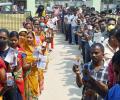
The proposed first constitutional amendment bill would deal with making provisions for holding Lok Sabha and state legislative assembly elections together.

Besides the bills, the government has listed the first batch of supplementary demands for grants for 2023-24 for presentation, discussion and voting during the session.

The reorganisation bill provides for formation of Union territory of Ladakh without legislature and a separate one for Jammu and Kashmir with legislature.

From issuing whips to arranging ambulances for their ailing leaders, opposition parties from the newly-formed Indian National Developmental Inclusive Alliance (INDIA) bloc are making all-out efforts to ensure that they get 100 per cent attendance of their MPs in the Rajya Sabha to give the Bharatiya Janata Party a tough fight on the Delhi services bill next week.
'Anyone they don't like can be potentially arrested and thrown in jail for 30 days to induce regime change.'

Union Home Minister Amit Shah introduced bills in Lok Sabha addressing the removal of arrested PMs, CMs, and ministers, sparking opposition protests. Shah emphasized the need for public decision on whether leaders should govern from jail, criticizing the Congress party's stance on the matter.
The monsoon session of Parliament which saw many disruptions since it began on July 20 over the Manipur violence issue, is set to become more turbulent with the government likely to introduce a bill in the Lok Sabha to replace the Delhi services ordinance.

Shah said nobody can stop him from introducing a resolution on Kashmir in Parliament.
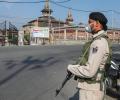
The return of around 6,000 paramilitary personnel to Jammu and Kashmir after election duty elsewhere has triggered large scale rumours, ranging from further bifurcation of the union territory to announcement of elections after realigning districts, for the last three days.

The legislation was passed by 125 votes in favour and 61 against.
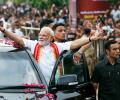
'Non-BJP state governments and their leaders, navigating today's political landscape, know well they have no clue what awaits around the corner.' 'The chances of charges pressed and oneself getting parked in custody play out on an uneven playing field,' points out Shyam G Menon.
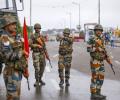
India and Pakistan should resolve their differences over the Kashmir issue peacefully through dialogue and consultation, China said on Friday on the third anniversary of the revocation of the special status of Jammu and Kashmir.
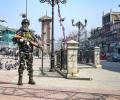
The Centre is planning a series of political initiatives in Jammu and Kashmir which may include discussion with mainstream parties of the Union Territory and elections to the assembly in the early part of next year, officials said in New Delhi.
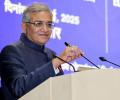
As an IAS officer in Kerala, Gyanesh Kumar -- who the Congress described as Amit Shah's 'right hand man' -- had a good working equation with the state's Congress and Left leaders.

He asserted that the concept of 'one flag, one prime minister, one Constitution' was not a political slogan and the Bharatiya Janata Party firmly believes in the principle and finally implemented it with regard to Jammu and Kashmir.

Tharoor said: "You have taken people who know no other home but India, who have lived here, in many cases since 1971. Many people have lives, families, career, property, and everything in our country and now they are suddenly told they are foreigners and must be shunted to concentration camps."

According to the orders of the commission, set up under the Jammu and Kashmir Reorganisation Act of 2019, the Union territory will have 90 assembly constituencies -- 43 in Jammu Division and 47 in Kashmir -- with nine of them being reserved for the Scheduled Tribes.
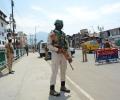
The central government's response was conveyed to the court by Solicitor General Tushar Mehta, after a five-judge constitution bench headed by Chief Justice DY Chandrachud, hearing the pleas challenging the abrogation of Article 370, asked it to set a specific time frame for restoration of electoral democracy in the erstwhile state.

Union Home Minister Amit Shah on Wednesday blamed India's first Prime Minister Jawaharlal Nehru's "two major blunders" -- declaring a ceasefire without winning the entire Kashmir and taking the issue to the United Nations -- for the sufferings of the people of Jammu and Kashmir.
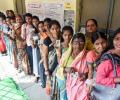
The ruling Bharatiya Janata Party on Thursday took a major step to implement its key plank of "one nation, one election" as the Union Cabinet headed by Prime Minister Narendra Modi approved the constitutional amendment bill to roll out the concept of simultaneous Lok Sabha and state assembly polls, sources said.
Sources in the Fifteenth Finance Commission said that they will implement the provisions after the bill is enacted and the President makes a reference to it.

Union Home Minister Amit Shah on Monday assured the country that the beginning of building a "new and developed Kashmir" that will be free from terrorism has been made under Prime Minister Narendra Modi and said that full statehood would be restored to Jammu and Kashmir at an appropriate time.

However, it is immediately not clear whether the relaxation will be given fully or partially.

The Triple Talaq and RTI bills were passed by Rajya Sabha in the last 10 days after the National Democratic Alliance government got support of a few parties, including the Biju Janata Dal, All India Anna Dravida Munnetra Kazhagam and the YSR Congress, in Rajya Sabha where the BJP lacked majority.

The Union home minister said he firmly believed that Article 370 that gave the special status to Jammu and Kashmir should be removed as it was not beneficial to the country.

The deputy commissioner said that the administration has made preparation for people on the occasion of Bakrid.

Prime Minister Narendra Modi is likely to chair a meeting with all political parties from Jammu and Kashmir on June 24 as part of the Centre's initiatives to bolster political processes, including holding assembly elections, in the union territory, officials said in New Delhi.

Practising journalism has never been easy in the volatile Kashmir Valley. But since the state's special status was revoked, it's become almost impossible for the media to go about their job, reports Umar Ganie/Rediff.com.
