The ITBP guards the 3,488 km long Line of Actual Control between India and China, along with the Indian Army.

Twenty Indian Army personnel including a colonel were killed in a clash with Chinese troops in the Galwan Valley in eastern Ladakh on the night of June 15 in the biggest military confrontation between the two countries in over five decades.
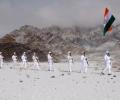
Video footage showed 'Himveers' dressed in white uniforms and chanting slogans of -- Bharat Mata ki Jai and Vande Mataram as the tricolour flies high. Two of the soldiers were seen holding the tricolour as they marched in the snow.

Satellite images dated August 17, 2021, have revealed upgraded infrastructure near the Depsang plains along with the Western sector of the LAC between India and China.

'The numbers of troops on both sides are enormous.' 'They are about 50,000-60,000 soldiers facing each other in that sector -- that's about the total number of troops that both sides had in the 1962 War in all sectors.'

16 Indian Army divisions face China, 20 face Pakistan and two divisions are reserves. This powerful signal can hardly be missed in China or Pakistan, notes Ajai Shukla.
'The Indian Army's surveillance had noticed the Chinese movements.' 'There was no intelligence failure.'

Deployed at 15,632 feet, Captain Shiva Chauhan, 25, highlights the calibre of the Indian Army's women officers.
'The Chinese -- up to the highest leadership -- will avoid a conflict because they know they will be badly licked.' 'The reputation they have painstakingly built over the last two-three decades of being a global power will be destroyed.'

With the two armies again in a face-off at multiple points, there is apprehension of renewed clashes.

Every week, we bring you fascinating videos, chosen by you, through your likes.

An army patrol operating at an altitude of approximately 18,000 feet in Southern Siachen Glacier was hit by an avalanche during the early hours of Saturday, Srinagar-based defence spokesperson Col Rajesh Kalia said in a statement.

In New Delhi, there are multiple views about China's not just strident but serious diplomatic attacks against India and also about Indian media's hype over the issues but still, nobody doubts that the rhetoric between two countries is different than normal times.

Through the past 18-month period, peace has prevailed in the disputed border regions, which was immensely helpful in the difficult situation that the country was passing through, observes Ambassador M K Bhadrakumar.

'This was Indian land the PLA advanced on and occupied.' 'The Chinese then 'negotiated' a pullback of their troops a small distance on Indian territory even as Indian jawans draw back further into India from the forward position.' 'An apparently satisfied Indian government says this is a great move for peace! How great is that for China!'

He also said if the prime minister likes abusing the Congress and his great-grandfather Jawaharlal Nehru, 'be my guest, but do your job'.
On April 13, 1984 the Indian Army launched a daring operation at Siachen, the world's highest battlefield, to gain control over the glacier in the eastern Karakoram range in the Himalayas. In the days to follow, Operation Meghdoot -- named after Kalidas's Sanskrit masterpiece -- secured the glacier and adjoining heights from Pakistani aggression. This operation has continued over the last 30 years with Pakistan making numerous failed attempts to dislodge the Indians from the Saltoro ridge along the western periphery of the glacier. Nitin Gokhale's book, Beyond NJ 9842: The Siachen Saga is the first of its kind, narrating the history of Operation Meghdoot. Rediff.com presents exclusive excerpts from the book.

'The MEA, hopefully, made it clear that the Indian PM can't be seen in Xi Jinping's company when China has, for all intents and purposes, annexed over 1,000 sq kms of Indian territory in eastern Ladakh, and essentially that the Wuhan spirit and the Mamallapuram spirit have turned into vinegar.'
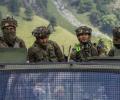
Today, the Ladakhis and Tibetans have been joined by the Sikhs, the Madrassis, the Garhwalis, the Rajputs, who are well trained psychologically and otherwise, to defend the nation, observes Claude Arpi.

Until last month more than two-thirds of the Indian Army was deployed against Pakistan. Of 14 army corps, just four-and-a-half faced China, while more than twice that number was ranged against Pakistan.

'Either China is building regional transport infrastructure long before it needs it, or this is in a chain of Chinese investments with more strategic than economic intent,' says T N Ninan.
If China's White Paper figures are authentic, the Indian Army, with 1.2 million soldiers, is 50 per cent larger than the PLAA.Ajai Shukla reports
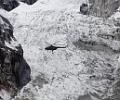
The Siachen Glacier has reduced by 5.9 km in longitudinal extent between 1989 and 2009 because of rising temperatures, researchers say.
Twenty-four army personnel were killed and five others were injured today when a bus plunged into a ravine in northern Pakistan, officials said.

'China's deep involvement in the stability and economic and political success of Pakistan actually produces some elements of congruence with India's core interest in a stable and productive relationship with Pakistan.' 'It is not far-fetched for us to pursue that congruence and with ingenuity work out with China a formula that also satisfies our formal position on PoK,' argues Ambassador Kishan S Rana.
People's Democratic Party chief Mehbooba Mufti on Monday hit back at Home Minister P Chidambaram, who had warned the party of stern action over its controversial propaganda map.

China has chosen to keep New Delhi guessing, while retaining for itself the option of constantly changing facts on the ground and shifting the LAC westwards -- the strategy called 'salami slicing', notes Ajai Shukla.
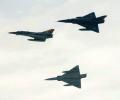
The report came a day after the Indian Army announced that it launched "punitive fire assaults" on Pak posts.
Five days after a huge avalanche buried their camp in high mountains of the Karakoram range, army rescuers are yet to find any trace or bodies of 138 people missing in the calamity, mostly soldiers.
Hopes were fading fast for finding any surviors buried under tonnes of ice as Pakistani military rescuers were hampered by fresh heavy snowfall and bad weather in an increasingly desperate search for 139 people, mostly soldiers, buried in an avalanche in Siachen sector, close to Indian border.

In its first official account of the standoff between the two militaries, the ITBP revealed how its troops "not only effectively used shield to protect themselves but also responded fiercely to advancing PLA (Chinese People's Liberation Army) troops and brought the situation under control". "The ITBP has recommended the names of 21 men who faced the Chinese during the face-offs and skirmishes in May-June this year for gallantry," it said.
Amid concerns voiced by India over China's plans to have a rail link with Pakistan through the Karakoram ranges, Beijing on Thursday said the Sino-Pak 'strategic' partnership was not aimed at targeting any third country.

The map displayed by PDP during a power point presentation yesterday showed Aksai Chin and Karakoram region painted in red and part of China and Pakistan-occupied Kashmir (PoK) in green.

Indian Army officers, serving and retired, will tell you that the one thing that makes the Indian soldier singularly unique is his josh and jazba.
'The Chinese have been moving in step by step; inch by inch for the last 40 years.'
China, which plans to have a rail link with Pakistan through the strategic Karakoram ranges, has signed another agreement with the country for building two highways in the disputed Gilgit-Baltistan region in Pakistan-occupied Kashmir close to the Chinese border.
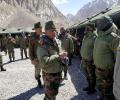
The military preparations underway show that the PLA may undertake operations this summer to achieve whatever objectives they could not achieve last May, asserts Jayadeva Ranade, the distinguished China expert and retired RA&W officer.
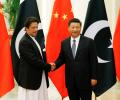
Gilgit Baltistan's large frontage with Kashmir and Ladakh across Kargil and the Siachen Glacier gives Pakistan and China the perceived scope for conduct of collusive operations against India and wrest control of the major course of the Indus and Shyok, observes Lieutenant General Syed Ata Hasnain (retd).
The Pakistanis, since the days of General Pervez Musharraf, have repeatedly sought Chinese assistance for the construction of a petrochemical complex at Gwadar and oil and gas pipelines and a railway line connecting Gwadar with the Xinjiang province.
