
Trump's comment marks a shift in his repeated statements that Iran hand over its enriched uranium to the US as a sticking point of any potential deal.
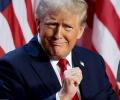
US President Donald Trump announced that a deal to end the war with Iran would be signed on Sunday, with the strategic Strait of Hormuz immediately becoming 'open to all'. This follows indications from Pakistan that negotiations were in their final stages, though Iran has yet to comment on the timeline.

'Actual implementation of the 14-point agreement is proving hard to achieve let alone striking and sustaining a long-term treaty or deal.'

Much will depend on how the protagonists use the current interlude to work proactively for the beginning of a durable settlement or, on the contrary, prepare for a new round of escalation, points out Ambassador M K Bhadrakumar.

Trump seems to have estimated that Ghalibaf is a pragmatic politician who is receptive to close relations with the US and is enthusiastic about fostering business and economic ties in particular, points out Ambassador M K Bhadrakumar.

US President Donald Trump on Monday confirmed that his administration has received a proposal from Iran aimed at ending the ongoing conflict in West Asia, but described the offer as insufficient.

...is a way out, notes Prem Panicker in his must read blog on the Iran War. What the indefinite extension produces is a prolonged condition of not-war-not-peace, in which oil markets cannot stabilise, Asian refineries cannot plan, European governments cannot stop subsidising consumption they cannot afford, and the next flashpoint -- a seized tanker, a miscalculated drone strike, a Truth Social post that claims too much -- is one news cycle away.

Trump has made it clear: the US will not lift its blockade of Iranian ports until a deal is signed.

Both sides have now revealed a preference for escalation over strategic defeat, and each new provocation narrows the space for the next pause. The Touska seizure, Iran's refusal to negotiate under blockade, Israel's strikes on Iranian oil infrastructure -- all of these add up to an increasingly untenable situation. This makes the wild card -- Trump and his motormouth -- more consequential than ever, notes Prem Panicker in his must read blog on the Iran War.

The ceasefire is still technically holding, to the extent that no overt hostilities have been reported yet, but the rhetoric has hardened dangerously. The week ahead will also clarify whether the Islamabad failure was a negotiating tactic or whether Washington has genuinely locked itself into a position from which the only exits are climb-down, escalation, or the slow bleed of a new status quo that nobody chose and nobody controls. Prem Panicker continues his must read blog on the Iran War.

The question is no longer whether the war will expand. It has. The next few days will tell us whether the war stabilises around Hormuz or whether the Strait itself becomes the trigger for a far larger rupture. What to watch for over the next 48 hours is simple: Any move by the US toward direct naval control of the Strait; any credible Iranian attempt to disrupt or mine shipping lanes and, critically, whether energy infrastructure in the Gulf continues to be targeted.If those lines are crossed in tandem, the war will no longer be containable within the region.

When missiles fly in this region, they are never just aimed at military targets.
India and the US have collaborated through the past one month on launching a powerful satellite; are commencing joint production of GE Aerospace's F414 jet engines in India; India is participating in a massive three week-long military exercise in the Western Pacific, observes Ambassador M K Bhadrakumar.

The embassy of Iran in India on Wednesday shared a statement made by the director general of the International Atomic Energy Agency, where he said that they (IAEA) did not have any proof that Iran is going to make nuclear weapons.

The reversal of Trump's policy with regard to Iran, like the withdrawal from the Paris Agreement, may not be a matter of just turning the clock back, but one of patient negotiations, with uncertain consequences in the post-COVID-19 world, observes Ambassador T P Sreenivasan.

The US is alarmed and appalled by reports of security authorities responding to university students' peaceful protests with violence and mass arrests.

Jaishankar also met his Iranian counterpart H Amirabdollahian and held productive discussions on bilateral economic cooperation, Afghanistan and the joint comprehensive plan of action, also known as the Iran nuclear deal.

The US president said new sanctions would be imposed, adding 'America will not be held hostage to nuclear blackmail'.

The reimposition of sanctions on Iran will have major impact on countries like India, with which it has traditional and historic trade relationship.

Abdollahian, who is on his first visit to India since he assumed office last year, raised the issue of the controversial remarks, made by two former Bharatiya Janata Party spokespersons, in his meeting with National Security Advisor Ajit Doval in the national capital on Wednesday.

Backing New Delhi's quest for a permanent seat in the UNSC, Rouhani asked why India, a nation with population of 1.3 billion, was not a member of the powerful club.

At a joint media briefing with Lavrov, Jaishankar listed issues such as "factors of instability" such as terrorism and its cross-border manifestation and said it remains a "major concern".

External Affairs Minister S Jaishankar held wide-ranging talks with his visiting Iranian counterpart Hossein Amir-Abdollahian on Wednesday against the backdrop of widespread anger in West Asia over controversial remarks on Prophet Mohammed made by two former Bharatiya Janata Party spokespersons.

The partial withdrawal would mean that Iran would stop exporting enriched uranium stocks as stipulated by the 2015 agreement.

BWith a distracted president brooding in the White House, Pompeo seems to think his day has come. He seems to be pushing a personal agenda before a target audience in America, observes Ambassador M K Bhadrakumar.

The ballistic missile launch was the first by Iran since Trump became President.

Italy, Greece, South Korea, Taiwan and Turkey also figure in the list released by Pompeo, who said over 20 countries have cut their oil imports from Iran, reducing purchases by more than one million barrels per day.
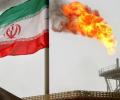
'Indian and Iranian sources both confirmed to me that India and Iran are moving ahead to implement a payment system on buying oil from Iran and hope to finalise it very soon,' says Aveek Sen.
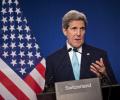
At scaling back Tehran's nuclear programme and relieving the Islamic Republic from the sanctions

The powerful United Nations Security Council on Monday unanimously adopted a resolution that endorses the landmark nuclear deal between Iran and six world powers.

The Biden administration should expect continuity in Iran's policies under Raisi. This may not necessarily mean that strengthening of ties with the West will be Raisi's top priority, observes Ambassador M K Bhadrakumar.

Trump called on Iran to "work together" to eliminate the Islamic State, saying the killing of ISIS chief Abu Bakr al-Baghdadi was "good" for Iran.

"We have the toughest sanctions ever imposed. But on oil, we want to go a little bit slow because I don't want to drive the oil prices in the world up," Trump told reporters.

Both statesmen possess a cultivated pugnacious style which they keep in reserve and can at will bring into play, and despite the mutual distrust in Russian-American relations, they are proponents of detente, quintessentially, who take their mission deadly seriously, points out Ambassador M K Bhadrakumar.
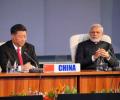
'Modi's finest political legacy ought to be a border settlement with Beijing,' asserts Ambassador M K Bhadrakumar.
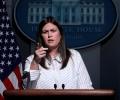
Information released by Israel provided new and compelling details about Iran's efforts to develop missile-deliverable nuclear weapons, says WH.

Secretary of State Mike Pompeo said that countries like India, if it gets the exemption, would be asked to bring down their oil imports from Iran to zero in six months' time.

"We are committed to building a new India. We have to do this as early as possible," he said.
