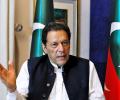
The judges reserved the verdict on Monday after the rival lawyers concluded their arguments on the suspension of the three-year sentence handed down to the 70-year-old PTI chairman by Additional District and Session Judge, Islamabad, Humayun Dilawar on August 5.
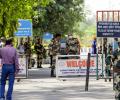
Abdul Waheed was brought from Srinagar by the Jammu and Kashmir police for his repatriation to Pakistan.
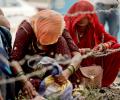
The Attari-Wagah border crossing point between India and Pakistan was shut completely on Thursday following a week-long heavy rush of people from either side to cross over after the Union government ordered all Pakistani citizens with short-term visa to leave India in the wake of the Pahalgam terror attack, sources said.

Members of Imran Khan's party, the Pakistan Tehreek-e-Insaf, plan to mount a huge anti-government protest in Islamabad, demanding that Khan be released from prison.
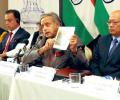
Tharoor, who is leading the all-party delegation to the Americas during his Bogota visit, had expressed dismay over the South American country's stance during a press conference on Thursday.
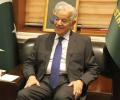
Last week, Information Minister Atta Tarar had said that 24-36 hours were important, fearing a possible strike by India. However, the time passed and there was no action by India.

The statement came hours after Prime Minister Narendra Modi on Tuesday told the top defence brass that the armed forces have "complete operational freedom" to decide on the mode, targets and timing of India's response to the Pahalgam terror attack, government sources said.
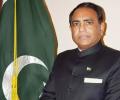
Pakistan's ambassador to Turkmenistan, K K Wagan, was deported from the United States after being denied entry at Los Angeles airport. The incident has sparked concerns about diplomatic protocol and the nature of the US authorities' decision. Wagan, who holds a valid US visa, was forced to return to his last port of departure. The Foreign Office confirmed the envoy had gone to the US on a private visit and is investigating the matter. It remains unclear what specific concerns triggered the deportation, but sources suggest the US immigration system flagged Wagan over controversial visa references. The incident has been communicated to Pakistan's Foreign Minister Ishaq Dar and Foreign Secretary Aamna Baloch, and the Foreign Ministry has directed its Consulate in Los Angeles to investigate.
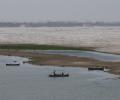
Weeks after India placed the 1960 Indus Waters Treaty (IWT) in abeyance following the April 22 Pahalgam terror attack, Pakistan has signalled its willingness to discuss New Delhi's long-standing concerns about the treaty, sources said.
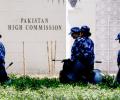
Pakistan has expressed condolences over the deaths of tourists in a terror attack in Pahalgam, Jammu and Kashmir, that killed 26 people. The Foreign Office spokesperson said Pakistan is concerned at the loss of tourists' lives and wished the injured a speedy recovery. The attack, claimed by The Resistance Front (TRF), a proxy of the banned Pakistan-based Lashkar-e-Taiba (LeT), is the deadliest in the Valley since the Pulwama strike in 2019.
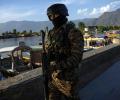
The 'mediation' by the United States from behind the scene on the diplomatic track appears to be once again working, which calls on both Delhi and Islamabad to show restraint and pull back from a military confrontation, notes Ambassador M K Bhadrakumar.

While the Prime Minister did not spell out the details of the three instances, his remarks are being widely interpreted as a reference to the 2016 surgical strikes following the Uri terror attack, the 2019 Balakot air strikes after the Pulwama bombing, and the recent cross-border strikes as part of 'Operation Sindoor'.
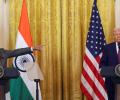
Prime Minister Narendra Modi spoke with President Donald Trump and set the record straight that India had paused strikes on Pakistan during Operation Sindoor following a request from Islamabad and not due to mediation or offer of a trade deal by the United States.
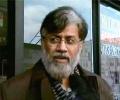
Pakistan has denied any connection to Tahawwur Rana, a key accused in the 2008 Mumbai terror attacks. Rana, a Canadian national, has not renewed his Pakistani documents for over two decades, according to the Foreign Office spokesperson.
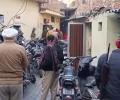
A blast was reported outside the Bakshiwal police chowki in Gurdaspur district, Punjab on Wednesday night. The police launched an investigation, and a forensic team has been deployed to the scene. While no one has reported hearing the sound of a blast, a burnt patch was found outside the chowki. This incident follows a series of other blasts in Punjab this month, including one at the Islamabad police station in Amritsar on Tuesday. In the Islamabad incident, a hand grenade was thrown at a police post in Nawanshahr on December 2nd. The Khalistan Zindabad Force has claimed responsibility for the alleged attack on the Bakshiwal police chowki.
'India has been preparing for the last 15 days... it won't be easy for Pakistan if it tries to dominate escalation.'
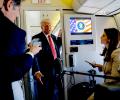
Two 'very smart' leaders of India and Pakistan decided to end last month's conflict that could have turned into a nuclear war, United States President Donald Trump said after holding a rare luncheon meeting with Pakistan army chief Field Marshal Asim Munir at the White House.
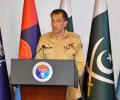
Lt Gen Ahmed Sharif Chaudhry, the spokesperson for the Pakistan Army, is the son of a nuclear scientist who was sanctioned by the United Nations and the US for providing information and expertise to al-Qaeda, according to Indian officials. Chaudhry's father, Sultan Bashiruddin Mahmood, allegedly provided insights into nuclear weapons infrastructure and raised funds for a fundamentalist organization linked to the Taliban. Mahmood was arrested in 2001 after admitting to meeting Osama bin Laden but was later released.
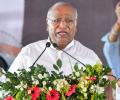
Congress president Mallikarjun Kharge on Saturday accused the government of misleading the nation on the India-Pakistan conflict and demanded holding a special session of Parliament immediately, following Chief of Defence Staff General Anil Chauhan's acknowledgement of aircraft loss in the hostilities.
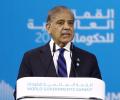
Sharif said that the US president had shown beyond any doubt that "he is a man for peace... and beneficial business deals".
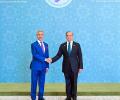
It was said that Sharif wanted the PML-N-led coalition government to utilise all available diplomatic resources to restore peace between the two nuclear-armed states, saying he was not keen on taking an aggressive position, The Express Tribune reported.

The PCB on Tuesday confirmed the resumption of the Pakistan Super League on May 17, following a ceasefire between India and Pakistan.
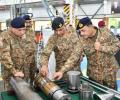
'Pakistan's army has got a streak of democracy. It is more democratic than the country.'

There was no reference to trade in talks between top leaders of India and the United States during the India-Pakistan military conflict, government sources said on Monday after American President Donald Trump claimed that he pressured New Delhi and Islamabad to stop hostilities by threatening to cut trade with both countries.
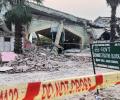
India dismissed claims on Pakistan social media about 'Operation Sindoor', saying the neighbouring country has unleashed a 'full-blown disinformation offensive' with 'lies' and digital theatrics to control the narrative.
A top American military commander has said that the US is watching the situation very closely after Indian military strikes on terror targets in PoK and Pakistan's Punjab province. The United States Indo-Pacific Command (USINDOPACOM) is one of six geographic Unified Combatant Commands of the United States Armed Forces, headquartered in Hawaii. Earlier on Wednesday, US President Donald Trump said he wants India and Pakistan to stop the conflict, saying if he can do anything to help, he will be there. Foreign Secretary Vikram Misri told reporters in New Delhi on Wednesday that the Indian military carried out a measured, non-escalatory, proportionate, and responsible strike to dismantle terrorist infrastructure in Pakistan to deter and to pre-empt any further terrorist strikes.
Pakistani troops continued to violate the ceasefire along the Line of Control (LoC) by resorting to unprovoked firing in Jammu and Kashmir's Poonch and Kupwara districts, army officials said. This was the fourth consecutive night that Pakistan resorted to unprovoked firing along the LoC and came amid heightened tension between New Delhi and Islamabad following last week's terror attack in Pahalgam. Indian troops responded swiftly and effectively.
'Trump's sons, and the son of Trump's Mideast envoy Steven Witkoff, are in the crypto business and recently signed deals with Pakistan's crypto council.' 'It may not be coincidental that not long before the Trump-Munir meeting, the head of Pakistan's crypto council met with Trump's White House crypto policy czar.'

Jailed former Pakistani Prime Minister Imran Khan has called for a dialogue with the military establishment, saying the country is currently governed by "jungle law." Khan, who has been in jail since August 2023, also said that rumors of a deal being made with him are entirely false. He criticized the government's handling of the economy, terrorism, and India's alleged attacks, and warned that Pakistan's moral and constitutional framework has been destroyed.
The United States stands strong with India against terrorism and Prime Minister Narendra Modi 'has our full support', the State Department said underlining that Secretary of State Marco Rubio urges India and Pakistan to work towards a responsible resolution that maintains long-term peace and regional stability in South Asia.
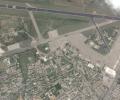
India's strikes on Pakistan damaged runways and structures across at least six airfields, according to a visual analysis by The Washington Post, which experts said were the most significant attacks of their kind in decades of simmering conflict between the two nations.
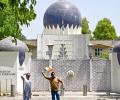
The ministry of external affairs said the official has been given 24 hours to leave the country.
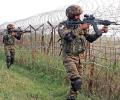
This marked the sixth consecutive night of ceasefire violations by Pakistan along the LoC, amidst heightened tensions between New Delhi and Islamabad following a recent terror attack in Pahalgam on April 22.
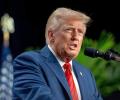
Trump said that leaders in India and Pakistan are "great leaders" and "they understood, and they agreed, and that all stopped".

This came after Pakistan People's Party chairman Bilawal Bhutto Zardari on Saturday stated that Pakistan's Prime Minister Shehbaz Sharif had tasked him to lead a delegation to present Pakistan's case on the recent escalations of tensions between the two nations.

India and Pakistan exchanged lists of their nuclear installations on Wednesday, fulfilling a decades-old agreement that prohibits attacks on each other's atomic facilities. The exchange took place amid strained relations between the two countries over the Kashmir issue and cross-border terrorism. The agreement, signed in 1988, mandates the annual exchange of such lists, which has occurred for the 34th consecutive year.

The final NRC, a list of Indian citizens residing in Assam, was released in 2019 by excluding 19,06,657 people. However, it has not been notified by the Registrar General of India, leaving the controversial document without any official validity.

India expects partners to understand its policy of 'zero tolerance' against terrorism, and it will never countenance 'perpetrators of evil' being put on par with its victims, External Affairs Minister S Jaishankar said on Saturday during extensive talks with his British counterpart David Lammy.
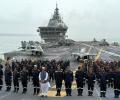
In an interaction with naval warriors on board aircraft carrier INS Vikrant off Goa, Singh sent a stern warning to Islamabad saying India will not hesitate to use the methods to deal with terrorism that Pakistan cannot even think of.

The Indian and Pakistani militaries targeted each other's installations using missiles in the last over 12 hours, further escalating the already tense conflict situation.
