
The Indian space agency has already begun work on the third generation of the earth observation satellite -- the first of which will be ready by 2018 and boost the capability to generate digital maps.
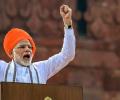
Prime Minister Narendra Modi is addressing the nation for the seventh time from the ramparts of the Red Fort on Independence Day on Saturday and it will be his second speech of the second term in office.
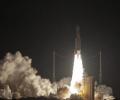
Boosting India's communication services, its latest satellite GSAT-16 was successfully launched on board Arianespace rocket from the spaceport of Kourou in French Guiana in the early hours of Sunday, after a delay of two days due to bad weather.

India's premier Space Research Organisation is targetting up to 10 launches a year by 2016 , a top ISRO official said on Monday.

One spacecraft will be Indian Space Research Organisation's own Chandrayaan-2, while the other will be from India's first private moonshot Team Indus which is competing in the Google LunarXPrize challenge.

Chandrayaan-3's success is a must for India's space ambitions; we can't afford to lose out. And for realising our space dreams, the Indian private sector must be encouraged because if we lose this race, the moon, Mars, and mineral-rich asteroids will already be crowded before we reach there.

The new ISRO chief talks bout the road ahead in his first interview after taking charge.

The Chandrayaan-2 will conduct the next level of scientific studies on the Moon, writes T E Narasimhan.

Aeron Systems, founded in 2008 by Ashvani Shukla and Abhijit Bokil, is looking to contribute to programmes such as the Tejas light combat aircraft

The successful orbiting of the satellites by the Polar Satellite Launch Vehicle PSLV C-40 comes four months after the Indian space Research Organisation's mission to launch backup navigation spacecraft IRNSS-1H onboard PSLV-39 ended in a rare failure.

The satellite would provide a thrust to mobile communication through multi-beam coverage facility, the ISRO said.

The rocket is almost 49 meters high -- as much as a 17-floor building. It weighs 415 tons -- as much as the combined weight of 80 full grown elephants.

Other than the Cartosat-2 series satellite, the PSLV is carrying 29 nano satellites from 14 countries - Austria, Belgium, Chile, Czech Republic, Finland, France, Germany, Italy, Japan, Latvia, Lithuania, Slovakia, the United Kingdom and the United States of America besides a nano satellite from India.

PSLV C-29 blasted off from the Satish Dhawan Space Centre, about 110 km from Chennai, at 6 pm and released the six satellites one by one into a 550 km circular orbit.
 © 2026 Rediff.com - Advertise with us - Disclaimer - Privacy Policy - Sitemap - Feedback - About us - Terms of use - Grievances