
'When sensitive territory goes into the hands of your enemy. he becomes more powerful in military terms.' 'Assuming the Chinese take over the Doklam Plateau they will not stop at that.' 'They will keep ingressing, and it will be easier for them to further expand their territory.' 'I feel the Chinese will vacate that area in two months after it begins to snow.'
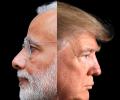
Here's why Rajeev Srinivasan believes there will be nothing particularly positive about the prime minister's US visit.

It is important the SCO focus strongly on economic development and regional integration that leads to greater benefits for the least developed regions of member-countries, writes Sana Hashmi.

Brushing aside India's concerns, China on Monday cemented its "all-weather ties" with Pakistan by agreeing to build a strategic $46 billion (Rs 2.9 lakh crore) economic corridor through Pakistan-occupied Kashmir as part of 51 deals signed, expanding the communist giant's influence in the region.

China's intended role for AIIB is not so different from the existing Western lenders like the World Bank.

The developments in Af-Pak region, particularly the fall out of Pak political paralysis, would make President Xi Jinping's task a little more complicated, says Colonel R Hariharan.

Beijing is clearly rattled by the Dalai Lama's visit. Unlike the 2009 visit, which was a four-day religious tour, the current visit is a high-decibel, 10-day affair, without the fig leaf of a "religious event", reports Ajai Shukla.

Days after the Indian Coast Guard intercepted a 'terror boat' from Pakistan, there are still some doubts over the claims.
'The Modi government's lurch toward America has not brought it any dividends so far. The Western world is simply not in a position to make big investments in India... India needs to take a leap of faith vis-a-vis China.'

'I believe Modi mentioned Balochistan only to embarrass Pakistan and also divert attention toward the situation in Kashmir.' 'I think from now on, India intends to raise Balochistan whenever Pakistan brings up Kashmir or upsets them on the issue of terrorism.' 'Balochistan is the least developed of Pakistan's four provinces. It is the least educated and least economically developed. People are agitated that a region so rich in mineral resources and a sea-port is still so poor.' Baloch political analyst Malik Siraj Akbar on why the province wants freedom from Pakistan.

In the case of India, there are no specific references in China's white paper. However, there are several takeaways for India, says Srikanth Kondapalli.

'Islamic State has declared that the liberation of Islamic Xinjiang from China is an objective. Beijing may well find that Pakistan is unable to assist in any meaningful way,' says China expert Jayadeva Ranade.

New Delhi remains a priggish suitor to Washington's overtures, but it has begun appreciating potential tech benefits to ties with the US.

'The army has stopped short of exerting the sort of influence it may have done historically.' 'It is comfortable with its relations with the civilian government as the superior partner.'

Four major political takeaways from Narendra Modi's much-anticipated trip to China

Modi, who is undertaking his first visit to China as prime minister, will reach the ancient city of Xi'an, the home town of President Xi Jinping, for a summit meeting, an unusual departure from normal protocol and seen as a reciprocal gesture by the Chinese leader who was hosted by Modi in Ahmedabad when he visited India in September last year.

Considering Modi's style of practicing diplomacy, it is likely that a clear message would be conveyed to China that it is high time Beijing stops using its good relations with Pakistan as a pressure tactic against India. This is imperative not only for strengthening India-China relations at the bilateral level but also for maintaining stability at the regional level, says Sana Hashmi.

The success story of Adani's Mundra Port in Gujarat, in terms of efficiency, technology and management, should be replicated at Vizhinjam to ensure that this ambitious project does not fail, say Shehzad Poonawalla and Riya Sinha.
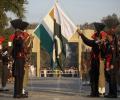
He was replying to a volley of questions about the outcome of Monday's brigade commander's flag meeting in Poonch.

'Chinese leaders rarely receive their foreign guests in cities other than Beijing. Such respect for India!' 'Does it mean that Modi could replicate "the warmth and unconventional way" by sending Indian troops into Tibet, as Xi did in Chumur (Ladakh) when he arrived in India? Of course, Indians are far too polite to do so,' says Claude Arpi.

'With the recent challenging of the notion of the Indian Ocean Region being India's strategic backyard, China is gradually upping the ante in the maritime realm around India.'
'Whether it's investments in Kashmir, building naval facilities, or selling top-of-the-range military equipment, Pakistan could well benefit more under Xi's watch.' 'Do Chinese concerns about the 'Islamisation' of Pakistan give it pause about how quickly to move forward with security and economic projects? At the moment the indication is quite the opposite: China is doubling down on its support to Pakistan, partly because of its fears about where the country is headed.'
