Unwinding of long dollar positions by banks too aided the sentiment

Abheek Barua & Bidisha Ganguly explain why the US treasury should intervene if the overvalued greenback continues to rise.

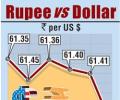
The rupee had ended almost flat at 61.41 against the Greenback in the previous session on Wednesday on alternate bouts of buying and selling.
It will have a positive impact on India's trade deficit and GDP growth.
Between October and December of 2013, the central bank net purchased $17.498 billion from the market.

Healthy demand for the American unit from importers and corporate weighed on the rupee
Foreign fund inflows and a higher opening in the domestic equity market supported the domestic unit

The domestic currency had lost 49 paise to close at a three-month low of 60.55 on Thursday on capital outflows after the US Fed trimmed its monthly bond buying programme by another $10 billion.

Dealers attributed the rupee's fall to increased demand for the US currency from importers.

The dollar maintained its bullish momentum in Asian and early European trade

In international market, the dollar rallied against the Japanese yen, stretching its gains which spiked above the key 100-yen level for the first time in four years.
The rupee had lost 33 paise, the most in a week, to close at 59.89 against the dollar on Monday on fresh demand from banks and importers amid disappointing industrial production, a fall in exports and higher inflation.

Year-to-date, the rupee is the worst-performing currency in Asia, weakening 4.184 per cent against the US dollar.
A resurgent US dollar is the key feature of the current scenario and its value continues to drive other markets, from euro, yen to the INR. Most currencies continue to seek lower valuations against the greenback. This trend is likely to continue until the dollar peaks out by yearend at around 89 as opposed to 84.5 right now, says Sonali Ranade

Robust capital inflows alongside a slightly weaker greenback too reinforced the dominance of the home currency
As the rupee breached the 57-level against the dollar on Friday, Deutsche Bank said the fall is temporary and it was not worried about outlook of the Indian unit which is likely to bounce back in second half of 2013.

The Maldives has an open economy with a narrow export base but high dependence on imports for most of its economic activities. As a result, foreign merchandise trade normally records a large deficit.
Forex dealers attributed the rupee's fall to increased demand for the US currency from importers

Weakness in the dollar against some currencies supported the rupee.

RBI fixed the reference rate for the dollar at 66.2930 and euro at 74.8978.

Bearish domestic equities restricted the rupee rise.

Forex dealers said dollar's weakness against other currencies overseas supported the rupee.

For the week, the battered rupee gained 26 paise against the greenback

The uncertainty over the gravity of the pandemic's impact on the global economy and financial markets worldwide triggered a flight to safety among foreign investors as they rushed to exit from relatively riskier investment destinations, such as emerging markets like India, a report said.

Dealers said dollar slipped against the euro and yen after President Barack Obama was re-elected in a knife-edge US presidential election.
Worst affected were the countries of euro zone, which saw a loss of $10.9 trn
Fag-end selling of dollars by banks and exporters
Companies are focusing on building a larger market base through mass market or alternative product variants, shedding premium tags for technically advanced products, providing cost efficient solutions and exploring synergies to match the ever decreasing customer threshold for consumption against the grim economic background.

In the global market, the US dollar index, which tracks the greenback against a basket of six major rivals, was up by 0.33 per cent.
The domestic currency has already dropped 44 paise, or 0.67 per cent, in the previous two sessions.
Forex dealers said apart from month-end demand for the American currency from importers, dollar's gains against other currencies overseas amid US data showing more-than-expected economic growth in the second quarter also put pressure on the local unit.

The rupee had plunged to close at its fresh two-year low of 66.84 against the dollar by falling 11 paise in Tuesday's trade.
Dollar's strength against some currencies overseas and firming crude oil prices also put pressure on the rupee, dealers said.

Yes Bank, Wipro, Kotak Bank, M&M, Sun Pharma, Maruti, HDFC, Hero MotoCorp, Infosys, TCS, L&T, Bajaj Auto and HUL were among the top gainers, rising up to 6 per cent.
Heavy unwinding by foreign portfolio investors and lacklustre equities dampened the sentiment
Several stocks cheaper in dollar terms now than in March 2009 when Sensex was below 9,000; FIIs in Coal India IPO stare at losses.
The sharp and sudden fall in the exchange rate of the Indian currency in relation to the American greenback has taken many by surprise.

A massive rally in domestic equities along with smooth supply of dollars on the back sustained capital inflows into equities and debt predominantly helped the upmove
 © 2026 Rediff.com - Advertise with us - Disclaimer - Privacy Policy - Sitemap - Feedback - About us - Terms of use - Grievances