
Aditya-L1 is meant to observe the corona, which are the outer layers of the Sun, extending to thousands of kilometres.
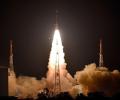
"I am really grateful to the entire ISRO family for having worked this hard and making IRNSS-1I a success," said the space centre's chief K Sivan.


There appears to be uncertainty over availability of a lander from Russia even as the 'desi' rocket to launch the space odyssey would take time to become operational.
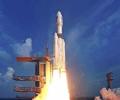
If successful, this would increase capacity to hurl small satellites into space, meeting both local demand and serving global customers.

Hours before Chandrayaan-2's 'Vikram' module's proposed soft landing on the Lunar surface, Indian Space Research Organisation chairman K Sivan said on Friday things are progressing as per plan for the much-awaited event.

The picture of Moon was taken by Chandrayaan-2's LI4 Camera from an altitude of about 2,650 km from the lunar surface.
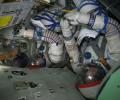
He also said it may be adopted for use in every stage of a rocket. He was speaking at the 16th convocation of SRM Institute of Science and Technology, near Chennai.

Here's a recap of moments captured in India in the past 24 hours.

Indian Space Research Organisation will announce a revised launch date later.

It also carries equipment for meteorological data relay and satellite based search and rescue services being provided by earlier INSAT satellites.

Rajeev Srinivasan on the disastrous after-effects of a made-up spying incident
The Indian government must support ISRO so that it is able to achieve its goal of becoming self-sufficient in all segments of the space business. The highly successful PSLV programme is a testimony to its capabilities. Now it needs to demonstrate the same with GSLV. Nothing should waver it from this goal. Not even competition with China, says Dinesh C Sharma
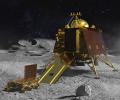
Most components of technology demonstration, including the launch, orbital critical maneuvers, lander separation, de-boost and rough braking phase were successfully accomplished.
Hailing Indian Space Research Organisation for its track record in launches, President Pranab Mukerjee on Monday said the country was looking forward to the success of homegrown GSLV mission.

India's premier Space Research Organisation is targetting up to 10 launches a year by 2016 , a top ISRO official said on Monday.

A recap of events that occurred in India in the past 24 hours.

"It is going to be the most complex mission ever undertaken by ISRO. It is going to take place between July 9 and 16, this year," Sivan said, addressing scientists from the Mission Control Centre.
ISRO chairman K Sivan said the proposed soft-landing was going to be a 'terrifying' moment.

"Efforts are underway to establish the link with the satellite," it added.
The Mars mission should not have been a priority at this stage for India which, instead, ought to have devoted time and energy on getting its rocket operational again and give momentum to the human space flight programme, former ISRO chief G Madhavan Nair said.
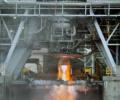
India's first indigenously designed and developed high-thrust cryogenic rocket engine generating a nominal thrust of 19 tonnes was successfully endurance hot-tested for 800 seconds.

Hit by inclement weather, the launch of India's latest communication satellite GSAT-16 was deferred for the second time after it was rescheduled to be put into space in the early hours on Saturday by Ariane 5 rocket from the space port of Kourou in French Guiana.
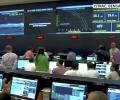
ISRO has said once the Lunar night falls, there would be no sunlight for the lander to generate power for its working and also it was not designed to operate in the heavy cold temperature of Moon during the phase.

ISRO launched 12 Indian, 22 foreign satellites and successfully flight-tested India's first winged-body aerospace vehicle.
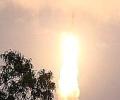
K Radhakrishnan, chairman of the Indian Space Research Organisation, has said that India is preparing to launch its second moon mission Chandrayaan-II by 2013. "The Chandrayaan-II we are planning to have in the year 2013. By that time, we should have our GSLV (Geosynchronous Satellite Launch Vehicle) flying with the Indigenous Cryogenic Engine Stage. That is the target with which we are working," said Radhakrishnan.

According to ISRO officials, Earth bound orbit is a phase during which the spacecraft will remain in the Earth's sphere of influence.

India on Monday successfully launched its second lunar mission Chandrayaan-2 onboard its powerful rocket GSLV-MkIII-M1 from the spaceport in Sriharikota to explore the unchartered south pole of the celestial body by landing a rover. Following the successful launch, leaders across the political spectrum congratulated the Indian Space Research Organisation for its hard work.

Sabka sath, sabka vikas, said Maldives President abdulla Yameen.

The Chandrayaan-2 will conduct the next level of scientific studies on the Moon, writes T E Narasimhan.

He said India wanted growth, development and peace in the region and was keen to utilise technology to pursue this goal for the shared prosperity.

India will be the fourth country after the United States, Russia and China to send humans to space.
Asked if the lander was 'damaged' during the 'hard landing", Sivan said: "That we do not know".

The Rs 978 crore mission, which has been rescheduled for Monday after scientists corrected the glitch in the rocket, will be launched at 2.43 p.m from the second launchpad at Satish Dhawan Space Centre, over 100 km from Chennai.

A truly 'made in India' satellite that will empower a digital India.
The Vikram Moon Lander, named after the father of India's space mission Vikram Sarabhai on his birth centenary year, is scheduled to touch the lunar surface near its south pole on September 7 about 1.55 am.

All spacecraft parameters are normal, the Bengaluru headquartered space agency said after the maneuver on the spacecraft.

GSAT-6, the country's latest communication satellite has been successfully positioned in its orbital slot, Indian Space Research Organisation said on Sunday.
There will be two more orbit manoeuvres to make the spacecraft enter into its final orbit passing over the lunar poles at a distance of about 100 km from the Moon's surface.
The GSLV will put into orbit the INSAT-4CR, which carries 12 high-power Ku-band transponders for direct-to-home television services, video picture transmission and digital satellite news gathering.
