
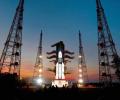
The rocket is almost 49 meters high -- as much as a 17-floor building. It weighs 415 tons -- as much as the combined weight of 80 full grown elephants.

GSLV-MK III, which uses a homegrown cryogenic engine, has to do at least two more launches before it begins commercial operations, report Raghu Krishnan and T E Narasimhan.
The satellite will enable a full range of services to neighbours including the areas of telecommunication, television, direct-to-home, VSATs, tele-education and tele-medicine.

The satellite would provide a thrust to mobile communication through multi-beam coverage facility, the ISRO said.

ISRO Chairman K Sivan said there might by a postponement if the weather was not conducive.
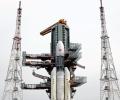
The Indian Space Research Organisation said that the countdown started at 6.51 am on Sunday.
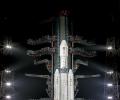
The Indian Space Research Organisation on Thursday launched its first experimental suborbital flight. Here are five things you need to know about the GSLV Mark III mission.
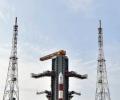
Here are some things you must know about this significant launch and why this satellite is a big deal for India.
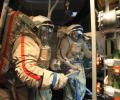
The Gaganyaan project has the objective of demonstrating human space flight capability to Low Earth Orbit with three crew members in orbit and safely recovering them after the mission.
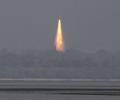
Enthused over its successful launch of GSLV D5 with GSAT-14 communication satellite from Satish Dhawan Space Centre in Sriharikota on Sunday, the Indian Space Research Organisation is planning a series of GSLV launches and an experimental launch of the advanced version GSLV Mark III soon from the spaceport.
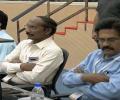
Join us in honouring the scientists for their latest achievement. Post your messages in the message board below.
And the first Indian to go into space from 'Indian soil' could well be a woman.

GSLV Mark-III will be India's most powerful launch vehicle built to lift the heaviest Indian communications satellites to space.

Indian Space Research Organisation plans to undertake next month the first developmental flight of a "game-changer" rocket capable of launching four-ton class of satellites from Sriharikota spaceport, says its Chairman A S Kiran Kumar.

The mission has three modules - Orbiter, Lander (Vikram) and Rover (Pragyan)

ISRO's first mission in 2023 and SSLV's sequel saw a strange coincidence--it was launched at 9.18 am, the same time its predecessor lifted off from the Satish Dhawan Space Centre here on August 7, 2022 but could not deliver due to orbit anomaly and flight path deviation.

The launch of the crewed space mission, Gaganyaan, is being planned before the next Independence Day and this will be proceeded by two uncrewed missions, Lok Sabha was informed on Wednesday.
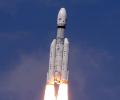
'ISRO takes a very cautious approach.' 'After reaching the moon, the orbit has to be brought down from a single elliptical orbit to a circular orbit while simultaneously ensuring the stability of Chandrayaan 3 and the health parameters of the lander and rover.'

Bharti Group-backed OneWeb on Monday said it has entered an arrangement with the commercial arm of ISRO, NewSpace India Limited (NSIL), to launch its satellite in India from 2022.

"ISRO has been launching at least one satellite every month, so our calender is perennially packed and at this point of time it looks difficult to launch the South Asian satellite in December. It could get delayed by a month," a senior official said.

If the April launch of the Chandrayaan-2, the country's second mission to the Moon, is not possible, then the ISRO will aim for a launch by October.

'We are looking at a joint venture between ISRO and a few companies to assemble the PSLV and launch it from Sriharikota.' 'In a month or two, the vehicle assembly building will be ready.' 'After that, we could see 13, 14 launches a year.'
With the launch of GSLV-MK III, slated for April, it will be able to cater to bigger satellites as well.
The ISRO had earlier said Chandrayaan-2 will be launched in a window from January-February 16, 2019.Sources said it is expected by the middle of next month but no date has been finalised.
'If Chandrayaan 1 had a launch with GSLV, we need not have an orbiter for Chandrayaan 2.' 'We could have gone straight round the moon and landed on the moon.'

Except Pakistan, seven SAARC countries are a part of the project.

India's heaviest rocket ever is expected to take to the sky next January on an experimental flight whose later versions could be used to send humans on space missions.

"Indeed, a satisfying feeling," K Radhakrishnan who as the then Chairman of Indian Space Research Oranisation (ISRO) led the Mars Orbiter Mission (Mangalyaan) team said on achieving the milestone.

Swapnila said they saw the GSLV Mk-III rocket that will launch the mission into space. "It was so huge," she added.

Indian Space Research Organisation's immediate plan was the launch of two more PSLV flights this year and a GSLV launch early next year.
"The launch of Chandrayaan 2 will be in 2014. We are working towards it. It would be on a GSLV, after we launch two GSLVs within an interval of six months," ISRO chief K Radhakrishnan told reporters here soon after the launch of RISAT-1.

The feat is the second one for the Indian Space Research Organisation scientists in using the indigenously made cryogenic stage after the January 5, 2014 launch of GSLV-D5.
According to sources in the Bengaluru-headquartered space agency, under the Department of Space, delivery of hardware by the industry was hit due to the lockdown imposed in several States to contain the pandemic in recent months.

The heaviest rocket of the Indian Space Research Organisation -- LVM3-M2/OneWeb India-1 -- blasted off from the Sriharikota spaceport on Sunday to place 36 broadband communication satellites into the Low Earth Orbit (LEO) for a UK-based customer.

Eminent rocket scientist S Somanath has been appointed as the chairman of the Indian Space Research Organisation as well as the space secretary, a personnel ministry order issued on Wednesday said.
The satellite was placed at 4.18 pm, a little over 17 minutes after the Geosynchronous Satellite Launch Vehicle (GSLV-F-01) carrying it was launched from the Satish Dhawan Space Centre in Sriharikota.
Officials of the Bengaluru-headquartered space agency said the first and second waves of the pandemic have "severely affected" the Gaganyaan programme.

'We have all the technologies available, but it should be converted to something that can be commercially viable.'

The Indian Space Research Organisation has resolved to alight its lander on the lunar surface with Chandrayaan-3 in addition to a maiden solar expedition in 2020.

The ISRO is aiming for a soft landing of the lander in the South Pole region of the moon where no country has gone so far.
