
Motorola has expanded its G-series lineup in India with the launch of the Moto G77 Power, a smartphone designed for users who prioritise battery life and reliable everyday performance.

Xi's bilateral meeting with Modi was substantial and readouts from both sides gave indications of rapprochement, if not a reset of bilateral relations between India and China, notes Ambassador T P Sreenivasan.

How the UN's flagship climate summit lost its direction and what's at stake.
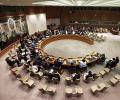
"In India's development cooperation, we will be guided by our partners' development priorities. Our assistance does not create indebtedness and is without conditionalities," he said at the 44th Annual Meeting of the G-77 Foreign Ministers on Thursday, in a veiled reference to China's loans which has led to debt-traps in some countries.

Ahead of the key climate summit in Copenhagen, representatives of the G-77 group of developing nations and China spent two days, discussing their strategy for the meeting and speculating on possible outcomes and their position on specific issues.

The G77 and China have reacted angrily over the leaked Danish draft proposal for an agreement on the climate change that puts mitigation commitments, calls on peaks years for developing countries as well as endorsing the IPR regime.

Talks on global climate finance virtually ground to a halt last week at COP29, the annual United Nations (UN) Climate Change event in Baku, Azerbaijan, as the developed world, led by the European Union (EU), and developing countries including India, Brazil, South Africa, and a clutch of island nations and African countries faced a wide chasm between their expectations. This has raised doubts about whether an agreement can be reached this week or whether talks will spill over to COP30, to be held next year in Benem, Brazil.

China has signalled that it will prevent India from assuming leadership of the Global South, observes Ambassador T P Sreenivasan.

India's dream to be in the forefront of international politics has come true. India has placed itself firmly as a major player in the shaping of a new world order, observes Ambassador T P Sreenivasan.
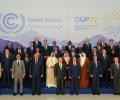
The overwhelming feeling at the end of COP 27 was that despite decades of meetings and landmark accords, like the Paris Agreement, the world was still not doing enough to slow the climate crisis, observes Ambassador T P Sreenivasan.

Diplomatic row erupts after co-chairs hold talks minus developing nations; third draft of Paris climate change agreement emerges at Bonn

The Bangkok talks are a last chance to sign a deal to replace the Kyoto Protocol, whose first commitment period expires in 2012.

The 54-page Paris agreement draft had been scaled down to 50.
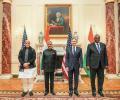
The pressure on India to take a hostile attitude towards Russia and China was not subtle, but it was guarded, observes Ambassador T P Sreenivasan after Monday's 2+2 ministerial meeting in Washington, DC.
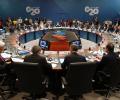
For India, the talks will work as another opportunity to sharpen its positions ahead of the formal UN negotiations.

Ahead of the key climate summit here, representatives of the G-77 group of developing nations and China spent two days in a conference room in Copenhagen, discussing their strategy for the meeting and speculating on possible outcomes and their position on specific issues.

"All the G77 and China members have made it very clear that they are not envisaging that there could be any kind of uncooked paper which would go up to the heads of state and the government," said Shyam Saran.


Modi said South America has tremendous potential.
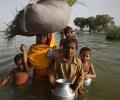
A proposal by the US and its allies asking developing countries to equally contribute towards global climate finance has irked developing countries at the Paris meet.

Hamid Ansari on Friday left for Lima on the first-ever visit at the Vice Presidential level to mineral-rich Peru and Communist Cuba as part of India's thrust towards Latin America.
.jpg)
The minister, who is in New York to attend high-level meetings of the UNGA, assured INOC that while he was aware of some of the concerns of the non-resident Indians, he did not know the extent of the problems and that the government will address the issues as soon as possible.

'This novel format of diplomacy -- the informal summit -- will not only facilitate bilateral communication and reduce miscalculations at the very top level of the two governments, but possibly open the space for China and India to speak in one voice on various issues of mutual concern,' note Feng Renjie and Ding Kun Lei

Decisions at a G20 meet are not added to the UN climate negotiations.

India said that the goal of capping global warming at 1.5 degree Celsius from pre-industrial times will require developed countries to "massively" reduce their emissions


Developed nations have refused financial support for climate change to India, China and Brazil.

India and South Africa on Friday agreed to deepen engagement in key areas of defence production, manufacturing, mining and minerals and combating terrorism.

The omission of historical responsibilities, implying the build-up in the atmosphere of 165 years of greenhouse gas emissions from industrialised countries, is a body blow to the notion of climate justice, sums up Darryl D'Monte, reporting exclusively for Rediff.com from COP21.

At the Paris climate change summit, there is talk of restricting temperature rise to 1.5?C instead of 2?C, which has been negotiated so far. This would give India less space to grow by limiting carbon emissions further, reports Darryl D'Monte, reporting exclusively for Rediff.com from the French capital.

'We want to provide data, we want to provide consultation, but we don't want to lecture.' 'The consciousness about this issue in India is starting to get quite high and if we can help contribute to solving this air quality issue in a spirit of partnership with the Indians, it would be a big achievement.'

And the US won the evening
