
Besides Jeff Bezos-led Amazon, Walmart-owned Flipkart is also facing a threat from Asia's richest man and RIL chairman Mukesh Ambani, who is also betting big to grab a share of the country's e-commerce market.

Prices of two-wheelers, passenger and commercial vehicles are set to rise 15-25%

High frequency indicators suggest that a growth recovery is underway, but very tentatively and with weak legs, says Saugata Bhattacharya.

With infrastructure claiming a larger share, movement and distribution of cement is bound to change.

Mutual funds (MFs) are set to be net sellers of Indian equities for the first time in the past seven financial years, having sold stocks worth about Rs 1.27 trillion so far in 2020-21 (FY21), making it the highest net sales on record in a financial year. MFs had been net buyers in the previous six financial years, including purchases of over Rs 1.41 trillion in FY18, Rs 88,152 crore in FY19, and Rs 91,814 crore in FY20. The last time they offloaded Indian equities was in FY14, when they net sold stocks worth Rs 21,159 crore. In contrast, foreign portfolio investors (FPIs) have ramped up buying in FY21, purchasing more than Rs 2.6 trillion worth of shares.

What worked for Airtel was that its data traffic growth was 13 per cent sequentially and its average data usage was even higher than Jio's at 11.9 gigabyte per month per user.

For state-run lenders, the average NPAs shot up to 14.5 per cent, with IDBI Bank, UCO Bank and Indian Overseas Bank having their NPAs at above 25 per cent.

It has been a year since the Reserve Bank of India (RBI) initiated prompt corrective action (PCA), an exercise that puts weak banks under central bank scrutiny, against the 94-year-old Lakshmi Vilas Bank (LVB). But recently, this low-profile Chennai-headquartered bank found itself attracting some unwonted publicity when 60 per cent of its shareholders voted against a proposal to re-appoint seven directors, including one of the promoters, K R Pradeep (who holds around 2 per cent), and the company's managing director & chief executive officer S Sundar.

Its production declined for the third consecutive year in financial year 2020-21 (FY21) to an 11-year low, while sales volume contracted for the second year to the lowest since FY15. The company manufactured around 1.08 million vehicles last fiscal, a decline from 1.17 million the previous year, and a steeper fall from its all-time high tally of 1.62 million reported in FY18.

After showing a consistent rise in the previous 4 quarters, gross NPAs of 40 listed bank declined to Rs 10.03 trillion at the end of June 2018, from Rs 10.25 trillion in the previous quarter.

The EPFO had decided that 8.15 per cent interest from its debt income would be credited immediately and the remaining 0.35 per cent capital gains from the equity sale would be given later, subject to its redemption.

'The economy needs to deliver the expected 7.5% growth for the markets to deliver better than single digit returns.' 'Any disappointment in growth can see the markets correcting downwards.'

Last month, the bank was placed under Prompt Corrective Action due to high level of bad loans, lack of sufficient capital to manage risks and negative return on assets for two consecutive years.

Ola has reported its first operating profit of Rs 89.82 crore for 2020-21, even as the ride-hailing company's revenue declined 65 per cent to Rs 689.61 crore amid COVID-19 induced lockdowns. As per regulatory documents filed by ANI Technologies - the parent company of Ola - it had logged standalone operating profit (profit before finance cost, depreciation, amortisation and tax (EBITDA)) of Rs 89.82 crore in FY21 on a standalone basis, while it had registered a loss of Rs 610.18 crore in the preceding fiscal year.

The combined fertiliser, food and petroleum subsidy budgeted estimate for FY19 is Rs 2.64 trillion, while the revised estimate is Rs 2.66 trillion. If the carrying forward to FY20 does not happen, the revised estimates for the major subsidies could actually cross Rs 3 trillion for the first time ever.

Despite a steady collection rate, the government faces a steep Budget target of Rs 6.1 trillion for CGST for 2019-20.

Whether it is protecting its turf in its core utility vehicle segment through new model launches, or stepping up investment in electric vehicles, the Anand Mahindra-led firm is leaving nothing to chance

Top gainers in the Sensex pack included Yes Bank, Sun Pharma, IndusInd Bank, Tata Steel, HUL, Vedanta, Tata Motors, ICICI Bank, ITC, HDFC and Bajaj Auto, that rose up to 3.75 per cent.

Squeezing growth prospects in IT services firms and higher compensation in technology centres run by global companies are the two factors driving this trend.

The stock, which is a play on the growth story of Indian Railways, has corrected 15 per cent from its 52-week high level of Rs 2,072.95 scaled on March 9. Yet, this has not deterred brokerages from holding a bullish view on the stock.

Listed realty developers saddled with unsold properties worth Rs 1 trillion

Paytm Travel claims to have a base of around 13 million customers, a threefold increase over the user base in FY17. While significant, it is but a fraction of Paytm's wallet user base of more than 300 million.
The 70 launches were made in the first half of the financial year alone and were mostly focused on hygiene, health & wellness, naturals and convenience, which were in high demand as Covid -19 raged across the world.

Collapse of the mobile operator could translate into total loss of nearly Rs 44,000 crore for the AV Birla group.

March was the first full quarter for Infosys under its new CEO Salil Parekh.

The month of March could be worst in many years, with imports estimated only around 18 tonnes amid the coronavirus pandemic and the nationwide lockdown, said an industry player. The import in March 2019 was 72.5 tonnes, according to the GFMS data.

The slowdown in growth is an industry-wide trend and companies are adjusting production to bring down the inventory levels at plants as well as dealerships.

While Wipro leads the pack on absolute numbers, analysts for Infosys for reporting consistent growth, revising FY22 guidance and beating TCS on revenue growth.

'A growth of above 7 per cent when the fundamentals of the economy are becoming stronger still makes India the fastest growing large economy.'

The report, however, did not include sales of Flipkart's subsidiaries Myntra and Jabong.

The direct tax collections are likely to fall short of the revised Budget target by Rs 650 billion and, in fact, were Rs 150 billion lower than the original estimate for the fiscal

Naresh Goyal, after being ousted with his wife from the board last week, and with his shareholding halved to 25 per cent, can still make a comeback by partnering a new investor and win back majority control.

Spread investments in equities, bonds, gold and cash to tackle volatility advise Nitin Singh, MD and head, and Vinay Joseph, director, investment strategy, Standard Chartered Wealth Management, India.

Among the key concerns of the Street is market share losses in growth segments, led by higher competitive pressures.
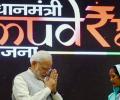
Not only has the Mudra loan mela generated no jobs, it has frittered away trillions of taxpayers' money and it's time to bury the scheme, argues Debashis Basu.

Post office savings deposit, recurring deposit accounts and the senior citizen savings scheme account have shown the highest growth in the current financial year.

NBFCs with a proven track record, supported by the brand values of reputed corporate, can play a key role in bringing the benefits of banking and economy to the underserved and newer segments of India.

Stock markets in structural bull run but there can be bouts of volatility says Ravi Gopalakrishnan, head, equities, Canara Robeco Mutual Fund

The thrust, they feel, remains on design thinking, AI and digital besides enhanced focus on investing in selling and marketing efforts, expanding local talent base and re-skilling staff

A well-established tax system would have a predictable buoyancy - how fast the collections grow as a proportion to the growth of the economy. But that is not the case with GST. It is still undergoing substantial changes as the government responds to structural as well as administrative glitches.
