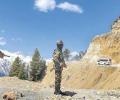
China and India have agreed to work to maintain peace along the Line of Actual Control and resolve the border standoff through talks while implementing the consensus reached between the two countries' leadership that 'differences' do not escalate into 'disputes', a top Chinese official said.

The Indian Army has shown it can face down the PLA, but is too often held back by a political leadership that lacks boldness, asserts Ajai Shukla.

'India should today tell China to provide proper facilities in Minsar for Indian yatris visiting Mt Kailash,' says Claude Arpi.

After remaining peaceful for most of the year, Chinese troops entered Indian territory in the fag end of 2010 along the Line of Actual Control in south-eastern Ladakh region and threatened a contractor and his team to halt work on constructing a 'passenger shed'.

Defence Minister Rajnath Singh on Saturday asserted that the government will not allow India's pride to be hurt under any circumstances even as he said bilateral talks were on at military and diplomatic levels to resolve the row.

In the wake of reported incursion attempts by China, India on Wednesday said such incidents take place due to difference of perception about boundary and leaders of both the countries are in talks to resolve the issue.
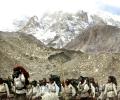
The Indian Army will continue to maintain its aggressive posturing in all disputed areas in eastern Ladakh and will not back off till status quo is maintained, sources said.
The External Affairs ministry was at odds with the Jammu and Kashmir government over reports on Chinese intrusion in Ladakh, saying no such incident had taken place and the media reports carrying the same were "baseless".
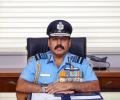
Air Chief Marshal Bhadauria was at the Leh IAF base on Wednesday where he reviewed operational preparedness of the force in effectively guarding the sensitive border areas in eastern Ladakh where Indian and Chinese armies have been on a nearly six-week standoff.
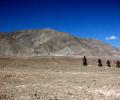
While the de-escalation process was underway, a violent face-off took place on Monday night between Indian and Chinese troops leading to the death of 20 Indian soldiers.

Sources said the Indian delegation was warmly greeted by senior officials of the Chinese Army before the talks began.
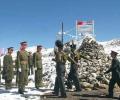
The two sides have already held at least 12 rounds of talks between local commanders and three rounds of talks between major general-rank officials but no positive outcome came out from the discussions, they said.
The enhancement of combat capability by the two armies in the region came even as both the countries continued their efforts to resolve the dispute through talks at military and diplomatic levels.
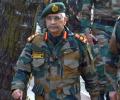
The commanders will also deliberate on the overall situation in Jammu and Kashmir besides delving into issues having national security implications, they said. However, the main focus will be on the situation in eastern Ladakh where Indian and Chinese troops are locked in an eyeball-to-eyeball face-off in Pangong Tso, Galwan Valley, Demchok and Daulat Beg Oldie, the sources said.

'If you behave like a nail, the adversary will behave like a hammer.'

'The Fire and Fury Corps is the only formation of the Indian Army and also in the world to have actually deployed mechanised forces in such harsh terrain. The maintenance of the tanks, infantry combat vehicles and heavy guns is a challenge in this terrain. To ensure crew and equipment readiness, adequate arrangements are in place for both man and machine'
The US hopes that the differences will be resolved peacefully, officials said in Washington.
It is learnt that Defence Minister Rajnath Singh has conveyed to top military brass that there was no need for reviewing the implementation of any of the key projects along the Line of Actual Control (LAC) in Ladakh, Sikkim, Uttarakhand or in Arunachal Pradesh in view of the aggressive behaviour by Chinese troops in several sensitive areas.
It is learnt that the India's top military brass is constantly monitoring the evolving situation even as the United States said the aggressive behaviour by Chinese troops was a reminder of the threat posed by China.

India on Wednesday delivered a strong message to China that the 'unprecedented' incident in the Galwan Valley will have a 'serious impact' on the bilateral relationship and held the 'pre-meditated' action by Chinese army directly responsible for the violence that left 20 Indian Army personnel dead.
The intrusions into India were likely carried out by the PLA's better trained and equipped 'mobile operational units'.
The Chinese side has particularly bolstered its presence in the Galwan Valley, erecting around 100 tents in the last two weeks and bringing in heavy equipment for construction of bunkers, notwithstanding the stiff protest by Indian troops. There have been reports of multiple incidents of transgressions by Chinese troops in several areas in Eastern Ladakh.

Prime Minister Narendra Modi raised the issue of Chinese incursions with the visiting Chinese President Xi Jinping during their meeting on Wednesday night.
Both the Indian and Chinese armies have brought in more troops in sensitive locations like Demchok, Daulat Beg Oldie and areas around Galwan river as well as Pangong Tso lake in Ladakh, the sources said. The area around Galwan has been a point of friction between the two sides for over six decades.

Until last month more than two-thirds of the Indian Army was deployed against Pakistan. Of 14 army corps, just four-and-a-half faced China, while more than twice that number was ranged against Pakistan.
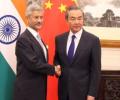
Wang said the two sides should follow the important consensus reached by the leaders of the two countries and strengthen the communication and coordination on the proper handling of the border situation through the existing channels so as to jointly maintain peace and tranquility in the border area, the Chinese foreign ministry said in a statement.

'The Chinese can't be trusted hence the need to verify and re-verify.'
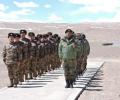
The Indian delegation led by Lt General Harinder Singh, the general officer commanding of Leh-based 14 Corps, and Commander of the Tibet Military District Maj Gen Liu Lin held an extensive meeting in Maldo on the Chinese side of the Line of Actual Control in eastern Ladakh on Saturday that began at around 11.30 am and went on till evening.
The MEA said it was the Chinese side that recently undertakook activities hindering India's normal patrols in the areas.

'The government will ensure that India's pride is not affected as far as the situation along Indo-China border is concerned'
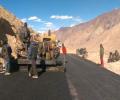
The feat was achieved under 'Project Himank' of the organisation.

The government must figure out what the Chinese game plan is and thwart the endgame before it is upon us, possibly in early winter, advises David Devadas.

There have been more than 100 face-offs and 150 transgressions by the Chinese army into the Indian territory near the Line of Actual Control in the Ladakh sector this year.

The incident took place on Wednesday afternoon in Demchok sector, located 250 km east of Leh, where the work for linking a village with 'hot spring' was being undertaken under the MNREGA.

Here's the full text of President's Ram Nath Kovind's address to the joint sitting of both houses of Parliament on the first of Budget Session 2022.

'All the government needs to do is to identify clear political and strategic objectives and to give the military planners a free hand,' asserts Ajai Shukla.
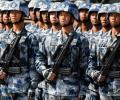
With the Indian Army having blocked the PLA several kilometres inside India, hundreds of soldiers from both sides remain in a tense face-off.
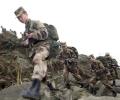
Heightening tension, the Chinese army pushed in more troops into Chumar village along the Line of Actual Control in the wee hours on Thursday, hours before the summit meeting between Chinese President Xi Jinping and Prime Minister Narendra Modi.

'Chinese troops are not geared to fight Indian troops who are battle hardened and acclimatised and are far more hardy.'

Amid a spate of incursions by China in Ladakh, its troops are also resorting to tactics like preventing the Indian army from patrolling posts in this sector along the border, which is well within India's territory.
