
Hours after the multi-lateral conference began in Moscow, India made it clear that its participation was in sync with its Afghan policy and asserted that attending the meeting was not talking to the Taliban at all.
With regard to where relations between New Delhi and Beijing stand, the Union minister said that he does not have a definite answer to offer at "this moment".

'Galwan has turned everything.' 'The casualties on both sides alerted the Chinese to the fact that Indians are not going to take it lying down.'

Notwithstanding India's objections to China-assisted developmental projects in PoK, Pakistan asserted it will go ahead with its plans there, including the multi-billion dollar Sino-Pak economic corridor.
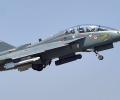
'The JF-17 is the aircraft of today and the Tejas is the aircraft of tomorrow.'

"The part (of J&K) which is with Pakistan (PoK) belongs to Pakistan and this side to India. This won't change. Let them fight how many wars they want to. This won't change," Abdullah said.

'Unlike the Chinese army that has been largely a peace time force, the Indian Army is a battle hardened force,' explains Colonel Anil A Athale (retd).

'We must acknowledge China will use Pakistan against India.' 'We all need to know that these two countries are ready to destabilise India at all times.'

Observers say China's repeated invitations to India to join the BRI highlights its own anxieties over the adverse impact of New Delhi's lack of support to the multi-billion dollar investments in South Asia as it would deny access to India's market consisting over 1.2 billion people.
The country opened its airspace for all flights except for New Delhi, Bangkok and Kuala Lumpur on March 27.

"Only one of the five permanent members, China, openly favours Pakistan," the Dawn report noted.
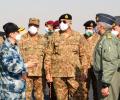
'There is much to glean from such exercises. And make it known that we are ready to take them on together!', says Air Commodore Nition Sathe (retd).

'It is a testing time for our foreign policy which may involve a certain element of taking risks, assessing costs, and expecting failures,' asserts Commodore Venugopal Menon (retd).

China's closer and enhanced relationship with Pakistan is putting considerable strain in India-China relations, says former RA&W officer Jayadeva Ranade.

He noted that the primary responsibility of the Indian Army is to maintain operational readiness of the "highest order".

India needs to shed its policy of lethargy and inhibitions to engage the Taliban with an intent to maintain its influence in Afghanistan. This would not just put a spanner in Pakistani designs, but also incentivise the Taliban not to be the puppets of GHQ, Rawalpindi, asserts Colonel Nikhil Apte (retd), who served on the Af-Pak desk at the Military Operations Directorate.

Three terrorists attempted a forced entry into the hotel. A guard at the entrance challenged them after which the terrorists opened fire and killed him, the army's media wing Inter-Services Public Relations said.
'The world does not care about the tension on our border.' 'India has to emerge as a strong economic power.' 'Respect comes when the world sees a country with a direction and leadership that has a vision,' points out Ramesh Menon.

An agreement was reached in Islamabad during a meeting between Pakistan Finance Minister Ishaq Dar and Xu Ziqin, President of state-owned China Shipbuilding & Offshore International Company Limited -- the trade arm of China Shipbuilding Industry Corporation.
Pakistan's offer to normalise relations with India is an attempt to buy temporary peace due to its economic and politico-strategic compulsions, notes Brigadier Narender Kumar (retd).

China's state-run media commented that India's close relationship with the US could create geopolitical rivalries in Asia.
In recent years, China has refrained from taking a public stance on the India-Pakistan ties, expressing hope for resolution of the disputes through dialogue.

The US took the lead, and many other council members also joined and made it clear that the Kashmir issue was not a matter for the UN body to discuss and is a bilateral issue between India and Pakistan.
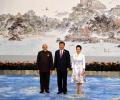
'By crudely dragging the topic into the bazaar to flog it for momentary pleasure, we turned it into a dead carcass by the time Modi even got back from Xiamen,' says Ambassador M K Bhadrakumar.
Shed suspicion and manage differences to improve Sino-Indian ties, says Chinese Foreign Minister.

This project is part of $46 billion China-Pakistan Economic Corridor (CPEC) package and is covered under the CPEC Framework Agreement.

Noting that China attaches great importance to its ties with Pakistan, Chinese President Xi Jinping on Saturday expressed hope that the two countries could cooperate closely so that their traditional friendship could be passed on from generation to generation.

Pakistan's powerful Army Chief Gen Raheel Sharif's visit to Beijing comes in the backdrop of assertions by Pakistan that it will raise its concerns at the international level over India's successful test of supersonic interceptor missile.

Considering Modi's style of practicing diplomacy, it is likely that a clear message would be conveyed to China that it is high time Beijing stops using its good relations with Pakistan as a pressure tactic against India. This is imperative not only for strengthening India-China relations at the bilateral level but also for maintaining stability at the regional level, says Sana Hashmi.

The road ahead will be long and winding and much resistance can be expected from the high-flying 'hawks' in our skies. But that should not deter the policymakers from planning a road map with the 'big picture' in mind, observes Ambassador M K Bhadrakumar.

India skipped the Belt and Road Forum in May this year due to its sovereignty concerns.

'A firm national resolve can only deter and defeat the nefarious designs of the adversary,' notes Rup Narayan Das.

Until last month more than two-thirds of the Indian Army was deployed against Pakistan. Of 14 army corps, just four-and-a-half faced China, while more than twice that number was ranged against Pakistan.

American help in defending our independence will send a strong signal to the Chinese, argues Colonel Anil A Athale (retd).

India cannot choose its geography and devise regional strategies to dovetail into the Western Indian Ocean hypothesis conceived in the Pentagon, argues Ambassador M K Bhadrakumar.

Beijing's political risks are also escalating because of a renewed wave of public anger in many parts of Balochistan against human rights abuses by Pakistani troops deployed to crush the low-intensity insurgency in the province, the report said.

'A Russia-Iran-China-Pakistan geopolitical grouping is evolving at this point of time.' 'Given that the grouping is in its nascent stages, will this week's terrorist attack in Mirjaveh affect it?' asks Aveek Sen.

In an oblique reference to China's Belt and Road Initiative, Prime Minister Narendra Modi on Friday cautioned against rolling out connectivity projects without respecting sovereignty and territorial integrity.
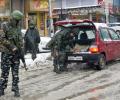
The attempt failed as other member countries felt Kashmir is a bilateral matter between India and Pakistan.
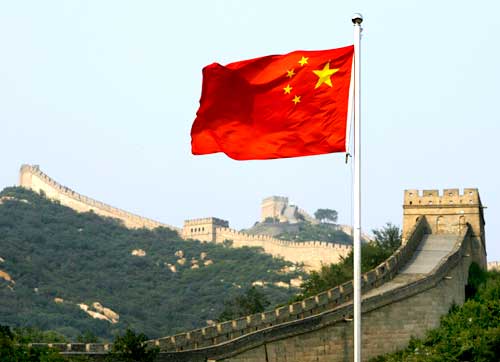
The Chinese envoy recommends an early harvest on the border issue while maintaining peace and tranquillity in the border areas, reports Ajai Shukla.
