
The Indian Space Research Organisation has resolved to alight its lander on the lunar surface with Chandrayaan-3 in addition to a maiden solar expedition in 2020.
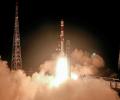
The Indian government has approved the construction of a third launch pad at Sriharikota, capable of sending heavier spacecraft into orbit. This new facility will support India's ambitious space program, including the Gaganyaan human spaceflight mission and a lunar landing. The launch pad will be built at the Satish Dhawan Space Centre and is expected to be operational within four years.

The Moon Mineralogy Mapper or M3 has confirmed existence of water on moon by analysing the data collected from Chandrayaan-I.

Vikram (with rover 'Pragyan' housed inside) is expected to touch down on the lunar surface on September 7, between 1.30 am and 2.30 am.
Join us in honouring the scientists for their latest achievement. Post your messages in the message board below.
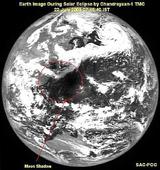
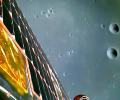
The images were captured by the Terrain-Mapping Camera (TMC) on board the 514-kg spacecraft, which is orbiting at 200 km above the lunar surface.

On Thursday, scientists sent the 1,380 kg spacecraft to its next destination -- highly elliptical orbit of 300 km perigee and 1.6 lakh km apogee respectively. This will be followed by three more orbit-transfer exercises.

NASA's Lunar Reconnaissance Orbiter spacecraft has snapped a series of images during its flyby on September 17 of Vikram's attempted landing sight near the Moon's uncharted south pole.

"We have been able to detect NASA's Lunar Reconnaissance Orbiter (LRO) and the Indian Space Research Organisation's Chandrayaan-1 spacecraft in lunar orbit with ground-based radar," said Marina Brozovic, a radar scientist at JPL and principal investigator for the test project.

Narayanan has a long and distinguished career at ISRO, having played a key role in several important missions, including Chandrayaan-2 and 3, and the Gaganyaan programme.

The Sarabhai Crater is around 250 to 300 kilometres east of the crater where the Apollo 17 and Luna 21 Missions had landed.
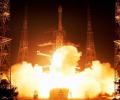
ISRO is part of an exclusive league which has forayed into the Moon and Sun.

In terms of success rate, the PSLV rocket has an enviable record of 57 successful missions out of 58 commercial ones.

Indian Space Research Organisation will announce a revised launch date later.

Sivan asserted that though Chandrayaan-2 did not go as per script, it will have no bearing with on the 'Gaganyaan' mission.

If the April launch of the Chandrayaan-2, the country's second mission to the Moon, is not possible, then the ISRO will aim for a launch by October.
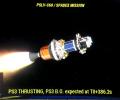
Dubbed as a prelude to ISRO setting up its own Space Station by 2035, the PSLV-C60 mission would also make India join an elite club in achieving this feat which is expected to take place in the coming days.

Somanath thanked all those who prayed for the mission's success, and ISRO veterans like A S Kiran Kumar , the space agency's former chief.

According to ISRO officials, Earth bound orbit is a phase during which the spacecraft will remain in the Earth's sphere of influence.

Prime Minister Narendra Modi announced that he will hand over his social media accounts to women achievers from different walks of life to mark International Women's Day on March 8. In his monthly "Mann Ki Baat" address, Modi said these successful women will talk about their work and experience on his social media accounts. He also renewed his appeal to people to take measures to deal with the growing problem of obesity and encouraged people to visit research laboratories or planetariums to mark National Science Day on February 28. Modi highlighted India's progress in space science and artificial intelligence, and emphasized the importance of celebrating and respecting the indomitable spirit of women. He also spoke about the diversity of India's wildlife and the importance of conservation efforts.

"I remember Chandrayaan-2's launch was earlier scheduled on July 15. I was there in Sriharikota. I saw the massive carrier, 'Bahubali', from close proximity.

He said the ISRO scientists have a very strong spirit of working and will not rest till the objective is met.

The Chandrayaan-2 will conduct the next level of scientific studies on the Moon, writes T E Narasimhan.

Here's some exclusive, behind-the-scenes footage of the moon mission's various components coming together.
Preliminary assessment of data from the LLRI by scientists indicates that the instrument's performance is normal, an ISRO statement said.
During this manoeuvre, Chandrayaan-1 entered a much higher elliptical orbit around the Earth. The apogee (farthest point to Earth) of this orbit lies at 1,64,600 km while the perigee (nearest point to Earth) is at 348 km. In this orbit, Chandrayaan-1 takes about 73 hours to go round the Earth once.
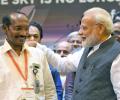
Addressing the scientists hours after ISRO announced that it had lost communication with the lander, he also said that the country's determination to land on the moon has become even stronger.

"I am extremely happy to announce that GSLV Mark III successfully injected Chandrayaan 2 in the defined orbit, infact the orbit is 6,000 km more than what was intended," Sivan said.

Scientists also expressed the hope that any technical problem will be sorted out by ISRO, and the mission will be launched successfully.
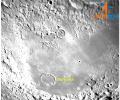
If any factor regarding the lander module appears unfavourable, then the landing will be shifted to August 27, said the Space Applications Centre-ISRO about Chandrayaan-3 on Monday.

Although Russia, United States and China have achieved a soft landing on the lunar surface, India is aiming at becoming the first one to explore the south pole of the Moon.

Meet Indian Space Research Organisation scientist Ningthoujam Raghu Singh, who was one of the bright sparks responsible for sending Chandrayaan-3 to the moon.
The BJP hit back accusing the Congress of drawing the issue into political arena.

Her comments came amid the ongoing war of words between India and Pakistan ever since India withdrew Jammu and Kashmir's special status and bifurcated it into two union territories on August 5.

There will be two more orbit manoeuvres to make the spacecraft enter into its final orbit passing over the lunar poles at a distance of about 100 km from the Moon's surface.
Taking to X (formerly Twitter), ISRO said, "Chandrayaan-3 Mission. Chandrayaan-3 Rover to MOX, ISTRAC, Moon walk begins!"

NASA posted images clicked by its Lunar Reconnaissance Orbiter camera, showing the site's changes on the Moon and the impact point before and after the spacecraft had made a hard-landing on the lunar surface.

The implementation of the NRC as nothing but a political vendetta of the Bharatiya Janata Party-led central government, she told the assembly.

Chandrayaan-3 mission's rover 'Pragyan' has traversed a distance of about eight metres on the lunar surface, and its payloads have been turned on, ISRO said on Friday.
The Indian Space Research Organisation is trying to track down Chandrayaan-1 with which it lost radio links on Saturday.
