
'If you align your ambition with India's rise, the peak of your careers will unfold alongside the peak of India's power.'
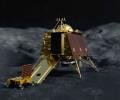
ISRO on Friday said it has made efforts to establish communication with its lunar mission Chandrayaan-3's lander Vikram and rover Pragyan to ascertain their 'wake-up condition' after they had been put into sleep mode early this month -- but no signals have been received from them as of now.

Swapnila said they saw the GSLV Mk-III rocket that will launch the mission into space. "It was so huge," she added.

Chandrayaan-2 was launched on July 22, 2019 and inserted into the lunar orbit on August 20, exactly one year ago.

The ISRO is aiming for a soft landing of the lander in the South Pole region of the moon where no country has gone so far.
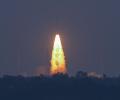
A PSLV rocket carrying Earth observation satellite EOS-09 failed to launch from the Sriharikota spaceport early on Sunday.
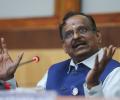
Ahead of Prime Minister Narendra D Modi's meeting United States President Donald J Trump, Russia's ambassador to India and the US charge d'affaires met Indian Space Research Organisation Chairman Dr V Narayanan.
The Lander and the Rover have scientific payloads to carry out experiments on the lunar surface. The main function of the Propulsion Module (PM) was to carry the Lander Module (LM) from the launch vehicle injection till final lunar 100 km circular polar orbit and separate the LM from PM, which it did.
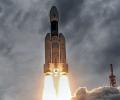
"The duration of manoeuvre was 1,738 seconds. With this, Chandrayaan-2 was successfully inserted into a Lunar orbit," Indian Space Research Organisation said.
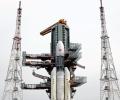
The Indian Space Research Organisation said that the countdown started at 6.51 am on Sunday.

ISRO Chairman S Somanath had recently said the most critical part of the landing will be the process of reducing the velocity of the lander from 30 km height to the final landing, and the ability to reorient the spacecraft from horizontal to vertical direction. "This is the trick we have to play here," he said.
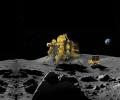
In a boost to the space programme, the government on Wednesday approved the Chandrayaan-4 mission to bring back moon rocks to earth, to send a spacecraft to orbit planet Venus and to expand the Gaganyaan project to build an Indian space station.
India's second moon mission Chandrayaan-2 is all set to be launched on board Indian Space Research Organisation's most powerful rocket GSLV-Mk0III-M1 from Satish Dhawan Space Centre in Shriharikota.

The picture of Moon was taken by Chandrayaan-2's LI4 Camera from an altitude of about 2,650 km from the lunar surface.

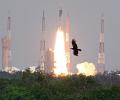
India on Monday successfully launched its second lunar mission Chandrayaan-2 onboard its powerful rocket GSLV-MkIII-M1 from the spaceport in Sriharikota to explore the unchartered south pole of the celestial body by landing a rover. Following the successful launch, leaders across the political spectrum congratulated the Indian Space Research Organisation for its hard work.

Chandrayaan-2 will explore a region of the moon where no mission has ever set foot. The spacecraft consists of an orbiter, a lander, and a rover together referred to as "composite body".

The Chandrayaan-2 spacecraft weighing around 3,290 kg would orbit around the moon and perform the objectives of remote sensing the moon.
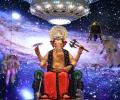
The Ganesha idol this time has been created against the backdrop of outer space.

The Indian space agency is all set to embark on its most complex mission.
Here are a few Ganesh pandals modelled after Chandrayaan-2.
The Chandrayaan-2 spacecraft is expected to reach the moon's orbit on August 20 and land on lunar surface on September 7.
The Vikram Moon Lander, named after the father of India's space mission Vikram Sarabhai on his birth centenary year, is scheduled to touch the lunar surface near its south pole on September 7 about 1.55 am.
The Indian Space Research Organisation has released the first images of India's heaviest rocket, referred to as "Bahubali" days before it ferries India's Chandrayaan-2 into space. India's most ambitious space mission yet, Chandrayaan-2, which aims to place a robotic rover on the moon, will be launched on July 15 at 2:51 am. Here's all you need to know about the rocket.

All spacecraft parameters are normal, the Bengaluru headquartered space agency said after the maneuver on the spacecraft.
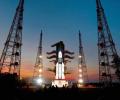
'If Chandrayaan 1 had a launch with GSLV, we need not have an orbiter for Chandrayaan 2.' 'We could have gone straight round the moon and landed on the moon.'
Chandrayaan-II hard-landed on lunar surface last year. The Indian Space Research Organisation had then resolved to launch the project again. It had said the project is likely to be launched by the end of the year.
India's second mission to the moon will be launched on Monday at 2.43 pm after its initial launch on July 15 was called off owing to a "technical glitch."
"Already, orbiter is in space and it should do an excellent job of mapping," Nair said.
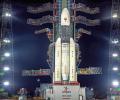
Late on Monday night, in a last-minute revision of schedule, ISRO announced that the launch of India's second lunar mission 'Chandrayaan-2' has been called off due to a technical snag.

Two de-orbit manoeuvres of Vikram Lander, to bring it further down, have been planned to prepare for its landing in the south polar region of the moon.

The landing on the moon near the South Pole, an uncharted territory so far, would be on September 6 or 7, Sivan told reporters, as the Indian space agency is all set to embark on its most complex mission.

"It is going to be the most complex mission ever undertaken by ISRO. It is going to take place between July 9 and 16, this year," Sivan said, addressing scientists from the Mission Control Centre.
Despite the odd time, hordes of enthusiasts had reached the island, some of them travelling long distances on two wheelers, to witness the historic moment.

All spacecraft parameters are normal, the Bengaluru headquartered space agency said after the maneuver.

The year ended with the launch of the PSLV's 50th mission.

India is the first country to attempt a soft-landing on south pole of Moon's surface.

The pictures were captured by L 14 camera on board Chandrayaan II. The pictures show the earth in different hues.

The Rs 978 crore mission, which has been rescheduled for Monday after scientists corrected the glitch in the rocket, will be launched at 2.43 p.m from the second launchpad at Satish Dhawan Space Centre, over 100 km from Chennai.
The nine-second de-orbiting or retro-orbiting manoeuvre was executed at 3.42 am using the onboard propulsion system.
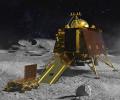
ISRO chairman K Sivan said the proposed soft-landing was going to be a 'terrifying' moment.
