
The Indian Space Research Organisation has declared that Chandrayaan-1, India's first moon mission is over.

India has completed the design of Chandrayaan-2, its next mission to the moon -- this time in collaboration with Russia -- that would have a lander and rover that can collect samples of the lunar soil and analyse them and send back the data.
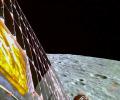
Chandrayaan-1, India's first mission to the Moon, was launched on October 22, 2008 from Sriharikota spaceport in Andhra Pradesh.

Aditya-L1 is meant to observe the corona, which are the outer layers of the Sun, extending to thousands of kilometres.

"Chandrayaan-2 is not the end of story. Our plans on Aditya L1 solar mission, human spaceflight programme are on track. A large number of advance satellite launches are planned in the coming months. SSLV will make its maiden flight sometimes in December or January. Testing of 200 ton semi-cryo engine is expected to begin shortly. Work is on to provide NAVIC signals on mobile phones, which will open the path to develop large number of applications for societal needs," he added.

There appears to be uncertainty over availability of a lander from Russia even as the 'desi' rocket to launch the space odyssey would take time to become operational.

After the successful landing of Chandrayaan-3 on the Moon on Wednesday, August 23, Bollywood has joined India to laud ISRO (Indian Space Research Organisation) and its team for the historic mission.

The players all converged near the dressing room and followed the closing stages of Chandrayaan-3's landing on Moon.

Scientists used a new calibration of data taken from NASA's Moon Mineralogy Mapper which flew aboard Chandrayaan-1 spacecraft in 2008.
Indian Space Research Organisation Chairman G Madhavan Nair met Dr Singh in Delhi on Friday afternoon and briefed him on the lunar mission launched on October 22.
"In situ chemical analysis and resource exploration is the main objective of Chandrayaan-II," said Mylaswamy Annadurai, Project Director of Chandrayaan-I. Annadurai visited Russia late last month to hold initial technical discussions on Chandrayaan-II, which is expected to be a much shorter mission than Chandrayaan-I, scheduled for launch on April 9, 2008.
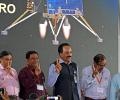
While the historic success of Chandrayaan-3 is celebrated by Indians across the world, two untrumpeted engineering colleges in Kerala are basking in the glory of the key role played by some of their alumni in the crucial Moon mission.

An entire nation waited, praying and hoping fervently, as the countdown to touch down on the moon wound to a slow close on Wednesday with many thousands gathering in schools, places of worship and elsewhere and scientists doing last minute checks to ensure Chandrayaan-3 makes a soft landing on the lunar south pole.

Chandrayaan-3 mission's lander 'Vikram' chose a relatively flat region on the lunar surface to touch down, images captured by its camera showed.
India's first unmanned moon spacecraft, Chandrayaan-1 has entered the lunar transfer trajectory and is heading to an apogee of 3,80,000 KM as ISRO scientists on Tuesday carried the fifth and final orbit-raising manoeuvre.

In his latest tweet, the 58-year-old actor said the successful landing of Chandrayaan-3 on the Moon's uncharted south pole was a moment of celebration for mankind.
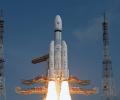
A mission to study the Sun, and launching a climate observation satellite, a test vehicle as part of Gaganyaan human space flight programme and an Indo-US synthetic aperture radar.

The ISRO on Monday released images of the Lunar far side area captured by the Lander Hazard Detection and Avoidance Camera (LHDAC).

The ISRO had earlier said Chandrayaan-2 will be launched in a window from January-February 16, 2019.Sources said it is expected by the middle of next month but no date has been finalised.
'In a part of the world where the government tells people what not to eat and what slogans to shout and not shout, it is beneficial to develop a mentality that is science minded and therefore open-minded.' 'That is possibly why the space programme has always had support from all sides of the political divide,' says Aakar Patel.

ISRO hopes to put a crew on the moon, but it has to learn how to keep people alive and healthy in space first.
'When you look at it from the point of view of science, Chandrayaan 2 is a big success.'

Foreign Office spokesperson Mumtaz Zahra Baloch during her briefing on Friday was asked to comment on the successful soft-landing of the Chandrayaan-3 mission on the Moon.

A visibly emotional Modi addressed scientists at the Indian Space Research organisation's command centre in Bengaluru, who were involved in the Chandrayaan-3 mission and lauded them for their efforts.

Readers have responded resoundingly to our invitation to congratulate the ISRO team for Chandrayaan-3's successful Moon landing.
India's maiden moon mission Chandrayaan-1 has captured a halo around the site where US spacecraft Apollo-15 had landed on the lunar surface nearly four decades ago.

Though the Indian Space Research Organization had to prematurely terminate the country's first moon exploration mission after it lost radio contact with Chandrayaan-1 over the weekend, the probe is already said to have yielded a treasure trove of useful data. This suggestion comes from Carle Pieters, a planetary geologist at Brown University in Rhode Island, the principal investigator of the Moon Mineralogy Mapper (M3), a NASA instrument on Chandrayaan-1.
Indian Space Research Organisation (ISRO) Chairman G Madhavan Nair today said the country should be proud of Chandrayaan-1 for being a successful low-cost planetary mission.
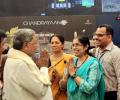
Even as the scientists and staff at Mission Operations Complex broke into applause, the core team members thanked all those who had worked on the mission. Quietly and without jingoistic boasting of their stupendous achievement. And that is the most remarkable aspect of ISRO -- they let their work do the talking, notes Minnie Vaid, author of Those Magnificent Women And Their Flying Machines, ISRO's Mission to Mars.

During the day-long debate, the lines between science and religion often got blurred with many invoking religious texts and the contribution of 'rishi munis' to highlight India's tryst with the extra-terrestrial world.
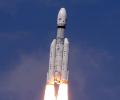
'ISRO takes a very cautious approach.' 'After reaching the moon, the orbit has to be brought down from a single elliptical orbit to a circular orbit while simultaneously ensuring the stability of Chandrayaan 3 and the health parameters of the lander and rover.'
Ex-ISRO chairman G Madhavan Nair said the scientists at space agency have achieved this historic success by getting a salary one-fifth of the scientists in the developed world.

India on Wednesday joined an elite group of three nations to have sent a spacecraft on the Moon, as Chandrayaan-3 landed a rover on the lunar surface to explore the uncharted territories near the south pole.

The ISRO chief further said that the ISRO is ready to fulfill the vision put forth by Prime Minister Narendra Modi.

Scientists at ISRO used the orbiter high resolution camera onboard the Chandrayaan-2 orbiter to study the lunar surface hours before and after the soft-landing of Vikram lander on the moon on August 23.
The payloads to be carried by India's second unmanned moon mission Chandrayaan-2 targeted for launch in 2013 were announced on Monday and there will be seven onboard instruments for a range of lunar experiments.
India's first unmanned spacecraft Chandrayaan-1 entered the lunar orbit on Saturday after Indian Space Research Organisation scientists successfully carried out a highly complex and tricky manoeuvre crossing another historic milestone in the country's space programme.
K Radhakrishnan, chairman of the Indian Space Research Organisation, has said that India is preparing to launch its second moon mission Chandrayaan-II by 2013. "The Chandrayaan-II we are planning to have in the year 2013. By that time, we should have our GSLV (Geosynchronous Satellite Launch Vehicle) flying with the Indigenous Cryogenic Engine Stage. That is the target with which we are working," said Radhakrishnan.
The American agency said the data from the two instruments Mineralogy Mapper and Miniature Synthetic Aperture Radar (Mini-SAR) will contribute to its understanding of the lunar environment and are part of its implementation of its space exploration policy which calls for robotic and human missions to the moon.

Luna-25 may land on the lunar surface earlier than Chandrayaan-3.
