
'When you look at the border -- from Ladakh to Arunachal -- which is called the Sino-Indian border, but in effect it is actually the Indo-Tibet border.' 'Since the borders are still not secure, it has resulted in transgressions in Galwan, Dokalam etc.'
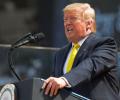
'It's a very tough situation. We're talking to India. We're talking to China. They've got a big problem there'

'Does it mean that we are witnessing the end of an era?' 'Probably not, but the post-Trump trade war has certainly brought a lot of instability in China,' notes Claude Arpi.

The US president, who has expressed disappointment over China's handling of the COVID-19 pandemic, claimed that it was the "incompetence" of Beijing that led to the mass killing across the globe.
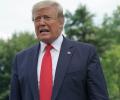
"We pay for a majority or the biggest portion of their money. They actually criticised and disagreed with my travel ban at the time I did it. They were wrong. They've been wrong about a lot of things. They had a lot of information early and they didn't want to -- they're very -- they seem to be very China centric," the US president charged during his news conference.

In his opening remarks at a ministerial meeting in Tokyo of the Quadrilateral coalition, also known as 'Quad', External Affairs Minister S Jaishankar said India remained committed to a rules-based world order, respect for territorial integrity and sovereignty, and peaceful resolution of disputes.

'COVID-19 will not stop the expansion of China's 'infrastructure power'.'
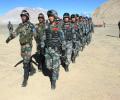
Esper also highlighted the 'increased' military cooperation with India and called it as 'one of the most important defence relationships of the 21th century'.

It will be interesting to see whether India-China border tensions figure during the deliberations of PLA deputies to the NPC and CPPCC, notes Jayadeva Ranade, the distinguished China expert and retired RA&W officer.

'If one puts the context of what Xi Jinping said at the UN about not wanting a 'hot or cold war with any country', one realises that his speech was quite bizarre.' 'The world does not expect such statements from China, a nation aspiring to be a superpower.
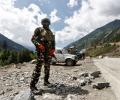
'How Xi Jinping will withdraw the aggression and justify it to his Communist party in case of a negotiated settlement might be his biggest headache.' 'Unless he is ready to gamble on an armed conflict, whose outcome given India's battle-readiness and determination is always uncertain,' observes Virendra Kapoor.

Such criticism by China of a foreign government official, particularly of a major power like the US, is very unusual. It is clear that China will come under increasing pressure certainly till the US presidential elections are held, observes former senior RA&W officer and China expert Jayadeva Ranade.

'The Ladakh clashes are mere warning signals of the storm to come on May 22 when the Chinese parliament meets,' observes Colonel Anil A Athale (retd).

'China's latest defence White Paper has been issued against the backdrop of the upgraded Sino-Pakistan strategic relationship which has impinged on India's sovereignty and territorial integrity, and Beijing's continuing intransigence on tackling the issue of the disputed border or intrusion by PLA troops,' says Jayadeva Ranade.
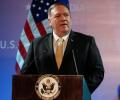
The United States, he said, 'desires a new age of ambition' in its relationship with India. Asserting that the US has never been more supportive of India's security, he said New Delhi too, is an important partner and a key pillar of President Trump's foreign policy.

Important for India was Xi's meeting with representatives of PLA officers and soldiers stationed in Tibet. The video of the encounter was interesting to watch, especially the large number of lieutenant generals and major generals, observes Claude Arpi.

'They know that India is no pushover.' 'We have to be extremely vigilant, remain ready and keep strengthening our positions.' 'We have to be militarily strong, whatever be the cost.'

'This allows opportunities for (Chinese) entry into the domestic politics of Nepal, something that is also encouraged by Nepali politicians's willingness to play the China card (vis-a-vis India).'

'Chinese troops are not geared to fight Indian troops who are battle hardened and acclimatised and are far more hardy.'

No country has achieved a faster, deeper modern transformation than China, says former ambassador Kishan S Rana.

'Islamic State has declared that the liberation of Islamic Xinjiang from China is an objective. Beijing may well find that Pakistan is unable to assist in any meaningful way,' says China expert Jayadeva Ranade.
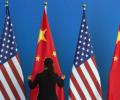
Chinese observers believe the Sino-US relationship will be impacted by issues in North Korea, Japan, India, Ukraine and Iran and that conflicts with these 'third parties' will without exception ultimately become conflicts between China and the US, points out former RA&W officer Jayadeva Ranade.

News of all that's transpired on and off the football field

There are signs of China's external behaviour becoming more aggressive in the coming years. If that happens, strategic implications for neighbours having territorial disputes with China can become deeper and imperatives can rise for the former to counteract, says D S Rajan

'Is Xi's China stable?'
'No one can say whether the regime will fall all at once or if its leaders are devising a new solid and competitive -- anything but democratic -- model.' A fascinating excerpt from Francois Bougon's Inside The Mind of Xi Jinping.

'After a strategic pause though, Beijing will revive its policy of slowly creeping towards acquiring sovereignty over the South China Sea.'

Domestically, China's 'strike hard' policy is alienating Uighurs further in Xinjiang. China's quid pro quo with the Taliban is hardly any lasting solution to the Afghanistan crises or to regional security, says Srikanth Kondapalli.

With many schools abdicating their legal and ethical responsibilities towards students, Avantika Bhuyan lists down things to keep in mind for your child's security

'Tibet remains a prickly issue between the giant Asian nations. China still claims more than 80,000 sq kilometres of Indian territory in the Northeast. Why? Just because Beijing refuses to acknowledge the McMahon line which separates India and Tibet, and this, simply because the 1914 Agreement delineating the border was signed by the then government of independent Tibet with India's then foreign secretary (Sir Henry McMahon),' says Claude Arpi.

'We should not flatter ourselves that China is fixated on encircling India. She has greater goals, becoming the pre-eminent power in the world, and India as a major power is dealt with as part of that strategy.'
