
Indian stock markets witnessed a significant rebound, with the Sensex rallying 1,109 points and the Nifty closing above 22,720, driven by strong performances in IT and financial sectors, a recovering rupee, and Finance Minister Nirmala Sitharaman's comments on long-term capital gains (LTCG) tax.

'There will be some inconvenience to people. But we have given one-month notice to the government one month ago.'

A World Bank report, 'The Promise of Artificial Intelligence', states that AI presents a historic opportunity for low- and middle-income countries to overcome development challenges, despite many being unprepared. It advises these nations to adopt and adapt existing AI tools rather than focusing on building frontier models immediately. The report also notes a significant gap in AI adoption and job automation between high-income and developing countries.
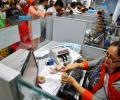
The finance ministry has announced that all banks, including Regional Rural Banks, will remain open on Sunday, September 27, 2026, to ensure public convenience amidst a proposed three-day strike by the United Forum of Bank Unions (UFBU) starting September 28, 2026. The strike, if it materialises, seeks a 5-day banking week and pension reforms.

'Ultimately, banks are a channel for people to get some long-term return, and this means banks need to adjust their asset-liability mismatch.' 'Customers also need long-term deposits, say those of three-five years. How would they get them if returns on those deposits do not climb?' 'Otherwise, on fixed deposits, a senior citizen doesn't get anything.'

Banking services across India, particularly at public sector banks, are set to be disrupted for three days starting Monday due to a nationwide strike by bank unions. The strike, called by the United Forum of Bank Unions (UFBU), is primarily to press for a five-day working week and other demands, despite the finance ministry's appeal for dialogue.

Bank unions have deferred a three-day nationwide strike after receiving assurances from the Indian Banks' Association (IBA) regarding their demands, including the implementation of a five-day work week and modifications to the PLI scheme for senior officers.

A deposit is not necessarily taxable simply because it appears in a bank account. What matters is whether its source can be satisfactorily explained.

Sikkim Vigilance Police has arrested a former general manager of the State Bank of Sikkim (SBS) in connection with a disproportionate assets case, conducting searches at multiple residential premises in Gangtok and Siliguri. The former GM is accused of embezzling crores of rupees and acquiring properties through illegal means during his tenure between 2022 and 2024. The Enforcement Directorate had also previously attached properties linked to him.

A 76-year-old man, Abdul Samad, has been sentenced to 13 years in prison and fined Rs 16,000 for his involvement in a 1988 bank robbery at the Nallurnad Service Cooperative Bank in Wayanad, Kerala. This sentencing concludes a decades-long legal process for the six-member gang.

A district consumer commission in Thiruvananthapuram has directed a cooperative bank to pay over Rs 14 lakh to a widow, Sheeba R, after it unlawfully denied her access to her deposited funds. The bank had cited an ongoing enquiry against its officials as a reason, but the commission ruled this was not a justifiable cause for withholding the money, especially given the woman's circumstances and need for funds for her mother's treatment.

A frozen phone screen, a fake customer-care call, a screen-sharing request or even a duplicate SIM can give cybercriminals a route into your bank account.

'Once you're wrestling with making a merger of that scale value-accretive, you're also under pressure to keep growing the balance sheet and chasing liabilities, and other things start to slip as a consequence.'
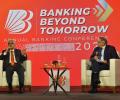
Bank of Baroda has launched 'bob World 2.0', an AI-powered mobile banking app featuring voice-command capabilities for payments and navigation. The updated app also includes a personal finance management module and a persona-based customer experience, aiming to offer intuitive, secure, and personalised banking services.

Mumbai Cyber Police have apprehended six individuals, including an IIT graduate and a bank manager, for allegedly defrauding a senior citizen of Rs 1.12 crore through a "digital arrest" scam. The victim was coerced into transferring funds after being threatened with family arrest by impersonators.

HDFC Bank has submitted two names to the Reserve Bank of India for the managing director and chief executive position, following incumbent Sashidhar Jagdishan's decision not to seek reappointment. The bank also announced board changes, increasing whole-time directors to four and appointing Jimmy Tata as an executive director. This move comes as Jagdishan's term ends in October, creating a tight timeline for succession.

A Delhi consumer commission has directed Punjab and Sind Bank to refund Rs 10,000 to a customer whose ATM transaction failed to dispense cash but debited his account. The bank was also ordered to pay significant compensation for delayed reversal, mental agony, and litigation expenses, reinforcing consumer rights in banking disputes.
If the strike materialises, banking services, especially in public sector banks, would be impacted for four days in many parts of the country. September 11 is a Friday, and the subsequent two days are bank holidays.

Non-banking financial companies (NBFCs) experienced a significant 68.5 per cent year-on-year growth in gold-backed credit in July 2026, while banks saw their gold loan growth moderate to 88.1 per cent from 136.4 per cent a year prior, according to RBI data.

Jared Kushner, former US President Donald Trump's son-in-law, has vehemently denied "outrageous and categorically false" allegations in a new book, "Princes and Thieves," which claims he accessed secret bank accounts linked to UAE, Saudi, and Israeli funds. Kushner stated on X that the author provided no evidence and that such claims never surfaced during his extensive past investigations.
J&K Bank MD and CEO Amitava Chatterjee defended the surcharge on UPI transactions above Rs 2,000, stating it is necessary for the system's long-term sustainability. He also discussed the shift of household savings to mutual funds, the bank's profit growth, and India's consumption-based economy.

'There is mis-alignment in strategic thinking of the board and management.' 'As the business environment and customer behaviour evolve rapidly, boards are increasingly looking for leaders who can bring new ideas and challenge legacy approaches.'

'The changes in its leadership team will help address the scepticism that has engulfed the bank over the recent period.'
A Delhi consumer commission has directed Punjab and Sindh Bank to refund Rs 10,000 to a customer whose ATM transaction failed to dispense cash but debited the amount. The bank was also ordered to pay compensation for delayed reversal, mental agony, and litigation expenses, highlighting a deficiency in service.

Police in Thane district have arrested 10 individuals for allegedly operating a work-from-home scam. The fraudsters reportedly lured job seekers, collected their bank details and SIM cards, and then diverted their money into illegal online betting platforms. The racket was exposed following a complaint, leading to a raid in Mumbai where several electronic devices were seized and the accused apprehended.

India's largest bank, SBI, is investigating the suspected exposure of 3,897 customer records containing personally identifiable information on the dark web. The bank received alerts on October 16 and has initiated cyber incident response protocols, engaging an independent cybersecurity agency. While a detailed assessment is underway, SBI states the incident has not materially impacted its core business operations. This comes as CERT-In also warned last week about autonomous AI agents accessing confidential data and reported a compromise of eMudhra's private keys.
Julian Suri, an Indian-origin golfer, successfully made the cut at the Simmons Bank Open, finishing at 4-under par. Fellow Indian-origin golfers Rayhan Thomas and Manthan Chirravuri, however, missed the cut but are set to participate in the upcoming Nationwide Children's Hospital Championship.

State Bank of India Chairman C S Setty stated that banks will take three to four months to deploy the significant funds mobilised through foreign currency non-resident (bank), or FCNR(B), deposits, which is unlikely to cause "abnormal lending". He also highlighted the need for agentic artificial intelligence (AI) costs to fall sharply for its widespread deployment in India, envisioning its role in transforming banking from fraud detection to personalised financial assistance.

Sashidhar Jagdishan, the managing director and CEO of HDFC Bank, has announced his decision not to seek reappointment and will retire at the end of his current term on October 26, concluding a six-year tenure marked by significant regulatory and governance challenges, including RBI restrictions, a major merger, and scrutiny over alleged illegal payments.

Indian benchmark equity indices, Sensex and Nifty, significantly recovered from sharp early losses, driven by buying in State Bank of India and Reliance Industries, alongside fresh foreign fund inflows, despite declines in Axis Bank and HDFC Bank.

Jaipur police have busted a fake technical support call centre, arresting 10 individuals, including two women, for allegedly defrauding US citizens of crores of rupees. The gang operated by offering fake iPhone technical support and then stealing banking information.

Investors are set to monitor quarterly earnings, crude oil prices, the Jio Platforms initial public offering, and foreign investor activity in the upcoming holiday-shortened week, according to market analysts.

Indian equity benchmarks Sensex and Nifty extended their losses for a third consecutive session, with the Sensex declining 460.30 points and the Nifty dropping 123.70 points, primarily due to surging crude oil prices driven by escalating tensions in West Asia and weak global cues.
'The sales pressure on the ground, a board and CEO not fully aligned, and a senior team that isn't pulling together -- that's when these things surface.'

The UK has announced a comprehensive sanctions regime against Israeli settlements in the West Bank, banning the import of goods and targeting entities involved in settlement expansion. Foreign Secretary Ed Miliband condemned the "ethnic cleansing of Palestinians" and highlighted international support for the UK's stance, while Israel reacted strongly with counter-measures.

Can your money be protected against online frauds like hacking, digital arrests, etc?

Gurugram police have arrested three men from Gwalior, Madhya Pradesh, for allegedly providing bank accounts to cybercriminals involved in a fake e-challan SMS fraud. The arrests followed a complaint where a man lost Rs 1.35 lakh after clicking on a fraudulent link. The accused received Rs 7,500 for facilitating the transfer of Rs 70,000 from the victim's account.
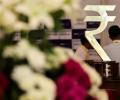
The Indian rupee has achieved its longest winning streak in nearly eight years, appreciating for eight consecutive sessions to close at a six-week high. This rally is attributed to strategic central bank interventions, healthy foreign capital inflows linked to the Jio Platforms IPO, and profit-taking in the US dollar.
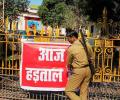
Banking services, particularly at public sector banks across India, were impacted by a nationwide strike called by the United Forum of Bank Unions (UFBU) to demand the immediate implementation of a five-day workweek and resolution of pending wage-related issues.

'Resolution plan with this much haircut is totally unviable.'
