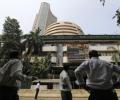
Analysts predict that the US midterm election results, which saw Democrats gain control of Congress, will primarily influence Indian markets through changes in global financial conditions, trade policy expectations, and geopolitical developments, with a keen focus on the US administration's actions in West Asia and their potential impact on crude oil prices.

The Indian rupee and government bonds are expected to face volatility in Samvat 2083, influenced by geopolitical developments in West Asia, crude oil prices, domestic inflation, and foreign capital flows, leading to cautious investor sentiment.

IndiGo is undertaking a comprehensive review of its long-standing policy against fuel hedging, particularly in light of rising jet fuel prices and its ambitious long-haul expansion plans. CEO Willie Walsh stated that while domestic competitors don't hedge, international expansion necessitates a re-evaluation to manage risk and provide stability against volatile fuel costs.

US Secretary of State Marco Rubio is on a three-day visit to India to discuss bilateral ties in energy, trade, investment, defence, and critical technologies, as well as the West Asia crisis. His visit aims to strengthen the India-US Comprehensive Global Strategic Partnership amidst existing friction, with a focus on finalising a proposed bilateral trade deal.

Pragya Misra, OpenAI's first India hire and former head of strategy and global affairs, has been promoted to Head of Business Development for India and South Asia. She announced her new leadership role on Tuesday, highlighting India's status as ChatGPT's largest country. Misra's new focus will be on building partnerships to drive AI transformation for businesses and expand technology access across the region.

'In fact, when monetary policy has been deployed, it does not distinguish between types of shocks. It goes straight for the kill.'

One should not expect the blue wave to reverse some of Mr Trump's hostile measures against India on immigration and on trade. The Democrats are unlikely to ease the limits placed on the entry of Indian professionals into the US. They are equally unlikely to ease up on Mr Trump's protectionist policies cautions former foreign secretary Shyam Saran.

Congressional scrutiny could increase, but immediate changes to immigration and visa policies are unlikely.

The trophy is supposed to be the full stop to a tournament, not another comma in an India-Pakistan controversy, points out K R Nayar.

'And it's a great place to have employees who help IBM on a global footprint.'

Analysts predict that developments in the West Asia conflict, crude oil prices, and upcoming US inflation data will be the primary factors influencing the Indian stock market next week, alongside foreign investor activity and global market trends.

UBS analysts indicate that Indian stocks' valuation premium over emerging markets remains high, despite concerns over crude oil prices and tighter monetary policy impacting India's growth outlook. They suggest a potential slowdown in AI capital expenditure and moderation in oil prices could alleviate these pressures.

The BCCI has clarified that the Indian women's cricket team's decision not to accept the Asia Cup trophy from Asian Cricket Council's Pakistani chief Mohsin Naqvi was a "conscious, institutional" call, made due to prevailing circumstances and national sentiments.

International Hockey Federation (FIH) president Tayyab Ikram stated that the Pakistan Hockey Federation (PHF) was informed well in advance about India hosting the Asian Champions Trophy. He expressed concern that global hockey suffers when India and Pakistan do not play each other regularly, despite Pakistan's decision to pull out of the recent tournament due to government policy. Ikram emphasized the importance of their rivalry for the sport's growth and viewership.

Former US Secretary of State Antony Blinken stated that the US must respect India's right to self-defence and maintain a zero-tolerance policy towards terrorism, highlighting the "fundamentally different" nature of Washington's relationships with New Delhi and Islamabad. He described US-India ties as global and strategic, while US-Pakistan relations are regional. Blinken also touched upon cooperation in emerging technologies, India's ties with Russia, rapid global changes, US domestic politics, and the West Asia conflict, advocating for a two-state solution.

Andhra Pradesh is developing a 25,000 crore space city near Sriharikota, aiming to create a robust ecosystem for private space technology startups and MSMEs, with major deals already signed for rocket engine manufacturing, testing, and R&D.

While remaining cautious of the unpredictability of a bruised Trump administration, New Delhi, and other world capitals, could go slow on the investment pledges made to stave off tariffs.

RBI Governor Sanjay Malhotra stated that the central bank is closely monitoring whether the supply shock from the West Asia conflict will lead to a generalised price rise, potentially necessitating monetary policy action.

Indian benchmark indices, Sensex and Nifty, closed almost flat in choppy trade as investors remained cautious due to ongoing uncertainty in West Asia, relentless foreign fund outflows, and anticipation of the RBI's monetary policy decision.

Indian stock markets are set to be influenced this week by a confluence of factors including quarterly corporate earnings, the US Federal Reserve's interest rate decision, fluctuations in crude oil prices, and ongoing geopolitical developments in West Asia.

Japan's military will use Indian firing ranges for live-fire training, with drills scheduled to begin next year. The exercises will include surface-to-ship missiles for the first time, marking a significant expansion of bilateral defence cooperation.

'Trump has weakened, not necessarily restrained.'

India's Indo-Pacific approach has traditionally emphasised strategic autonomy, ASEAN centrality, freedom of navigation, respect for international law and an inclusive regional order. Its growing defence and maritime partnerships with Australia, Japan, Indonesia, Vietnam and other Southeast Asian countries provide additional depth to this approach, point out Dr Kumar and Dr Jasmeet Kaur.

Gold and silver prices are anticipated to maintain a positive trajectory in the coming week, with market volatility expected to remain high due to ongoing developments in West Asia and upcoming global economic data, particularly the Federal Reserve's FOMC meeting minutes.

Top Quad leaders announced new initiatives including a maritime surveillance system, military exercise, cable connectivity, and cybersecurity partnership to strengthen cooperation in the Indo-Pacific. They also opposed destabilising actions and economic coercion, reaffirming their commitment to a free and open region.

Chief Economic Advisor V Anantha Nageswaran stated that 2026 marks an inflection point for India, akin to 1991, necessitating the country to become globally indispensable in carefully chosen sectors to build strategic leverage for accessing geopolitically contested resources amidst a series of external shocks.

US President Donald Trump received a grand welcome from Chinese President Xi Jinping in Shenzhen for the APEC Economic Leaders' Meeting, culminating in an unprecedented trilateral meeting with Russian President Vladimir Putin. The leaders discussed critical global issues including the Ukraine conflict, Iran, artificial intelligence, and nuclear arms reduction, marking significant political gains for each leader on the international stage.

India has secured a spot among the top 10 leading emerging-market performers in artificial intelligence (AI) readiness, with private investment in AI more than tripling to USD 4.1 billion in 2025, according to a new World Bank report.

The Reserve Bank of India's Monetary Policy Committee (MPC) has commenced its three-day meeting, with a majority of economists and bankers anticipating a 25 basis point rate hike to counter escalating inflation risks, particularly from West Asia conflicts.

Iranian supreme leader Ayatollah Mojtaba Hosseini Khamenei has declared that the results of the US midterm elections and shifts between American political parties will not alter Iran's defensive strategy or soften Washington's long-standing hostility toward the Iranian nation.

Analysts predict that the Reserve Bank of India's interest rate decision, the evolving situation in West Asia involving the US-Iran conflict, and crude oil prices will be the primary factors influencing investor sentiment in the Indian stock market this week.

Vaishnavi Adkar, India's women's tennis number one, is leveraging her distinctive heavy topspin forehand as a key weapon in her game. The 21-year-old, currently ranked 344, aims to break into the world's top 200, a goal she believes is achievable with her unique playing style and structured training. Her recent successes, including an ITF W100 final and a W35 title, highlight her rapid ascent in Indian tennis.

Iranian President Masoud Pezeshkian on Monday called for "regional unity" as he met top defence officials from Saudi Arabia, Turkiye and Pakistan in Tehran to discuss the regional situation, amid escalating tensions in the region.

The Reserve Bank of India's Monetary Policy Committee (MPC) has indicated that rate cuts are improbable in the near term, with headline inflation projected to reach 6 per cent in the third quarter. Minutes from the October meeting reveal growing concerns among members about inflation spreading beyond food and fuel, leading to a shift in policy stance towards calibrated tightening.

India's wholesale price-based inflation surged to 11.39 per cent in September, up from 9.92 per cent in August, primarily driven by increasing prices of food, manufactured items, and fuel and power.

Several Indian-Americans have achieved significant victories in the US midterm elections, with five securing seats in the House of Representatives and Maryland Lieutenant Governor Aruna Miller winning re-election. The article profiles these successful candidates, highlighting their backgrounds and contributions to American politics.

Engagement with neighbours has gathered pace, particularly as the conflict in West Asia has exposed their vulnerability to energy supply disruptions.

The Indian stock market is poised for a volatile week, influenced by the Reserve Bank of India's monetary policy decision, crucial global macroeconomic data, and the escalating geopolitical tensions in West Asia, according to market analysts.

Vance was sceptical about the war against Iran and was the only figure in Trump's circle who refused to endorse Benjamin Netanyahu's bid for re-election as prime minister, points out Ambassador M K Bhadrakumar.

Analysts predict that crude oil prices, geopolitical tensions in West Asia, and upcoming inflation data will be the primary drivers of the Indian stock market this week, alongside foreign investor activity and domestic quarterly earnings.
