
We allowed her to rot daily. We simply did not care. Soon she will be forgotten and the stories of the nurses who cared for her will become Mumbai's urban legend, says Neeta Kolhatkar.

A look at the top tweets from your favourite Bollywood celebrities.
'Aruna Shanbaug's death has again opened up the euthanasia conversation in the public domain. For a health care discourse often dominated by inane news, this is not such a bad thing.'

The Supreme Court on Monday rejected the petition seeking euthanasia for Aruna Shanbaug who has been lying in a vegetative state for over three-and-a-half decades at the KEM hospital in Mumbai.

'There was special bonding between all the nurses and Aruna. It has been a bond lasting 40 years among us. We all have fond memories of her, she will be missed, for sure,' the nurses of KEM Hospital, who looked after Aruna Shanbaug selflessly for more than four decades, tell Syed Firdaus Ashraf/Rediff.com.

Aruna Shanbaug, a former nurse who lived in a vegetative state for the past 42 years after being brutally sexually assaulted at the KEM Hospital in Mumbai and became the face of the debate on euthanasia in India, died on Monday.

Nurses who attended to Aruna Shanbaug, a former nurse at the KEM hospital desire that the room, Aruna's 'home' these four decades, be turned into a memorial.

Harish Rana, the first person in India to be granted passive euthanasia, has died at AIIMS-Delhi after being in a coma for over 13 years. His case led to a landmark Supreme Court judgment allowing passive euthanasia and sparked discussions about the right to die with dignity in India.
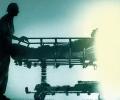
'Why can't we work towards a dignified end of the person when a cure is not possible and the end is inevitable?'

Even as police remains clueless about Aruna Shanbaug's assailant, a local newspaper on Friday claimed to have traced him to a village in Uttar Pradesh.
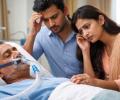
'Families go through turmoil at that time. There is a feeling of guilt and uncertainty, and they do not know what they should be doing.' 'Now that the new judgment has clarified what the procedure is, doctors will be confident enough to talk to the families and explain what is to be done.'
The Supreme Court verdict dismissing the plea for mercy killing of 60-year-old Aruna Shanbaug was on Monday welcomed by the medical fraternity, including nurses looking after the comatose sexual assault victim, which cautioned that any move to legalise active euthanasia was fraught with dangers. "India is not mature enough to handle euthanasia," said senior Bangaluru-based cardiologist Devi Prasad Shetty, while expressing his joy over the verdict on Shanbaug.

Best tribute to Aruna Shanbaug would be to take some legislative action on ending the mental trauma of those who can't live outside of a hospital again.
Those talking about euthanasia using Aruna Shanbaug as leverage had better cry out for an actively functioning, effective and affordable healthcare regime. That would be a better service rendered to those who need it, says Mahesh Vijapurkar.
On a day the Supreme Court rejected Mumbai-based nurse Aruna Shanbaug's euthanasia plea, Rediff.com's M I Khan speaks to the mother of two teenaged boys suffering from a rare muscular disorder, whose appeal before the government that they be allowed to die, as they have been immobile for over a decade, remains unheard.
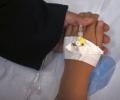
"Human beings have the right to die with dignity." That's what the Supreme Court said on Friday while saying that passive euthanasia is permissible within guidelines. However, what is passive euthanasia? What is a living will? Here's all you need to know on the issue.

Kerala Catholic Bishop Conference president Archbishop Soosa Paikam said the verdict was "painful" and would have disastrous consequences.
A five-judge constitution bench headed by Chief Justice Dipak Misra reserved its verdict on a plea seeking recognition of 'living will' made by a terminally-ill patient for passive euthanasia.

'Passive euthanasia is actually more important in the sense that the need to administer it arises every day in some hospital or the other. And it can be administered without a living will,' Vipul Mudgal, director of the NGO Common Cause -- which had filed a plea to declare 'right to die with dignity' as a Fundamental Right flowing from Article 21 or the Right to Life, -- tells Rediff.com's Swarupa Dutt.
Senior counsel Mihir Desai, who represented Swamy in the high court, said that although the activist was dead and there existed no question of him being granted bail any more, the high court need not consider the late priest's appeals seeking bail abated.

The Supreme Court on Friday said it will await the government's stand in its endeavour to examine a plea to legalise passive euthanasia by means of withdrawal of life support system to terminally-ill patients.
Faced with the vexed question of permitting euthanasia or mercy killing of a rape victim virtually brain dead for the past 36 years, the Supreme Court on Monday sought the Attorney General's response on the tricky issue as it is not legalised in the country.

It was in 1989, 39 years after the setting up of the Supreme Court in 1950, that Justice M Fathima Beevi was appointed. Meet the brilliant legal minds who have shattered the glass ceiling since then.

Amazing stories about some of our best loved movies from Bhavani Iyer who wrote them.
