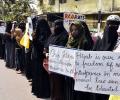
The Allahabad high court has dismissed a petition filed by a minor student of a school in Prayagraj. The petitioner had sought permission to wear a hijab additionally along with the prescribed school dress code while attending classes.

The All India Muslim Personal Law Board (AIMPLB) announced a nationwide movement against the 'deteriorating condition' and social and political marginalisation of Muslims in India, citing concerns over mob violence, demolition drives, and attempts to impose Vande Mataram.

The All India Muslim Personal Law Board (AIMPLB) has urged Muslims to wear a black armband on their right hand during Juma prayers on the last Friday of Ramzan as a mark of protest against the Waqf (Amendment) Bill. The AIMPLB has been vocal in its opposition to the Bill, calling it "controversial, discriminatory and damaging." The organization has planned nationwide protests against the Bill, with large sit-ins scheduled in several cities.

Amid a debate triggered by Uttar Pradesh Chief Minister Yogi Adityanath's recent remarks on offering namaz in public places, several Muslim clerics have said that Eid-ul-Azha prayers would be offered inside mosques and Eidgahs as in previous years, and, if required, arrangements could be made for multiple prayer shifts.

The AIMPLB said this in an affidavit filed in the apex court which is seized of a plea relating to the entry of Muslim women into mosque for offering namaz.

'Every issue that Muslims are facing today affects Muslim women. But how come women's issues don't affect the community?' 'How does the community benefit by the practice of halala or polygamy?'

The All India Muslim Personal Law Board (AIMPLB) has announced its intention to challenge the Waqf (Amendment) Bill in court, labeling it a "black law" that threatens the community's rights. The AIMPLB, a major organization representing Muslims in India, asserts that the Bill, if passed, would lead to the seizure of Muslim properties and undermine the autonomy of Waqf Boards. The organization plans to launch nationwide protests against the Bill, echoing the farmers' agitation, and has urged all citizens to resist the legislation. The Bill has been met with criticism from various quarters, including opposition parties, who claim that the Centre is rushing it through Parliament without adequately addressing concerns raised by the Joint Parliamentary Committee (JPC).

The All India Muslim Personal Law Board (AIMPLB) has called for a nationwide 'lights out' protest from 9 PM to 9:15 PM on April 30 to oppose the amendments made to the Waqf Act. The AIMPLB spokesperson, SQR Ilyas, stated that the protest is a symbolic expression of solidarity against the 'discriminatory and constitutionally incompatible' amendments. The Board has been running a campaign against the amendments since April 10, organizing meetings and protests across the country.

AIMPLB general secretary Maulana Khalid Saifullah Rahmani urged Muslims, especially women, not to fall prey to 'propaganda' being spread against the Muslim Personal Law Board.

'The courts should not dishearten the people that might end the hope of last justice'

Terming the idea as impractical, AIMPLB general secretary Maulana Syed Nizamuddin made it clear that the Board had no objection as long as such a registration was allowed to be optional.

Jamiat chief Maulana Arshad Madani said they took the decision following extensive deliberations involving lawyers and experts.

Stressing that the decision of the Sunni Central Waqf Board, one of the main litigants, will have no effect on the AIMPLB decision, Jilani said the board has already taken a final decision in this regard in its meeting on November 17.

The CBI court had on September 30, 2020 acquitted the accused including former deputy prime minister L K Advani in the case after which two Ayodhya residents -- Haji Mahboob and Syed Akhlaq -- moved a revision petition before the Allahabad high court.

A three-judge Supreme Court bench will hear petitions challenging the constitutional validity of the Waqf (Amendment) Act, 2025, on April 16. The petitions, including those by politicians and the All India Muslim Personal Law Board (AIMPLB) and Jamiat Ulama-i-Hind, were filed in the top court challenging the validity of the newly-enacted law. The Centre has filed a caveat in the apex court, seeking a hearing before any order is passed.
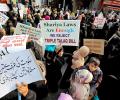
The application has been filed to oppose a batch of petitions on which the apex court had in 2018 issued notices to the Centre and other stakeholders while referring the matter to a 5-judge Constitution bench.

The Supreme Court on Friday refused to entertain a fresh plea challenging constitutional validity of the Waqf (Amendment) Act, 2025.

Dhavan took to Facebook to disclose that he has been removed from further participation in the Ayodhya case on the 'nonsensical' ground that he is unwell.

Shivling claim is an attempt to create communal disharmony, The All-India Muslim Personal Law Board said.

The Supreme Court of India will likely hear a batch of petitions challenging the constitutional validity of the Waqf (Amendment) Act, 2025 on April 15. The Act, which came into force on April 8, has been met with widespread criticism from various stakeholders, including politicians, the All India Muslim Personal Law Board (AIMPLB), and Jamiat Ulama-i-Hind. They argue that the law is discriminatory and violates the fundamental rights guaranteed under Articles 25 and 26 of the Constitution. The petitions allege that the amendments give the government more control over the administration of Waqf, effectively sidelining the Muslim minority from managing their own religious endowments.
The stand adopted by both the All India Muslim Personal Law Board (AIMPLB) and Bhartiya Janata Party vice president Vinay Katiyar has clearly frustrated the peace initiatives taken by the two sides to bring an end to the vexed Ram Janmbhoomi- Babri Masjid issue without seeking further adjudication by the Supreme Court.

After a meeting of its working committee in New Delhi, the board adopted a resolution which stated that the recent judgment of the Supreme Court on the maintenance of Muslim divorcee women is "against the Islamic law (Shariah)".

The senior advocate had represented the Muslim parties, including the Uttar Pradesh Sunni Central Waqf Board, in the case in trial court, Allahabad High Court and the Supreme Court.

The AIMPLB contended that the object of the Act is to prevent disturbances of public order, maintain peace and tranquility, and strengthen the basic feature of secularism.

'Whatever Shami did was right, and there is no need to pay attention to these things. He should focus on the final match and forget all these things.'
Sources in the prominent Muslim body Jamiat Ulama-i-Hind said it was not in favour of filing a review petition and wants the matter to end.

Crucial reforms in Muslim personal law, especially laws related to inheritance and adoption, need to be initiated forthwith; historically speaking, without the State's backing, hardly has any reform taken place or allowed to prevail, asserts Mohammad Sajjad.

While seeking response from former Union minister and senior advocate Kapil Sibal, representing AIMPLB, the bench said, "Don't infer anything from our side."
It urged Muslims to express their anguish by observing a peaceful bandh, but prevent vested interests from taking advantage of the situation to create trouble.
The Centre on Thursday assured the Supreme Court that it will neither denotify Waqf properties, including "Waqf by user", nor make any appointments to the central Waqf council and boards till May 5.

The All India Muslim Personal Law Board said that it would ask Qazis to tell bridegroom at the time of execution of 'nikahnama' that they would not resort to "three divorces in one sitting" as it was an "undesirable practice in Shariat".

The Varanasi district court arrived at the decision of allowing 'puja' in a Gyanvapi mosque cellar in "haste", the All India Muslim Personal Law Board (AIMPLB) said on Friday, asserting it would pursue the matter right up to the Supreme Court.

He said going through the court was a loss for both Hindus and Muslims and an out-of-court settlement would be a 'win-win situation' for both the communities.
The outfit's international president Ashok Singhal said there was no need for a new mosque in Ayodhya.

Samajwadi Party chief Akhilesh Yadav said his party would oppose the Centre's move to bring a bill in Parliament to amend the 1995 law governing Waqf boards, and accused the BJP of trying to snatch the rights of Muslims.

Meeting in Lucknow, the board also urged the judiciary to take a serious note of "injustice" being meted out to the weaker sections and the minorities.

'The Centre has brought an ordinance on triple talaq. Its duration is of six months. If it is made into a law, then we will challenge this in the Supreme Court.'

"Now after 20 years, the Madrasa Education Act has been declared unconstitutional. Obviously there has been some mistake somewhere. Our lawyers could not present their case properly before the court," he said.
