
PM Modi articulated five action points that would serve the common interest of promoting peace and prosperity in the Indo-Pacific region.

Earlier, Modi met Jinping seperately and the two leaders concurred there had been a perceptible improvement in bilateral relations.

The PM will pay a two-day visit to Japan from October 28-29 to hold the annual India-Japan summit with Abe. The focus of the visit will be to further expand cooperation in the Indo-Pacific region, carry out joint infrastructure projects in third countries and further boost ties key sectors like defence and trade.
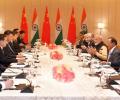
The prime minister started off his remarks at the meeting in Tamil, welcoming China to the talks, which were held right after one-on-one discussions between Modi and Xi at the Taj Fisherman's Cove Hotel.

The meeting, which comes after the Doklam standoff, is aimed at a working a new paradigm for the bilateral relations for the next 15 years.

An MoU on sharing hydrological information of the Brahmaputra River by China to India and another pact on amendment of the protocol on phytosanitary requirements for exporting rice from India to China to include non-Basmati rice were signed after the Modi-Xi talks in the eastern Chinese port city.

China on Wednesday warned that it will take "necessary measures" to defend its territorial sovereignty and interests after India "obstinately" allowed the Dalai Lama to visit the "disputed" parts of Arunachal Pradesh causing "serious damage" to the bilateral ties.

India said a new mechanism will be set up for issues relating to trade and investment.
The Congress for its part urged Modi not to politicise the armed forces.

The prime minister said India will continue to support Nepal according to that country's priorities, adding both sides have agreed to expedite all connectivity projects.
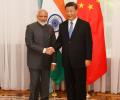
'The fact that Modi and Xi exuded confidence to accelerate the negotiations for a border settlement alone underscores that the Russia-India-China triangle has become very dynamic,' notes Ambassador M K Bhadrakumar.

Mukherjee said Prime Minister Narendra Nodi and Chinese President Xi Jinping Would be meeting soon on the margins of G-20 summit scheduled to be held in China later this year.

A realistic assessment will tell us that not much has changed between India and Pakistan; the relationship remains as fraught as before with little prospect of reconciliation, notes Ajai Shukla.

He said countries should work for promoting open and inclusive cooperation for win-win outcomes.
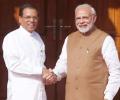
'Modi's first foreign trip at the very outset of his second term as PM reinforces a growing impression that this regional tour underscores a shift in emphasis in India's foreign policy that was traditionally focused on the northern tier of countries to the Indian Ocean rim,' explains Ambassador M K Bhadrakumar.

The pre-dawn operation, described as "non-military" and "preemptive" struck a five-star resort style camp on a hilltop forest and caught the terrorists in their sleep.

Modi said Nepal must identify its needs and priorities to deliver results.

'From Doklam to Wuhan and the return of the India-China relationship to its previous equilibrium is indeed a major contribution of President Xi and PM Modi. Without any doubt they deserve the kudos for their sagacity and their wisdom,' says Ambassador Gautam Bambawale, India's envoy to China during the Wuhan summit.

Ahead of the G20 Summit, Prime Minister Narendra Modi met his Japanese counterpart Shinzo Abe in Osaka, Japan and discussed a range of issues of mutual interest.

"Both India and China are victims of terrorism and the region was suffering from the menace. The prime minister said no country is immune from terrorism and on this issue, we cannot afford to have any differences," MEA spokesperson Vikas Swarup told reporters after the meeting.
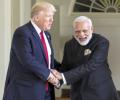
'The Modi government would chaff at the very idea of holding talks with Pakistan, facilitated by Washington and under close US monitoring, when the 2019 poll is sailing into view.' 'But in politics and diplomacy, there may be moments when drinking from the chalice of poison is necessary,' says Ambassador M K Bhadrakumar.

President Xi said that the Chinese side is ready to work with the Indian side to carry forward the fresh impetus of bilateral relations.

Soaked in patriotism, hundreds of Indians on Monday proudly marked the country's 70th Independence Day, as the tricolour fluttered and the national anthem reverberated at Indian missions across the world.
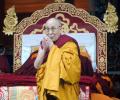
The papers said India is using the Dalai Lama as a "diplomatic tool" against China for its "vice like veto" against India's membership in the Nuclear Suppliers Group and United Nations ban on Jaish-e-Mohammed chief Masood Azhar.

Modi also said the people of India felt proud that President Xi has twice received him out of the capital.

'If, as appears to be the case, India is on way to 'mending fences' with China, and China is equally desirous to 'reset' the relationship, this could be a self-reflexive moment in India's positioning vis-a-vis not just the Dalai Lama, but also the Tibetan issue and China as a whole,' points out China expert Alka Acharya.

Indians in countries like the United States, China, Australia, Japan, Singapore, Egypt, Israel and South Africa celebrated the day with hoisting of the national flag and singing of patriotic songs.

'There are hundreds of items from Madhya Pradesh, Andhra, Rajasthan, Gujarat in Subhash Kapoor's loot. The Tamil Nadu Idol Wing wants to just prosecute Kapoor for three cases and close it. To me that's myopic.'
 © 2026 Rediff.com - Investor Information - Advertise with us - Disclaimer - Privacy Policy - Sitemap - Feedback - About us - Terms of use - Grievances