
'No country can go from zero to hero at the Olympics.' 'A hundred Indians now feature in the world's top 25 and that's progress,' says Shekhar Gupta.
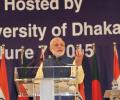
In a blunt attack on Pakistan, Prime Minister Narendra Modi on Sunday accused it of creating "nuisance" and "constantly" troubling India by promoting terrorism.
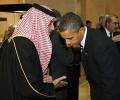
Further deterioration of the US-Saudi relationship will have geo-economic and geopolitical effects, says Nitin Pai.

Former external affairs minister, K Natwar Singh, shares his critique of the Narendra Modi government's foreign policy in this e-mailed interview with Aditi Phadnis. Edited excerpts

Prime Minister Narendra Modi had gone to China with a bagful of initiatives, but not all seems to have been fulfilled given China's reluctance to go the whole hog with him

India should enhance its economic, cultural and defence ties with Mongolia. It is high time Modi should focus on gaining clout in smaller Asian countries such as Mongolia. It is in this context, India's engagement with Mongolia would give much-needed impetus to India's foreign policy, says Sana Hashmi.

India has some ability to influence what the world order will look like, but it needs to make structural changes to the ministries of external affairs and commerce, and evolve formal coordination mechanisms with the ministries of finance and home, says Nitin Pai

As India rises, creating niche areas for itself in the Asian landscape, China and India are bound to step on each other's vital areas of importance, says Srikanth Kondapalli.

'The government is using the Intelligence Bureau to go after NGOs.' 'It is not only the NDA, the UPA also didn't like NGOs.' 'NGOs predominantly work with the poor. So, when you cancel an NGO, the affected are the poor, the Dalits, the tribals, the street children and the marginalised.'

The new equation between 'Namo' and 'Barack' may well 'convert a good start into lasting progress.'

Addressing world leaders at the 68th session of the UN General Assembly, Obama said if the international community cannot be united against forcing Syria to give up its chemical weapons, "then it will show that the United Nations is incapable of enforcing the most basic of international laws".

'Look East' policy was first coined by the Narasimha Rao government in the 1990s and has been followed by the successive governments.

The biological weapons convention is a non-starter in spite of the efforts of many states in the world for the last five decades mainly because the US is not ready to accept the 'verification protocol' which could allow the formation of some official mechanism for inspections, says Ajay Lele.

'No matter how severe sanctions the UN security council imposes on North Korea, the impact of the sanctions would depend on how faithfully they are enforced by China,' says Dr Rajaram Panda.

As the context of Panchsheel has changed, it is all the more essential that India and China need to reinvent and redefine Panchsheel for a new world order taking into account globalisation, and mutual economic interdependence. The new Panchsheel, in order to be relevant, needs to shed its binary approach of west verses the east recognising the seamlessness of global frontiers, which globalisation has brought in, says Rup Narayan Das.

'Modi and Obama both had agendas that went beyond the nuclear deal. The threat from the chilly Himalayas had to be tackled in the warm waters of the Indian Ocean.'

The Diaspora is no longer a mere remittance economy. It today claims dual loyalty and demands a say in Indian politics, says sociologist Shiv Visvanathan

Domestically, China's 'strike hard' policy is alienating Uighurs further in Xinjiang. China's quid pro quo with the Taliban is hardly any lasting solution to the Afghanistan crises or to regional security, says Srikanth Kondapalli.

'What should worry India and which needs to be expressed is Russia's simultaneous proximity to both China and Pakistan from a strategic angle. That hasn't happened ever before,' says Lieutenant General Syed Ata Hasnain (retd).

President Xi Jinping's visit may put relations between India and China on a new trajectory

'Happily,' says Ambassador B S Prakash, 'BRICS displayed new-found energy and built something real, a bank. Between needless nihilism and as yet unjustified euphoria, there are many stations for the BRICS train and we can watch its progress with renewed interest.'

After Pyongyang tests a missile potentially capable of reaching the US, Dr Rajaram Panda explores the realistic -- and peaceful -- options before Donald Trump and the international community at large.
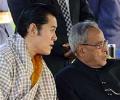
This quiet assertion of China has allowed various smaller countries of South Asia to play China off against India. Most states in the region now use the China card to balance against the predominance of India. Forced to exist between their two giant neighbours, the smaller states have responded with a careful balancing act, says Harsh V Pant.
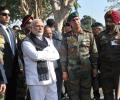
'If India employed a strategy of a 'thousand cuts', Pakistan will wither away.'
'By his very presence in Delhi on Republic Day, Obama is revisiting the most defining relationship of the 20th century after a period of stagnation,' says Ambassador T P Sreenivasan.

'We are completely engaged in fighting poverty; alas, our neighbour Pakistan seems only engaged in fighting us.'

The external affairs ministry's files, as distinct from those of the ministry of defence or the agencies, at least from before 1974 should be declassified. And if select files that are more than 40 years old are not to be declassified, the ministry should follow explicit guidelines to justify taking such a view, says Jaimini Bhagwat.
'We have been found seriously wanting in addressing our undersea warfare capability and China's emergence is a cause for concern.'

Once again an Indian prime minister has realised that with Pakistan and China, things will not move as he wishes.


Seeking a peaceful and secure neighbourhood amidst threat of terrorism and extremism, India and Kyrgyzstan on Sunday signed four agreements including one on bolstering defence cooperation and holding annual joint military exercises.

PM Modi seems to be gradually ending India's strategic ambiguity

'Foreign policy-making cannot be shifted out of Delhi and the regional satraps, who do not have a national perspective, should not be allowed to dominate foreign policy. But regional inputs should be integral to foreign policy-making at every step of the way,' says Ambassador T P Sreenivasan.

'The intrusion in Chumar, during and beyond the Chinese president's visit, is unprecedented and has qualitatively changed the tone of the India-China relationship,' says Jayadeva Ranade, a member of the National Security Advisory Board.

Two US warships fired at least 50 cruise missiles at the Ash Shai'rat airfield in Homs province in western Syria, from where the US administration believes Syrian President Bashar Al-Assad fired the chemical weapons against his own people, media reports said.

Narendra Modi's promise to allow states a bigger say in strategising and building foreign policy is unexceptionable, says TP Sreenivasan.

'Clearly, from the Indian viewpoint, the US retrenchment from Asia cannot be happening as good news.' 'The abandonment of the US' pivot to Asia exposes the US-Indian partnership to be a mere transactional relationship,' says Ambassador M K Bhadrakumar
'Under Narendra Modi's leadership, we will be able to regain our rightful place in the community of nations,' veteran diplomat Hardeep Singh Puri, who joined the BJP on January 2, tells Rediff.com's Sheela Bhatt.

The Security Council as it is today is unable to bring peace and security in the world and so there is reason for countries like India to become members of the Council, Ambassador Asoke Kumar Mukerji tells Sheela Bhatt/Rediff.com.
 © 2026 Rediff.com - Advertise with us - Disclaimer - Privacy Policy - Sitemap - Feedback - About us - Terms of use - Grievances