
Though dubbed as the 'war hero', the role of Rajapaksa in ending the conflict with the LTTE with the death of its supremo Velupillai Prabhakaran in 2009 is quite divisive as he stands accused of violating human rights, a charge he vehemently denies.

There appears to be inadequate appreciation of the freedoms and rights that are guaranteed and practised daily in a vibrant democracy, India says.

Brushing aside opposition from the Dravida Munetra Kazhagam and other parties in Tamil Nadu, Prime Minister Manmohan Singh on Tuesday met Sri Lankan President Mahinda Rajapaksa but did not give him any assurance on which way India will vote on a the United Nations Human Rights Council resolution for an independent international probe into rights abuses during the war with the Liberation Tigers of Tamil Eelam.

To provide more active support to African countries fighting the Nigerian Islamist militant group.

'People have been infected. They are responsible for it internationally.' 'They only admitted in February that it is infectious. This proves our case.'

Israel threatened to wipe out Hamas if current truce in Gaza collapsed as time ran out on Wednesday on the 72-hour ceasefire with no breakthrough in indirect talks between Israeli and Palestinian negotiators due to "significant disagreements".
Eyebrows went north in India, especially in New Delhi where in the confusion some people criticized the United Nations Security Council (UNSC) which is based in New York. Chitra Subramaniam offers some perspective.

M Karunanidhi was a masterful practitioner of modern-day politics, wielding considerable influence beyond his own state, in the corridors of power in New Delhi, for a long time and sewing up alliances with both the Congress and the Bharatiya Janata Party.

In a significant development, India for the first time on Thursday abstained from voting on the United States-sponsored resolution against Sri Lanka on alleged human rights violation which was passed by 23 votes in favour as against 12 in opposition and 12 abstentions in the United Nation's Human Rights Council in Geneva.

Saudi Arabia on Sunday came under attack globally a day after it carried out mass execution of 47 people, including Shia cleric Sheikh Nimr al-Nimr who was a vocal critic of the government and the Saudi monarchy.

'This was the worst phase yet in the state's human rights history.' 'Notorious interrogation centres were set up, large numbers died in firing on civilian mobs.' 'This is what today's generations might identify better as the Haider phase in Kashmir's history,' says Shekhar Gupta.

Commerce Minister Anand Sharma has a tough time in Davos pacifying African leaders, who are extremely upset over Delhi law minister's midnight raid. Anita Katyal reports

Even as the polity find ways and means to address the genuine concerns and fears of the society, the Sri Lankan State apparatus would have to unravel these mystery-questions with convincing answers, and a road-map to the future, says N Sathiya Moorthy.
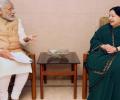
Narendra Modi's meeting with J Jayalalithaa in Chennai has set the rumour mills abuzz. Will the Tamil Nadu chief minister ally with the BJP ahead of the 2016 polls, asks N Sathiya Moorthy.

'Previous governments in India had reservations about working with Israel.' 'Modi has shed this tag.' 'Disengaging itself from its traditional and ideological foreign policy approach in the Middle East shall serve India's long-term interests.' Rajaram Panda explains why the significance of Modi's visit to the Jewish nation goes beyond markers like the first-ever visit to Israel by an Indian PM and 25 years of diplomatic ties.

Since the US and India broadly share similar interests in Sri Lanka, they should coordinate closely to ensure that the country preserves its democratic institutions, says Lisa Curtis

In a frontal attack on the Narendra Modi government, Congress President Sonia Gandhi on Wednesday said there has been an "alarming increase" in communal incidents since it came to power and asked party men to resist its "authoritarian and sectarian" tendencies.

A recent inquiry report by the Geneva-headquartered Office of the High Commissioner for Human Rights has cast serious aspersions on the claims of the Sri Lankan government over alleged war crimes duirng the conflict with the LTTE. Vicky Nanjappa reports.

Do Modi's foreign visits actually serve India or they nothing more than expensive tools for domestic positioning and image-building, asks Shehzad Poonawalla.
Abstaining from voting on a UNHRC resolution on Sri Lanka was dictated as much by necessity and self-preservation as by a desire to place bilateralism at the front and centre of New Delhi's ties with Colombo, says Ramesh Ramachandran.
 © 2026 Rediff.com - Advertise with us - Disclaimer - Privacy Policy - Sitemap - Feedback - About us - Terms of use - Grievances