
The key reason for the country's stagnating exports is its failure to build a strong manufacturing base, says T N Ninan.

If the country is to meet its jobs and income challenge, there has to be a parallel focus on jobs in the formal sector.

If the Modi government is going to set new benchmarks of performance, don't expect the majority of his dozen-odd ministers-who-matter with economic portfolios to be making the difference, says T N Ninan.
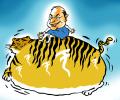
While people have paid the price for the disruption it caused, now is the time to reap its benefits, says T N Ninan.
It is a pity that the Modi government, which began on the right note when it came to pricing issues, has changed colour and become interventionist in its impulses, says T N Ninan.
Is it because of the failure to deliver serious institutional reform or that, at the end of the day, we are like that only, asks T N Ninan.

Whether it was the Bofors gun in 1986 or Italian helicopters in 2012, a leak or disclosure at the source overseas is like dynamite, and usually impossible to refute. They acquire a life of their own in the hands of the media, says T N Ninan.

Revamping Indian Railways will need bold thinking, and lots of money and time. And all three may be scarce, points out T N Ninan.

The Modi government has ambitious plas to achieve 10% growth, but there is no assessment of how much money is needed for the whole package of measures, and where it will come from. In short, there is no plan for how to get from here to there, points out T N Ninan.

At a time when more and more of government spending is done by states, the impression you get from these large advertisements could well reflect the slogan of Emergency days: the nation is on the move, says T N Ninan.

Many stalled projects are about to get going again, providing potential relief to banks, says T N Ninan.

'Surplus money in individuals' pockets has moved away from real estate and flowed into the stock market either directly or through mutual funds.' 'This being one reason for the continuing surge in stock prices.' 'Market indices have soared to levels that are well above historical averages for price-earnings ratios.' 'Market pundits insist that this is not a stock price bubble, but when was the last time the pundits called a bubble a bubble?'
Business houses don't think twice about blacklisting a newspaper.

The record of other prime ministers too shows how much can change when a prime minister is faced with the two-year challenge, says T N Ninan.

One way to do a reality check on the official numbers will be to develop a desi version of what came to be called the Li index in China.

The Brics line-up has yielded to a shaky China-India story, with new question marks over China even as India remains a "B+" performer, says T N Ninan.
Sustaining anything in the region of 7% growth should be good enough in a troubled and risk-laden world, says T N Ninan.

Emission norms for automobile industry should be tightened.

If you take the minimum wage to Rs 15,000 tomorrow, the choice may not be between Rs 8,000 and Rs 15,000; it might be Rs 15,000 or nothing, says T N Ninan.

It has built confidence in the possibility of change; now reality has to catch up with the image and the expectation, says T N Ninan.

The really disturbing numbers relate to inequality.

Every country is a free trader when it sees advantage, and a trade warrior when it does not, says T N Ninan.

Of all the markets in which politicians interfere with prices, the land market is probably the last that will be reformed, says T N Ninan.

China and India have approached trade negotiations very differently: the former with confidence, the latter in a defensive crouch, says T N Ninan.
The prime minister seems to have turned his face away from the business of introducing serious reform, says T N Ninan.

The crushing of this tiny entity by demanding creditors should be a lesson for all countries, warns T N Ninan.

Sons-in-law are 'in' these days in the circles of power.

Colombo can handle more container traffic than all of India's ports put together. For a country with a long maritime tradition, this is a pathetic state of affairs, saya T N Ninan.

Congress campaign seeking to paint the ruling party as anti-poor and anti-farmer seems to have unnerved the BJP, feels T N Ninan.
His current predicament stems from a combination of personal failing and circumstance

Biggest culprit behind India's eroding tax base is excise

We could be on the brink if our export industries actually start losing jobs, says Shreekant Sambrani.
Most encouraging thing is savings and investment rates are high.
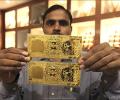
If India has more billionaires than before, it is because the Indian economy began to look more attractive to FIIs, notes T N Ninan.

Six men are in the news, and in very different boats

The inflow of cheap capital has also kept the rupee at a high level, making exports uncompetitive and broadening the current account deficit despite falling oil prices.
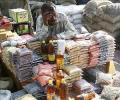
Foreign retail chains, reluctantly allowed limited entry, have begun to make their initial moves and, like Ikea, intend to spend big money -- sometimes in the billions of dollars.

If oil prices stay at their new level of $72 or drop further, India will be in the happy position next year of enjoying a surplus on the trade account.

While Manmohan Singh had to deal with high oil prices, inflation and trade deficit, Narendra Modi is lucky as major threats have receded, says T N Ninan.

'There appears to be no relation between a government with a majority and GDP growth as the stock market and its analysts seem to fear.'
