
In its status report, Delhi Police said that the accused was part of the conspiratorial design to not only cause disaffection but also the use of any means to cause death and injury to persons.

Justice Rajiv Shakdher released Zargar on bail on furnishing a personal bond of Rs 10,000 and surety of like amount.
The court said that even if there was no direct act of violence attributable to the accused (Zargar), she cannot shy away from her liability under the provisions of the UAPA.
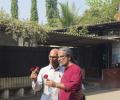
Researcher Rona Wilson and activist Sudhir Dhawale, accused in the Elgar Parishad-Maoist links case, were released on bail from a Navi Mumbai prison on Friday, more than six years after they were arrested. The duo walked out of the Taloja jail after completing bail formalities before the special NIA court, over a fortnight after they were granted bail by the Bombay High Court. The HC granted bail to Wilson and Dhawale on January 8, noting they had been in jail since 2018 and the trial in the case, in which anti-terror act UAPA has been invoked, was yet to start. Apart from Dhawale and Wilson, 14 other activists and academicians were arrested in the case. Eight of them have been granted bail till now, with one, Mahesh Raut, still in jail as the appeal filed by the National Investigation Agency (NIA) against his bail is pending before the Supreme Court. Jesuit priest and activist Stan Swamy, one of the accused, died in 2021 while lodged in judicial custody. The case pertains to provocative speeches allegedly delivered at the Elgar Parishad conclave held in Pune on December 31, 2017, triggering violence at Koregaon-Bhima, a village outside Pune city, the next day. The Pune police had claimed the conclave was backed by Maoists. The NIA later took over the probe.

Kalita pleaded that she needed the videos and chats to prove her innocence, but the Delhi police counsel contended that her petitions were not maintainable.
Additional Sessions Judge Amitabh Rawat, who was scheduled to pronounce the order on Monday, posted the matter for Wednesday, saying it was not ready.

The 11 people were discharged on February 4 by the trial court, which said they were made 'scapegoats' by police and that dissent has to be encouraged, not stifled.

The court said the legal proceedings against the 11 accused were initiated in a 'perfunctory and cavalier fashion' and 'allowing them to undergo the rigmarole of a long-drawn trial does not augur well for the criminal justice system of the country'.

The counsel pointed to two contradictions in Delhi Police's claims. Firstly, he showed the court a 21-minute video clip of Khalid's speech in Maharashtra, which the prosecution had allegedly labelled inflammatory.
'From the look of those photographs and videos, it cannot be made available to anyone,' the judge said.
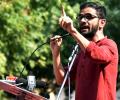
The high court's observation came while hearing the bail plea of Khalid who has challenged a trial court's March 24 order dismissing his bail application in the case.
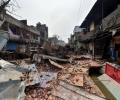
She has been booked under the anti-terror law in a case related to communal violence in northeast Delhi in February. Additional Sessions Judge Dharmender Rana granted the interim relief from June 10 to June 19 to Jahan on furnishing two sureties of Rs 1 lakh.
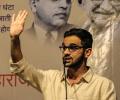
'It is very easy to invoke Bhagat Singh but difficult to emulate him... There was a gentleman who was eventually hanged .... He stayed there..., he did not run away. You are saying you weren't even there'
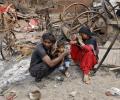
According to the sources, those named in the chargesheet are Taahir Hussain, Mohd Parvez Ahmed, Mohd Illyas, Saifi Khalid, Ishrat Jahan, Miran Haider, Safoora Zargar, Asif Iqbal Tanha, Shahdab Ahmed, Natasha Narwal, Devangana Kalita, Tasleem Ahmed, Saleem Malik, Mohd Saleem Khan and Athar Khan.
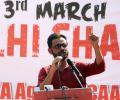
A bench of Justices Siddharth Mridul and Rajnish Bhatnagar was hearing Khalid's plea challenging a trial court's order which had on March 24 dismissed his bail application in the case.

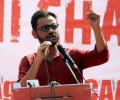
The anti-Citizenship (Amendment) Act protest was secular but the charge sheet in the Delhi riots conspiracy case was communal and the police fabricated a story to suit its narrative, former Jawaharlal Nehru University student leader Umar Khalid told a court in New Delhi on Tuesday calling it a 'naked form of false implication.'

The court further observed that Imam, also a former JNU student, and Khalid were stated to be 'co-conspirators' in the case and it would thus hear both the two bail applications together.
The Delhi high court on Tuesday refused to grant bail to former Jawaharlal Nehru University student Umar Khalid in a Unlawful Activities (Prevention) Act (UAPA) case related to alleged conspiracy behind the riots here in February 2020.
A Delhi court on Thursday denied bail to former JNU student Umar Khalid in a case of larger conspiracy in connection with Delhi riots during February 2020.
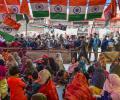
The chargesheet in which 15 persons have been named as being part of a 'premeditated conspiracy' in the north east Delhi riots, said the tone and nature of the communication of the members of Jamia Co-ordination Committee (JCC) changed from the evening of February 24 and they started talking about relief, rehabilitation and care of the victims while 'simultaneously unleashing concerted disinformation campaign blaming the state, police and the ruling political party for the loss of lives and property caused by their terrorist and unlawful act'.

The high court said prima facie charges of rioting and unlawful assembly are made out against nine of the 11 accused, including Imam, Tanha and Zargar.
In this conspiracy, firearms, petrol bombs, acid bottles and stones were collected at numerous homes, police claimed.
The Delhi high court Wednesday expressed its displeasure over the use of the term jumla by former Jawaharlal Nehru University student Umar Khalid in his criticism of the prime minister while delivering the speech.

'India is now surrounded on its north, west and east by unfriendly neighbours -- Pakistan, China, Nepal and Bangladesh -- some of whom are openly inimical,' notes Amulya Ganguli.
Arguing his bail plea in the riots conspiracy case before additional sessions Judge Amitabh Rawat, his lawyer referred to the supplementary charge sheet filed in the case and said that the police wished to paint every accused with the same brush while adding tadka (flavour) to it.
The police can now name them in their supplementary charge sheet, an official said. In a late evening statement, the government said that this is a purely procedural matter, adding that the elected government has no role to play in this.
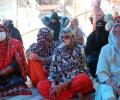
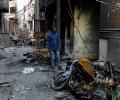
Several protests and mass movements across Delhi and the country were at their peak when the coronavirus threat slowly crept in, throwing normal life out of gear and pushing everyone indoors to ensure social distancing.
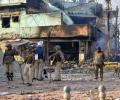
The judge asked the concerned deputy commissioner of police (DCP) to monitor the probe to ensure fair investigation as police have failed to point out what investigation has been carried out so far regarding the involvement of the rival faction.
 © 2026 Rediff.com - Investor Information - Advertise with us - Disclaimer - Privacy Policy - Sitemap - Feedback - About us - Terms of use - Grievances