
Experts said while meteorological conditions were "moderately" favourable for dispersion of pollutants, a "very high" number of farm fires in Punjab was the primary reason for "severe" air quality.

Mohapatra said there is a 40 per cent chance of a normal rainfall, 22 per cent above normal, 12 per cent excess and 18 per cent below normal.

Scores of people die every year due to cold waves that sweep across the north Indian plains.

Normally, monsoon reaches Delhi by June 27. It covers the entire country by July 8. Last year, the wind system had reached Delhi on June 25 and covered the entire country by June 29.

According to latest data, crops have been sown in around 72.13 million hectares, which is 8.90 per cent less than the same period last year.

The India meteorological department has stated that day temperatures are likely to be above normal by 0.5 degree Celsius, reports Sanjeeb Mukherjee.

The country received 16 per cent more rainfall than its normal limit in June, the IMD on Tuesday said.

Pre-monsoon rainfall, colloquial referred to as "mango showers", is vital to many parts of the country.

Close to half the country is experiencing deficient rains and the shortage for the figure has gone up to 16 per cent.

According to the IMD forecast, monsoon is likely to be normal this year.

'It is the most prone month for the development of cyclones in the pre-monsoon period.'

According to the Central Water Commission, of the 91 major reservoirs in the country, 62 water bodies reported 80 per cent or below of normal storage.

The central government's Air Quality Early Warning System for Delhi said a significant increase in the number of "fire points" was observed over Punjab (around 3,000), Haryana and Uttar Pradesh on Wednesday, which is likely to impact the air quality of Delhi-NCR and other parts of northwest India.

The seasonal temperature would be above normal by more than one degree Celsius over Northwest India.

The air quality had turned 'severe' on Saturday evening with stubble burning accounting for 32 per cent of Delhi's PM2.5 pollution, but firecracker emissions and calm winds made the situation even worse.
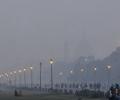
Pollution levels in Delhi during the Diwali period are likely to remain in the higher end of the 'very poor' category in the absence of emissions due to fireworks, the Ministry of Earth Sciences' air quality monitor, SAFAR said.
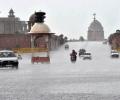
The IMD chief also allayed fears of occurrence of an El-Nino.

There has been a sudden dip in temperatures in several parts of northwest India. Day temperature today in Delhi was 23 degrees Celsius against a normal of about 38 degrees Celsius, Met officials said.

Monsoon normally starts withdrawing beginning September 1 from west Rajasthan.
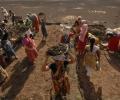
Around 40 per cent of the country is staring at drought-like conditions ahead of the monsoon as water levels have receded sharply.
The Nuclear plants in Gujarat, Uttar Pradesh and Rajasthan remained unaffected by the earthquake that hit the Pakistan-Iran border region this evening, impact of which was widely felt in northwest India.
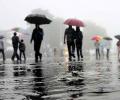
India will receive normal monsoon this season, country's meteorological department said on Wednesday in its forecast for the Southwest monsoon that covers 75 per cent of the country, and thereby may bring much-needed respite to the economy, which is reeling under the catastrophic effect of the Covid-19 pandemic.

In Assam, nearly 27.80 lakh people across 26 districts have been affected by the deluge. The deaths were reported from the Barpeta, Kokrajhar and Morigaon districts. The death toll due to floods and landslides this year has risen to 122.

The news will augur well for the country as large parts have been witnessing agriculture distress and water levels in reservoirs in west and south India have dipped to low levels.
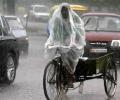
Next week could see some respite from the heat.

Several states are likely to witness heat wave conditions, the India Meteorological Department said in its summer forecast for the season (March to May).

The southwest monsoon which reached the country on May 30 well within its normal onset date
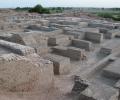
Scientists have found that much of the Indus civilisation thrived around an extinct river, challenging ideas about how urbanisation in ancient cultures evolved.

People flock to electronics shops to buy air conditioners.

In the national capital, the maximum temperature was recorded at the season's highest at 44 degree Celsius.

It has also advanced into most parts of Tamil Nadu, some parts of south interior Karnataka and remaining parts of south Bay of Bengal, according to IMD.

Rain for the central and northwestern parts a concern.

n the broader market, both the BSE Midcap and Smallcap indices, were up 1.2% and 0.7% each.
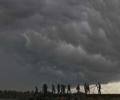
For the second successive year, Monsoon is likely to be below normal with parts of north-west and central India to be the most affected.
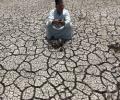
India now faced a higher likelihood of a drought in some parts, as monsoon rain would be less than predicted in April, private weather forecaster Skymet said on Friday.

India loses 333 acres of prime forest every day. Instead of working to conserve India's forests and water resources, the environment minister has set up a committee to 'dismantle' the five key laws that provide environmental protection.

As far as India is concerned, the danger is the potential of the IS to create mischief rather than its actual capability as of now, says Rajiv Kumar
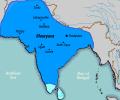
'There is a remarkable link between the eating of beef (or at the very least, tolerating the eating of beef) and India being a superpower.' 'In India, whenever an empire was strong, religion took a back seat.' 'Alternatively, whenever religion asserted itself, the main empire of India crumbled...'
 © 2026 Rediff.com - Investor Information - Advertise with us - Disclaimer - Privacy Policy - Sitemap - Feedback - About us - Terms of use - Grievances