
Contradictions have emerged over the death of eight SIMI men, who were gunned down in an alleged encounter with the police on the outskirts of the Bhopal hours after they escaped from the high-security Bhopal Central Jail killing a security guard.
'If you solve it in one day, it will go after a day.' 'If it is there for 100 years or 1,000 years, reservation has to continue.'

Prime Minister Narendra Modi has five key aspects to his style of leading -- total command over bureaucracy, direct approval on every decision, flexible approach to issues, importance of communication and adept at repackaging schemes, says A K Bhattacharya.

'The situation in the country is very scary.' 'There is an increasing attack on the Constitutional democratic rights of our people.'
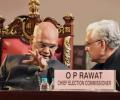
For successive governments the Election Commission remains a 'holy cow', where unhealthy precedents are allowed to be nurtured since Independence, says N Sathiya Moorthy.

Prime Minister Malcolm Turnbull's first State visit to India is an indication of the success of India's Act East Policy, says Dr Rahul Mishra.
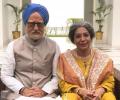
'People have a certain perception about my political leanings -- and rightly so.' 'But I am an actor first, and then an activist.' 'And I am not an accidental actor.' 'There was no way I was going to be dishonest with my acting,' Anupam Kher tells Veenu Sandhu.

'A fierce crusader against communalism, George joined hands with majoritarian forces, never to revisit or re-assess his saffron association.' 'He was a Union minister in 1998-2004, a time when people like Graham Staines were lynched in Orissa.' 'On the Gujarat pogrom of 2002, George went on to kind of justify the slashing of pregnant women, by saying in the Lok Sabha that this was nothing new for India.' 'Thus, he was in sharp contrast to what he had himself stood for in the heyday of his political career in the 1970s and 1980s, says Mohammad Sajjad.

The frenzy to be present at the Madison Square Garden on September 28 when Prime Minister Narendra Modi addresses the Indian-American community likely rivals a rock concert held at the famous New York venue.

Culinary legend Satish Arora hangs up his apron after almost 5 decades of service at the Taj group of hotels.

The finance ministry website that lists the total disinvestment revenues to be mobilised during the current year already shows that no receipts are expected from strategic sales in the current year.
'It is imperative that all parties make a commitment that they shall abide by the final decision of the Supreme Court.' 'This will be the best way to bring a closure.' 'It is time India moves on to face several other challenges.'

'As someone who has had the opportunity of cross examining Vinod Rai, extensively over three days as part of the Joint Parliamentary Committee, many of us included I had concluded at that point of time that this report rests on the foundation of sand.'
'The leak is likely to continue for some time before it becomes stable, but this is something that NPCIL, who is the plant operator, will have to do. For this, we have to plan very carefully.'
How seriously should we take Natwar Singh's book? Indeed how seriously should all such memoirs and autobiographies be taken? The answer, I imagine, depends on the intent. If the authors are merely settling scores, as many think Natwar Singh is, future historians would be entitled to ignore such autobiographies. But if there is no mens rea (guilty mind), so to speak, these books must be taken seriously, says T C A Srinivasa-Raghavan.

The remarkable feature of those reforms unveiled in 1991 is that none of those decisions has been disowned by subsequent governments in the last 25 years.

Businessmen love low import duties on their inputs and high duties on their outputs. And the Bharatiya Janata Party has a keen ear for business sentiment.

20 years ago this day, May 11, 1998, India conducted its second nuclear test at Pokharan in Rajasthan. In a fascinating interview on Rediff.com, K Subrahmanyam revealed how Indian PMs reacted to nuclear ambitions.

The prospects for strong, sustained economic reforms do not appear to be promising in India.
A weak presence in the Rajya Sabha has forced the NDA to try and rope in 'weak links' in the Opposition ranks to pass key legislation in the Upper House.
Like Nehru, Modi is loathe to touch the public sector. His policy towards Israel leans towards 'non-alignment'. You can find other similarities: frequent public speeches, personalised leadership, total control over foreign and strategic policies, even stylised dressing, says Shekhar Gupta.

Mamata Banerjee was on Friday sworn in as the chief minister of West Bengal for the second consecutive time, heading a 42-member ministry.
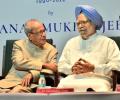
What Shekhar Gupta would have really liked to know from Pranabda: Why did Sonia prefer Dr Singh to him as PM? Why did he deny finance first, why did he accept it 5 years later, and why did he make such a mess of it? How did he force Sonia to nominate him for President and not Hamid Ansari? And how does he justify that most toxic legacy -- the Vodafone tax amendment?
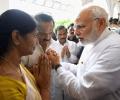
The deaths of Jayalalithaa and M Karunanidhi within months of each other neutralises any sympathy factor their parties may hope to gain from. What's more, by removing charismatic leaders from the fray, it also levels the field for others, says N Sathiya Moorthy.

The 1992 Babri Mosque demolition was an "act of planned sabotage" and not a by frenzied mob of Hindu outfits, a news portal claimed on Friday on the basis of a sting operation it had carried over a period of two years.
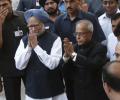
Manmohan Singh, reveals the former President, was keen that either P Chidambaram or Montek Singh Ahluwalia be the finance minister.
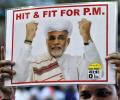
Report card of the Narendra Modi-led central government for the first six months, on the basis of ratings by top CEOs, under key parameters.

Foreign exchange reserves as a percentage of India's total external debt were 73 per cent at the end of December 2015.

The Bharatiya Janata Party's hot saffronite swami is yoga teacher Ramdev.

The Modi-Shah definition of secularism is, India is a confident, resurgent Hindu, and therefore secular, country.

No prime minister of India ever had greater experience of running a state than Narendra Modi.

'Tilting at the Government in English in front of India may make him feel like Joan of Arc, but without a feel for Bharat he will merely be Don Quixote,' says S Muraleedharan, former managing director, BNP Paribas.

'The politician in him saw to it that the foundation stone was laid in Ahmedabad in the run-up to the assembly election in Gujarat in 2017.' 'But the statesman in him also wants it to be his legacy.'

Controlled communal tension is useful in ensuring continued Muslim support. Fear of the BJP is a requirement for both, the Congress and the Samajwadi Party, to keep their Muslim vote bank in line, says Saeed Naqvi.

'The timing is a little suspect.' 'Could it be, just be, a convenient tool to wield months ahead of a hyper-crucial state election, judge if its efficacy in sending out its subliminal message is intact, and accordingly decide the future course of action on the long but quick road to 2019?'
Prime Minister Narendra Modi is being accused of wrong things. His main problem is his view of himself, says T C A Srinivasa-Raghavan
'The D K Adikesavulu clan is so wealthy, owns so many houses, and has so much jewellery,' notes T V R Shenoy, 'that it did not notice a servant stealing at the rate of Rs 66 lakh every year!'

If an elected government had been sworn in, Jung's tenure and the government would have been more or less co-terminus and Jung would have been just the ceremonial head of Delhi. Now, he will run Delhi, pending another round of assembly elections, says Aditi Phadnis

As India strives to make its Act East Policy a comprehensive politico-diplomatic and economic success, Brunei gains more salience, says Dr Rahul Mishra.

'The Modi government has been taking credit for improvement in respect of the ease of doing business in India.' 'But when I look at the scams I cannot help feeling that it is too easy to do business with banks in India, if one is a Harshad Mehta, Vijay Mallya or Nirav Modi and their tribe,' says former Union home secretary Madhav Godbole.
 © 2026 Rediff.com - Advertise with us - Disclaimer - Privacy Policy - Sitemap - Feedback - About us - Terms of use - Grievances