
'Our problem is not a budget deficit but a trust deficit. We need to trust our institutions and industries to innovate and lead. That is the way forward for India.'
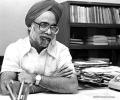
What stood out in his 15-year journey as a member of the political executive at the Centre was his glowing record as India's most successful and effective finance minister. Both as prime minister and finance minister, he understood the importance of gradualism, except when the economy or the polity was in a crisis.

A host of conspiracy theories followed, involving Indira Gandhi, her younger son Sanjay, his favourite small car project, secret funding of the Bangladesh Mukti Bahini and even the Central Intelligence Agency of the United States.


'Indira Gandhi and P N Haksar did not want Pakistan to leave as an embittered foe hell-bent on taking revenge for being humiliated so comprehensively.'
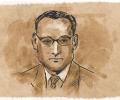
'R N Kao was a spymaster, an institution builder and a gentleman.'
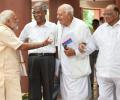
'Being authoritative is one thing -- Nehru was that -- but being authoritarian is quite another -- the current prime minister is clearly one.'

'Crucial intelligence was obtained by a R&AW operative from a couple of moles inside the camps four days before the Balakot operation.'

But use of that word -- privatisation -- is not encouraged. This seems to be a classic case of reforms through subtle signals, observes A K Bhattacharya.

Nationalisation has served its purpose. It's time to move ahead, keeping majority ownership of the government in a few banks to serve the people, argues Tamal Bandyopadhyay.
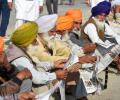
In politics, if your objective is only winning elections, just Chanakya neeti might do. For governance you need both, Chanakya neeti and Ram Rajya. You can neither beat up the farmers into submission, nor dismiss them as 'Khalistanis', asserts Shekhar Gupta.
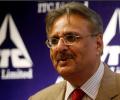
During his time as executive chairman, the company's net revenues grew 17-fold to Rs 42,777 crore and profit after tax nearly 40 times to Rs 10,289 crore. Total shareholder returns grew at a compounded annual rate of around 20%. Besides numbers, his biggest achievement was to transform ITC from a cigarette company to a diversified enterprise.
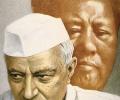
'Hindi-Chini Bhai Bhai? Don't you believe it. I don't trust the Chinese one bit,' Nehru told Gopalaswamy Parthasarathi before he traveled to China as India's ambassador. Asking GP to be ever vigilant, Nehru advised the diplomat to send telegrams on important matters only to him. Many such anecdotes from a long and eventful career as diplomat and bureaucrat crowd the pages of GP: 1912-1995, discovers Uttaran Das Gupta.
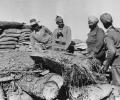
'The Himmatsinghji Report is still 'missing'.' 'It is a great loss for the knowledge of India's borders.' 'It would have an immense value at a time China is bound to shift its attention to other border fronts in the Himalayas,' notes Claude Arpi.

The great pity is that Mr Siddiqui has a remarkable, even inspiring, story to tell, feels Sunil Sethi.
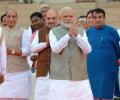
'The Modi Model we see now is still the old Gujarat Model.' 'But with an acknowledgement that governing India is more challenging than governing Gujarat,' notes Shekhar Gupta.

'Modi has shown political courage by instituting several economic reforms which include demonetisation, ushering in GST, eradication of benami transactions...'

The 64-year-old Planning Commission, a vestige of the socialist era, will soon become history.
'Actually, the RSS is deeply ambivalent and uncomfortable with Gandhi as well as also Ambedkar, but it is not politically wise to oppose these two.' 'So Nehru is the main and only target.'
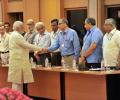
From Swachh Bharat to spearheading the Make in India campaign, the PMO seems to be at the centre of all policies, writes Nivedita Mookerji.

'The purported jitters of the ministers under Modi, the intriguing part is that the stories churned out by the rumour mill have not so far been denied. For aught I know, they may not be true. Or, if true, all that Modi intended was to subject his ministers to a process of grooming to ensure that all of them adhere to a uniform code of propriety, discernment and credibility,' says the distinguished civil servant B S Raghavan.

20 years ago this day, May 11, 1998, India conducted its second nuclear test at Pokharan in Rajasthan. In a fascinating interview on Rediff.com, K Subrahmanyam revealed how Indian PMs reacted to nuclear ambitions.
 © 2026 Rediff.com - Investor Information - Advertise with us - Disclaimer - Privacy Policy - Sitemap - Feedback - About us - Terms of use - Grievances