
The Vikram Moon Lander, named after the father of India's space mission Vikram Sarabhai on his birth centenary year, is scheduled to touch the lunar surface near its south pole on September 7 about 1.55 am.

The Indian Space Research Organisation (ISRO) has received approval for the Chandrayaan-5 mission, which aims to study the Moon's surface using a 250kg rover. The mission will be conducted in collaboration with Japan. This follows the success of the Chandrayaan-3 mission, which achieved a soft landing on the Moon's South Pole in August 2023. ISRO is also planning to establish a space station, Bharatiya Space Station, in the near future.
Speaking to PTI, Somanath said, "(The lander landed) perfectly in the intended site. The landing location was marked as 4.5 km x 2.5 km -- I think on that space, and the exact centre of that was identified as the location of landing. It landed within 300 metres of that point. That means it is well within the area identified for landing."

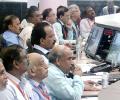
The players all converged near the dressing room and followed the closing stages of Chandrayaan-3's landing on Moon.

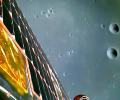
ISRO on Friday released a set of visuals of the Moon captured by cameras positioned on the Lander Module of Chandrayaan-3 spacecraft.

Interspersing their tweets and posts with an occasional 'Welcome buddy!' and 'Thanks for the ride, Mate!', ISRO's social media handles occasionally departed from using just technical terms to give updates about India's ambitious Moon mission Chandrayaan-3.

India created history on Wednesday when the lander module of Chandrayaan-3 touched down on the lunar south pole, propelling the country to an exclusive club of four and making it the first country to land on the uncharted surface.

After the successful deployment of Chandrayaan-3's lander and rover on the moon, Indian Space Research Organisation (ISRO) is hoping that their mission life will not be limited to one lunar day or 14 earth days, and that they will come back to life when the sun again rises on the Moon, to carry on with the experiments and studies there.

In his latest tweet, the 58-year-old actor said the successful landing of Chandrayaan-3 on the Moon's uncharted south pole was a moment of celebration for mankind.

In a giant leap for its space programme, India's Moon mission Chandrayaan-3 touched down on the lunar south pole at 6.04 pm on Wednesday, propelling the country to an exclusive club of four and making it the first country to land on the uncharted surface.
Leading scientists and experts said this monumental accomplishment not only marks India's indelible imprint on lunar exploration but also demonstrates the prowess of human collaboration, determination, and cutting-edge technology.

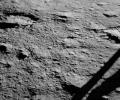
Chandrayaan-3 mission's lander 'Vikram' chose a relatively flat region on the lunar surface to touch down, images captured by its camera showed.
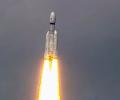
The Chandrayaan-3 mission that aims for a soft landing on the moon's surface, paving the way for future interplanetary missions, carries six payloads that would help ISRO understand the lunar soil and also get the blue planet's photographs from the lunar orbit.

Weighing 320 tonne at lift-off, the vehicle used larger strap-on motors to achieve higher payload capability.

Glimpses of what the historic Chandrayaan Mission discovered on the dark side of the Moon.

ISRO made efforts to re-establish communication with rover Pragyan and lander Vikram after they were put into sleep mode in September following the onset of night on the moon.
Taking to X (formerly Twitter), ISRO said, "Chandrayaan-3 Mission. Chandrayaan-3 Rover to MOX, ISTRAC, Moon walk begins!"

Somanath thanked all those who prayed for the mission's success, and ISRO veterans like A S Kiran Kumar , the space agency's former chief.

People gathered in educational institutions, offices, city squares and religious places to watch the Indian Space Research Organisation's live telecast of Chandrayaan-3's final descent to the uncharted surface of the lunar south pole.

The entire mission operations of Chandrayaan-3, right from the launch till landing, "happened flawlessly" as per the timeline, the team that led India's third mission to the Moon said on Wednesday.

Film folk like Akshay Kumar, Chiranjeevi, Jr NTR and Sunny Deol congratulated the country and the Indian Space Research Organisation (ISRO) on the historic achievement of Chandrayaan-3's landing on the Moon.

Prime Minister Narendra Modi was accorded a warm reception as he arrived at the Indian Space Research Organisation headquarters in Bengaluru on Saturday morning.
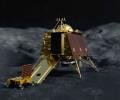
ISRO on Friday said it has made efforts to establish communication with its lunar mission Chandrayaan-3's lander Vikram and rover Pragyan to ascertain their 'wake-up condition' after they had been put into sleep mode early this month -- but no signals have been received from them as of now.
The Lander and the Rover have scientific payloads to carry out experiments on the lunar surface. The main function of the Propulsion Module (PM) was to carry the Lander Module (LM) from the launch vehicle injection till final lunar 100 km circular polar orbit and separate the LM from PM, which it did.
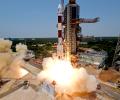
The successful launch of Aditya-L1 - the country's maiden mission to study the Sun - is expected to garner increased investor interest in the Indian space sector and trigger more funding for private players. Several private sector players, including Larsen & Toubro (L&T), MTAR Technologies, and Ananth Technologies, have played a pivotal role in the Indian Space Research Organisation's (Isro's) solar observatory mission. Aditya-L1 on Saturday set off on a 125-day journey on a PSLV-C57 rocket, in its attempt to study various elements relating to the nearest star from the halo orbit around Lagrange point 1 (L1) of the Sun-Earth system, which is about 1.5 million km from Earth.

Chandrayaan-3 mission's rover 'Pragyan' has traversed a distance of about eight metres on the lunar surface, and its payloads have been turned on, ISRO said on Friday.
The lessons learned from the failure of Chandrayaan-2 contributed to the success of India's third lunar mission, former space scientist with the Indian Space Research Organisation (ISRO) Nambi Narayanan said, after the successful touchdown of the 'Vikram' lander on the lunar South Pole.

ISRO Chairman S Somanath had recently said the most critical part of the landing will be the process of reducing the velocity of the lander from 30 km height to the final landing, and the ability to reorient the spacecraft from horizontal to vertical direction. "This is the trick we have to play here," he said.

Lander Module of Chandrayaan-3 spacecraft comprising the lander and rover has successfully separated from the Propulsion Module, Indian Space Research Organisation said on Thursday.
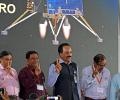
Ex-ISRO chairman G Madhavan Nair said the scientists at space agency have achieved this historic success by getting a salary one-fifth of the scientists in the developed world.

India on Wednesday joined an elite group of three nations to have sent a spacecraft on the Moon, as Chandrayaan-3 landed a rover on the lunar surface to explore the uncharted territories near the south pole.

Using a comic strip, the ISRO tweeted, showing orbiter telling the lander 'Vikram' that it enjoyed its company before it separated on September 2 afternoon.

Former National Aeronautics and Space Administration (NASA) Official Mike Gold has said Chandrayaan-3's success is a triumph of Indian innovation, human capital and the capabilities that will take India even further.

Singh also said a final decision on the launch of India's sun mission 'Aditya-L1', scheduled for September 2 at present, will rest on the prevailing cosmic aspects.

India will become the fourth country to master the technology of soft-landing on the lunar surface after the US, China and the erstwhile Soviet Union.
While the historic success of Chandrayaan-3 is celebrated by Indians across the world, two untrumpeted engineering colleges in Kerala are basking in the glory of the key role played by some of their alumni in the crucial Moon mission.

Meet Indian Space Research Organisation scientist Ningthoujam Raghu Singh, who was one of the bright sparks responsible for sending Chandrayaan-3 to the moon.

The entire process being autonomous when the lander has to fire its engines at the right times and altitudes, use the right amount of fuel, and scan of the lunar surface for any obstacles or hills or craters before finally touching down.

So, if ISRO is able to revive them as the Sun rises on the Moon again, information that is derived from experiments that could once again be conducted by the Chandrayaan-3 payloads would be a "bonus".

India is now on the Moon and the success of the lunar mission has sounded the bugle for the emergence of a developed nation, Prime Minister Narendra Modi said on Wednesday as Chandrayaan-3 landed successfully on the lunar surface.
 © 2026 Rediff.com - Investor Information - Advertise with us - Disclaimer - Privacy Policy - Sitemap - Feedback - About us - Terms of use - Grievances