
The mission objectives of Chandrayaan-3 are to demonstrate a safe and soft landing on the lunar surface, to demonstrate rover roving on the Moon, and to conduct in-situ scientific experiments.

Announcing that the health of Chandrayaan-3's Lander Module is normal, ISRO on Friday said that the module has successfully undergone a deboosting (slowing down) operation, taking it closer to the Moon.

An entire nation waited, praying and hoping fervently, as the countdown to touch down on the moon wound to a slow close on Wednesday with many thousands gathering in schools, places of worship and elsewhere and scientists doing last minute checks to ensure Chandrayaan-3 makes a soft landing on the lunar south pole.

August 23, the day the Chandrayaan-3 lander touched down on the lunar surface, would be celebrated as 'National Space Day'.
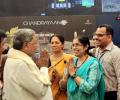
Even as the scientists and staff at Mission Operations Complex broke into applause, the core team members thanked all those who had worked on the mission. Quietly and without jingoistic boasting of their stupendous achievement. And that is the most remarkable aspect of ISRO -- they let their work do the talking, notes Minnie Vaid, author of Those Magnificent Women And Their Flying Machines, ISRO's Mission to Mars.
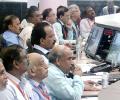
'The benchmark was set by Dr Sarabhai.' 'If there is a problem, everybody would be encouraged to come up with a solution.' 'The final solution will be the result of all the inputs.' 'This is passed on through time.' 'Even today, you see that nobody wants to take particular credit on a success.'

The rover will carry out in-situ chemical analysis of the lunar surface during the course of its mobility.

Vikram (with rover 'Pragyan' housed inside) is expected to touch down on the lunar surface on September 7, between 1.30 am and 2.30 am.

Deciphering its secrets will unlock the early history of not only our planet, but also of the star system, explains Kumar Abishek.

The Indian space agency is all set to embark on its most complex mission.

'All possible efforts are being made to establish communication with (the) lander,' the ISRO further said in a tweet.

Chandrayaan 3 follows the Chandrayaan 2 mission which did not achieve the desired soft landing on the surface of the moon in 2019, disappointing the scientists.

'You declare a date, time and place for the landing two months in advance and exactly at that moment, it touched on the moon.'

The COVID-19 lockdown has hit several projects of the ISRO including Chandrayaan-3, which was scheduled to be launched in late 2020, and Gaganyaan, the country's first manned space mission.

The ISRO said that 90 to 95 per cent of the mission objectives have been accomplished, notwithstanding the loss of communication with the lander.
An ISRO official said: "Unless and until everything is intact (lander), it's very difficult (to re-establish contact). Chances are less. Only if it had soft-landing, and if all systems functioned, then only communication can be restored. Things are bleak as of now."
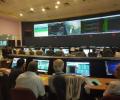
"Already, orbiter is in space and it should do an excellent job of mapping," Nair said.

A photo of the prime minister hugging Indian Space Research Organisation chief K Sivan after a last-minute setback that led to the loss of lander Vikram, was also put on display for visitors.

The ISRO plans to send three Indians to space by 2022, an announcement made by Prime Minister Narendra Modi during his last Independence Day speech.

The Sarabhai Crater is around 250 to 300 kilometres east of the crater where the Apollo 17 and Luna 21 Missions had landed.
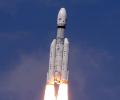
'ISRO takes a very cautious approach.' 'After reaching the moon, the orbit has to be brought down from a single elliptical orbit to a circular orbit while simultaneously ensuring the stability of Chandrayaan 3 and the health parameters of the lander and rover.'

The mission has three modules - Orbiter, Lander (Vikram) and Rover (Pragyan)

'There's nothing like failure in science, we experiment & we gain'
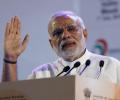
I urge you all to watch the special moments of Chandrayaan-2 descending on to the Lunar South Pole! Do share your photos on social media. I will re-tweet some of them too," the prime minister wrote on Twitter.

Chandrayaan-2 was launched on July 22, 2019 and inserted into the lunar orbit on August 20, exactly one year ago.

Modi, in his address at the ISRO centre asked the scientists not to get disheartened by the hurdles in the lunar mission Chandrayaan-2 and asserted that there will be a "new dawn".
Hours before Chandrayaan-2's 'Vikram' module's proposed soft landing on the Lunar surface, Indian Space Research Organisation chairman K Sivan said on Friday things are progressing as per plan for the much-awaited event.

CARTOSAT-3 is a third generation agile advanced satellite having high resolution imaging capability.

NASA posted images clicked by its Lunar Reconnaissance Orbiter camera, showing the site's changes on the Moon and the impact point before and after the spacecraft had made a hard-landing on the lunar surface.
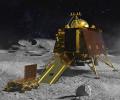
Most components of technology demonstration, including the launch, orbital critical maneuvers, lander separation, de-boost and rough braking phase were successfully accomplished.

"It is going to be the most complex mission ever undertaken by ISRO. It is going to take place between July 9 and 16, this year," Sivan said, addressing scientists from the Mission Control Centre.

The space agency had got support from the entire nation, despite it losing communication with the lander ahead of the touchdown, with people from all walks of life praising ISRO and its scientists for the achievement.
ISRO chairman K Sivan said the proposed soft-landing was going to be a 'terrifying' moment.

The landing on the moon near the South Pole, an uncharted territory so far, would be on September 6 or 7, Sivan told reporters, as the Indian space agency is all set to embark on its most complex mission.
The US astronaut reflected on the importance of international cooperation in space missions like these.
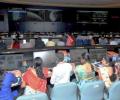
"Progressively, you can imagine that it becomes that much more difficult, with each passing hour, the available power on the battery gets drained out, and there won't be anything left for it to power and operate", an ISRO official said.

"I remember Chandrayaan-2's launch was earlier scheduled on July 15. I was there in Sriharikota. I saw the massive carrier, 'Bahubali', from close proximity.

Scientists also expressed the hope that any technical problem will be sorted out by ISRO, and the mission will be launched successfully.
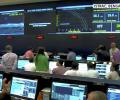
ISRO has said once the Lunar night falls, there would be no sunlight for the lander to generate power for its working and also it was not designed to operate in the heavy cold temperature of Moon during the phase.
NASA's Lunar Reconnaissance Orbiter spacecraft has snapped a series of images during its flyby on September 17 of Vikram's attempted landing sight near the Moon's uncharted south pole.
 © 2026 Rediff.com - Investor Information - Advertise with us - Disclaimer - Privacy Policy - Sitemap - Feedback - About us - Terms of use - Grievances