
The Supreme Court on Friday deferred the question of Aligarh Muslim University's minority status to a fresh bench and overruled the 1967 judgment that said the university cannot be considered a minority institution since it was created by a central law.

They all assembled at the judges' lounge before the start of the day's work and gave a standing ovation to Pragya, daughter of an obscure cook at the top court Ajay Kumar Samal.

'The ruling does not automatically mean that your house can be taken away, but suppose it blocks an expressway or a highway or such essential development, then it can be taken away as long as there is a law to support that action.'

He could have blazed a trail that few Indian judges had. It was a missed opportunity of a lifetime, notes Ramesh Menon.

Chandrachud said there were several comments on the social media which alleged that the CJI is "so arrogant" that he got up in the midst an important argument in court.
'A rigid or overly broad interpretation could lead to a chilling effect on investments and growth in sectors traditionally driven by private initiative.' 'Entrepreneurs may fear that their assets could be arbitrarily appropriated by the State under the guise of serving the 'common good' without sufficient legal safeguards.' 'The judgment thus supports a more nuanced view, one that balances individual property rights with public welfare objectives.'
'This government is not in the hands of M K Stalin but in the hands of the bureaucracy -- the IAS and IPS.'

A five-judge bench headed by Chief Justice D Y Chandrachud noted that Karnataka high court judge Justice Vedavyasachar Srishananda, who had made those observations, had on September 21 tendered an apology for his comments in the open court there.
The announcement on integration of WhatsApp with its Information and Communications Technology (ICT) services was made by the CJI before a nine-judge bench headed by him commenced the hearing on the vexed legal question arising from the petitions about whether private properties can be considered "material resources of the community" under Article 39(b) of the Constitution, which is a part of the Directive Principles of State Policy (DPSP).

Senior-most Supreme Court judge Sanjiv Khanna on Wednesday recused himself from considering pleas seeking review of the apex court's judgment last year declining legal recognition to same-sex marriage, sources said.

A bench headed by Chief Justice DY Chandrachud, which had taken cognisance of the incident, has kept the matter on top of the cause list for hearing at 10:30 am on Tuesday.

The letter comes after a report by the London-based Financial Times, citing documents from George Soros-backed Organized Crime and Corruption Reporting Project (OCCRP), alluded to a "fraud" by the Adani Group by selling low-grade coal as high-value fuel in 2013.

According to the cause list of July 10 uploaded on the apex court website, a five-judge bench headed by Chief Justice DY Chandrachud would consider in chambers the pleas seeking review of the October 17 last year verdict.
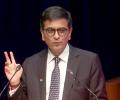
"It is very easy to fling allegations and letters," an anguished Chief Justice of India D Y Chandrachud said on Thursday while clarifying that the bail plea of Aam Aadmi Party leader Satyendar Kumar Jain in a money laundering case was listed before a bench headed by Justice Bela M Trivedi as Justice A S Bopanna was unavailable due to illness.

Counted as a judge who enriched the 'verdict docket' of the apex court, Justice Chandrachud is viewed as sharp, articulate and forward looking.

The Supreme Court on Thursday announced the launch of portal 'SuSwagatam', which would enable advocates, visitors, interns and others to register themselves online and get e-passes to enter the apex court.
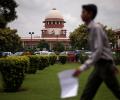
A seven-judge Constitution bench headed by Chief Justice D Y Chandrachud, by a majority of 6:1, set aside the apex court's five-judge bench verdict of 2014 in the EV Chinnaiah vs State of Andhra Pradesh case which had held that no sub-classification of Scheduled Castes (SCs) can be allowed as they are a homogeneous class in themselves.
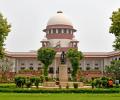
A five-judge bench of the apex court chaired by Chief Justice D Y Chandrachud sat on a holiday to address the dispute where a defiant judge overruled an order of a division bench that had quashed his direction for a CBI probe and asked the central agency to go ahead with the investigation.

'People don't know about the immense pressures that come with this position -- every decision a judge takes affects real people and their lives.' 'This is not a job that one can take lightly.' A

Holding that the electoral bonds scheme was not fool-proof, the Supreme Court said on Thursday that information about funds received by a political party is essential for voters to exercise their freedom to vote effectively.

President Droupadi Murmu administered him the oath at a brief ceremony held at the Rashtrapati Bhavan.
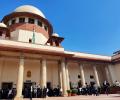
A committee headed by Chief Justice of India DY Chandrachud designated 56 lawyers and advocate-on-record as senior advocates, 11 of them women.
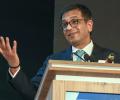
Chief Justice of India D Y Chandrachud on Friday said that as a judge, he is a 'servant' of the law and the Constitution and has to follow the position that has been laid down.

Justice Chandrachud also dealt with questions about criticism by eminent lawyers on the allocation of cases to particular judges and 'bench hunting', and said the allocation of cases is not "lawyer-driven" and vowed to maintain the credibility of the institution of the Supreme Court.
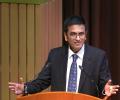
The sources said the CJI took his daughters to his chamber while explaining about his workplace and showed them the place where the judges sit and from where the lawyers argue their cases.

Quoting Greek philosopher Socrates, Justice Bopanna emphasised that there are four qualities that are expected of a judge -- to hear courteously, to consider soberly, to answer wisely and to decide impartially.
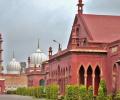
There is nothing "fundamentally inconsistent" with a minority institution being an institution of national importance (INI), the Supreme Court said on Wednesday while hearing arguments on the vexed issue of minority status to Aligarh Muslim University (AMU).

Democracy does not begin and end with elections and the integrity of election process is pivotal for sustaining the democratic form of government, the Supreme Court said on Thursday while striking down as unconstitutional the electoral bonds scheme for political funding.

It is crucial to electoral democracy that the exercise of freedom to vote is not subject to undue influence, the Supreme Court said on Thursday while striking down as unconstitutional the electoral bonds scheme for political funding.
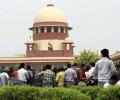
"It does not matter," the Supreme Court on Friday observed after an advocate mentioned before it that an objectionable video in which the apex court has been compared with a brothel is being circulated on social media platforms.

Directing the Centre, states and Union Territories (UTs) to ensure the queer community is not discriminated against, the CJI, who is heading the constitution bench, said queer is a natural phenomenon known for ages and is neither urban nor elitist.

The Delhi high court on Friday dismissed with a cost of Rs 1 lakh a public interest litigation (PIL) challenging the appointment of Justice D Y Chandrachud as the Chief Justice of India.

Grappling with the intractable issue of Aligarh Muslim University's minority status, the Supreme Court said on Thursday the 1981 amendment to the AMU Act, which effectively accorded it a minority status, only did a "half-hearted job" and not restore to the institution the position it had prior to 1951.

Chief Justice of India D Y Chandrachud on Tuesday said the State has an obligation to recognise unions entered into by queer couples and grant them benefit under the law.

Chief Justice of India (CJI) D Y Chandrachud on Thursday announced launch of 'neutral citations' which would ensure a uniform pattern of citing the decisions of the Supreme Court.
Within a span of little over a month since Chief Justice D Y Chandrachud assumed office, the Supreme Court has disposed of 6,844 cases, including 2,511 bail and transfer petitions, sources said.

Not ordering disclosure of details of electoral bonds prior to April 12, 2019, was a "conscious choice" by the Constitution bench, the Supreme Court said on Monday while refusing to entertain the submissions of ASSOCHAM and CII against the disclosure of bond details on the ground of their plea not being listed.

Cameras were focused on Chief Justice of India Justice Dr Dhananjay Yeshwant Chandrachud at the Independence Day event at the Red Fort in New Delhi on Tuesday morning.
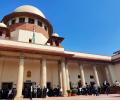
A five-judge bench headed by Chief Justice DY Chandrachud considered the pleas in chambers and dismissed applications for listing of the review petition in open Court.

Chief Justice of India (CJI) D Y Chandrachud on Tuesday said the greatest challenge before the Indian judiciary is to eliminate barriers to accessing justice and make sure that the judiciary is inclusive and accessible to the last person in the line.
 © 2026 Rediff.com - Investor Information - Advertise with us - Disclaimer - Privacy Policy - Sitemap - Feedback - About us - Terms of use - Grievances