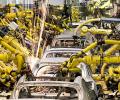
The sharp increase in commodity prices on account of the Russia-Ukraine war has put automakers in a fix. After the frequent price hikes in the current fiscal, manufacturers fear that any more price increases may further dent the already weak demand in certain segments. "We have taken several hikes and cannot immediately do it again. "We will have to closely watch the situation and act accordingly," said an official at an auto firm, declining to be identified. Even for companies like Tata Motors Passenger Vehicles, which has had a strong volume run and a robust order book, passing on the entire costs has been tough.

If 2019-20 (FY20) was an unusual year for highway construction in India, with the pace of work slowing down for the first time since the Narendra Modi government assumed power in 2014, largely due to the general elections in May and liquidity crunch, the outbreak of the Covid-19 pandemic in 2020-21 (FY21) only made matters worse with lockdowns and labour unavailability. The pace of highway construction in 2021-22 (FY22) has not been able to bulldoze the pandemic barriers in a year marred by two Covid-19 waves - the second at the start of the fiscal year, the third towards the close. With localised lockdowns and restrictions on mobility, highway construction growth in the country has now fallen to a five-year low.

'Bharat has been leading, but it cannot carry India as the bulk of the sales come from India in terms of volume and profitability.'
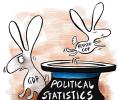
India Ratings and Research on Friday revised down India's FY22 real GDP growth forecast to 10.1 per cent, from earlier projection of 10.4 per cent, citing the second wave of COVID-19 infections and slower pace of vaccination. At a time when large parts of the country are experiencing tremendous pressure on medical infrastructure, the agency said it expects the second wave to start subsiding by mid-May. Earlier this month, the Reserve Bank maintained its 10.5 per cent GDP growth estimate, but Governor Shaktikanta Das has flagged the rising cases as the biggest impediment to recovery.

After a very weak December quarter and a poor year-to-date fiscal year volumes-when sales plunged to the lowest in nine years, the signs in the first 15 days of January haven't been encouraging either. "Though the severity of the current wave is not as high as the previous one, it has hit the sentiments hard impacting conversion of enquiries into sales," said Vinkesh Gulati, president, Federation of Automobile Dealers Association (FADA).

The Centre could better its fiscal deficit at 6.6 per cent of GDP in this financial year on stronger-than-expected revenue buoyancy, even if the budgeted disinvestment target is not met, Fitch Ratings has said. The international rating agency had last week kept the sovereign rating unchanged at 'BBB-' with a negative outlook, and said that the risks to India's medium-term growth outlook are narrowing with rapid economic recovery from the pandemic and easing financial sector pressures. In an email interview with PTI, Fitch Ratings Director (Asia-Pacific Sovereigns) Jeremy Zook said the two key positive triggers that could lead to a revision of the outlook to stable are implementation of a credible medium-term fiscal strategy to lower debt burden and higher medium-term investment and growth rates without the creation of macroeconomic imbalances, such as from successful structural reform implementation and a healthier financial sector.

Flush with liquidity, banks are eager to lend. And, therein lies the problem, warns Tamal Bandyopadhyay.

The share of total health expenditure as part of the gross domestic product (GDP) went down to 3.3 per cent in 2017-18 from 3.8 per cent in the previous two years, according to the national health account data released on Monday by the health ministry. The share of government expenditure as part of total expenditure as well as GDP has gone up from from 3.78 per cent to 5.12 per cent between 2013-14 and 2017-18, which could also explain a decline seen in out of pocket expenditure in 2017-18. Health ministry also emphasised the increase in the government health expenditure as part of the total GDP from 1.15 per cent in 2013-14 to 1.35 per cent in 2017-18.

The retail inflation rate breached the 6 per cent upper tolerance limit of the RBI for the first time in seven months in January, while the wholesale price index stayed in double-digits for the 10th month in a row, showed two sets of data released by the government on Monday. Retail inflation, the key input for the RBI while reviewing the repo rate every two months, soared during the month mainly because of a spike in certain food items. The previous high for retail inflation was 6.26 per cent in June 2021.

The economy, though projected to grow 9.6 per cent in the next financial year in year-on-year growth term, may grow just 1 per cent in real terms to Rs 147.17 lakh crore as against Rs 145.66 lakh crore in 2019-20, at the 2011-12 prices, according to a report by India Ratings. The size of the economy, as per the National Statistical Office's data, had stood at Rs 145.66 lakh crore in 2019-20, at the 2011-12 prices. According to the rating agency, the country's gross domestic product (GDP) is expected to contract 7.8 per cent to Rs 134.33 lakh crore in 2020-21, but may grow 9.6 per cent to Rs 147.17 lakh crore in 2021-22.

Household indebtedness is higher in the southern states as compared to the other parts of the country, a report said on Tuesday. Citing the All India Debt and Investment Survey (AIDIS) data from 2013-2019, domestic agency India Ratings said household indebtedness both in rural and urban areas was higher in southern states than rest of India. In 2019, Telangana with 67.2 per cent had the highest proportion of its rural households indebted and Nagaland with 6.6 per cent had the lowest proportion of its rural households indebted.

India Inc resorted to salary cuts to protect their profits in the June quarter, as revenues came under pressure due to the second pandemic wave that affected nearly the entire country, a report said on Wednesday. The "weak" wage growth will prove to be a drag on the overall economic recovery in the medium term as it will affect household consumption, the report by India Ratings and Research said. An environment of pandemic-led uncertainty and elevated inflation could impact the level of spending and hence the overall demand, it said.

The sudden stop in economic activity led to a sharp decline in employment-intensive sectors like construction, manufacturing and trade, hotels, transport etc.

'The wish is that 2022, if not bring us into happier times, at least sees some easing of the pain,' hopes Aakar Patel.

At a combined level, the fiscal deficit of the Centre and states together will come at 12.1 per cent, with the states contributing 4.5 per cent.
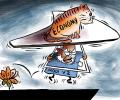
India's growth outlook has weakened sharply this year, with a crunch that started with the non-banking finance institutions spreading to retail businesses, car-makers, home sales and heavy industries.

India's dependence on imported crude oil to meet domestic demand has been a matter of concern for years. Delivering the inaugural address at the global energy summit - Urja Sangam - in 2015, Prime Minister Narendra Modi had called for enhancing domestic oil and gas production to cut the import burden. He aimed at lowering it by at least 10 per cent by 2022 - to coincide with the platinum jubilee of India's independence. But this target is far from being achieved and the country's import reliance has only risen.

Providing services like broadband connectivity, cable TV, enterprise solutions, and payment wallets is the need of the hour for telcos, and a second wave of consolidation is upon the industry, a rating agency said on Tuesday. India Ratings and Research said the sector, which was battered following the aggressive entry of Reliance Jio, will continue showing signs of recovery amid conducive regulatory environment and maintained a "stable" outlook for the industry in FY22. The second round of consolidation (Consolidation 2.0) is kicking-in in the industry, which will bring a transformation in the business models of telecom companies, leading to the evolution of incumbents from the providers of traditional voice-only services to complete digital solutions for households, it said.

MEIL has become one of the fastest growing and most successful infrastructure and engineering, procurement, and construction companies in the country in recent times.

'In 2016, we had De-Mon and in 2017, we had GST.' 'The combined impact of these two started showing up in 2019 and 2020.' 'COVID-19 only added insult to injury.'

The improved outlook on the Government of India announced by rating agency Moody's might need to be viewed with some scepticism. There is no doubt the performance of the Indian economy has sharply improved from the deep trough it hit last year. But the ability of the second largest global ratings agency to assess an upside and downside before events make everyone wise about India has been dismal for a long time, as the chart shows.

Days after keeping India's rating at lowest investment grade for 13th year in a row, the rating agency in a webinar said despite the contraction in GDP this year, the country continues to be an outperformer among the peer groups.

From Covid-19 essentials, such as Vitamin C supplements and thermometers, to bicycles, laptops, and personal weighing scales, demand for certain items galloped during last financial year as the pandemic altered what Indians used on a day-to-day basis. Imports of outdoor sports equipment, handbags for women, and dentures, among others, plummeted. With outdoor activities coming to a halt last year and schools functioning virtually, imports of sports goods witnessed a decline, while inbound shipments of laptops and battery chargers saw a sharp uptick, according to the import data for the financial year 2020-21.

After the government sought Parliament's nod for a second batch of supplementary demand for grants that will cause a hit of Rs 2.99 trillion to the exchequer, doubts suddenly arose about the government's ability to meet the Budget projections of reining in its fiscal deficit at 6.8 per cent of gross domestic product (GDP), or Rs 15.06 trillion, for the current financial year. Till now, many were of the opinion that the government would succeed in checking the deficit at a much lower figure than what was given in the Budget Estimates (BE). The government had sought Parliament's approval to spend Rs 3.74 trillion extra, but Rs 74,517.01 crore will be matched by equal savings on other heads.
In Q1, India's GDP shrank by a staggering 24 per cent year-on-year amid the imposition of one of the most stringent global nationwide lockdowns.

From spending a little less than three hours on making voice calls, Indians are spending well over 5 hours. So, while people make more calls, they are spending less than ever, reports Romita Majumdar.

The real estate sector might have been caught off guard by the second wave of the Covid-19 pandemic, but large listed developers like Godrej Properties and Prestige Estates Projects soldier on undeterred. They aim to have sales bookings of Rs 10,000 crore in the next few years.

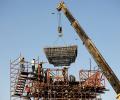
India's economy is unlikely to see double-digit growth and may grow between 8 per cent and 9 per cent this fiscal year (2021-22, or FY22), against the estimated 11.5 per cent, according to leading economists and rating agencies. The downward revision of growth projections to as low as 10 per cent is mostly on account of stringency in restrictions by states, relatively slow vaccination pace, and the possibility of a third wave of the pandemic. However, they say the impact will not be as severe as the first wave, and expect the first quarter to see positive growth.

Zero-coupon bonds don't give out interest but are issued at a deep discount to the face value, making it difficult to ascertain the net present value.

Railway route privatisation is not as rosy it looks as there is no bar on competition on one hand and demand-risks outweigh the benefits on other, even though the private operator is free to fix the tariffs, warns a report.

Remittances growth is muted due to "structural" reasons which will hamper consumption demand locally, a report said on Thursday. "...the muted external remittances growth is more of a structural issue than transitory," India Ratings and Research said in its note. India has been the largest recipient of remittances from its diaspora spread all across the world and received over $70 billion inflows last year. The agency argued that flows had started to moderate even before the COVID-19 pandemic outbreak, pointing out that as a percentage of gross disposable income, the share of remittances fell to 2.5 per cent in FY19 as against 3.5 per cent in FY10.

Welcoming the latest round of stimulus announced by Finance Minister Nirmala Sitharaman on Thursday, experts said the measures will support the economic recovery boosting demand, job creation and by providing funds to the MSME and stressed sectors. The fiscal impact of the stimulus is likely to be around 0.25-0.6 per cent of GDP in the current fiscal, they said.

If the government cuts wasteful expenditure as it is trying now, the deficit would at most fall to 8 per cent, not less than that.

If raters get away by moving from AAA to D overnight after companies default, as happened with DHFL, YES Bank, RCom, and IL&FS, it shows a complete breakdown in the rating system. It calls for exemplary punishment, not kid glove treatment, says Debashis Basu.

For 2021-22, it projected the economy to clock a growth of 10.6 per cent.

Auto-debit payment bounces have gone up for the second consecutive month in May, emphasising the stress building up due to a halt in economic activities as authorities lock down various parts of the country to stop the spread of the virus in the second wave. According to the National Automated Clearing House (NACH) data, in May, of the 85.7 million transactions initiated, 35.91 per cent, or 30.8 million transactions, failed.

Sluggish infrastructure sector growth would also have impact on IIP as these segments account for about 41 per cent of the total factory output.

The Indian team has all the markings of a great team as it can not only fight it out but win against the odds in all conditions, former Australia opener Matthew Hayden said.

The airline had raised Rs 700 crore from the debt market through a non-convertible debenture issue and the same was up for interest payment or redemption on Thursday.
