
Fitch Ratings on Thursday said the resurgence of COVID-19 infections may delay India's economic recovery, but won't derail it, as it kept the sovereign rating unchanged at 'BBB-' with a negative outlook. It projected a 12.8 per cent recovery in GDP in the fiscal year ending March 2022 (FY22), moderating to 5.8 per cent in FY23, from an estimated contraction of 7.5 per cent in 2020-21. Fitch had in June last year revised outlook for India to 'negative' from 'stable' on grounds that the coronavirus pandemic had significantly weakened the country's growth outlook and exposed the challenges associated with a high public debt burden.

The bond market is not in a mood to reason with the Reserve Bank of India (RBI) on keeping yields low. The 10-year bond yields continued to rise for the fourth straight session to close at 6.202 per cent from its previous close of 6.135 per cent. The yield was at 6 per cent a week ago. The RBI wants the yields to remain at 6 per cent, but bond dealers say the central bank will have to step up its bond-buying programme.

India's industrial production contracted by 3.6 per cent in February, official data showed on Monday. According to the Index of Industrial Production (IIP) data released by the National Statistical Office (NSO), manufacturing sector output declined by 3.7 per cent in February 2021. Retail inflation rose to 5.52 per cent in March, mainly on account of higher food prices, government data showed on Monday. The consumer price index (CPI) based retail inflation stood at 5.03 per cent in February.

Indian economy is likely to rebound with an 8.9 per cent growth in the fiscal year beginning April 2021 after economic activity showed significant improvement in the last quarter, IHS Markit said on Friday. The National Statistical Organisation (NSO) on Thursday predicted that the economy will contract 7.7 per cent in the current financial year ending in March, the worst performance in four decades.

Going forward, the February factory output may be impacted as several industries such as automobiles, technology, pharma and fashion have some exposure to imports of raw and intermediate materials from China.

As India emerges from the COVID-19 crisis, the ninth budget under the Modi government, including an interim one, is widely expected to focus on boosting spending on job creation and rural development, generous allocations for development schemes, putting more money in the hands of the average taxpayer and easing rules to attract foreign investments.

A communiqu sent by the department of investment and public asset management (DIPAM) to the heads of all PSUs, said the move would help the government to get predictable and periodic dividends before Budget estimates are firmed up.

Check out some of the stocks that will react on the basis of their numbers in the near term.

To enable widen the fiscal deficit beyond the permissible limit under the present legislation, the government may have to propose amendment to the FRBM Act in the Finance Bill.

India Ratings expects long products demand growth to be sharp, supported by a demand push from the government-led infrastructure investments in affordable housing, railways, rural electrification and road networks.

Bajaj Finance was the top laggard in the Sensex pack, tanking up to 8 per cent, followed by M&M, Tata Steel, Bajaj Auto, ONGC, HDFC Bank and Kotak Bank. On the other hand, TCS, Tech Mahindra, HUL, Axis Bank and ITC were the top gainers.

The number of centrally sponsored schemes have increased to 35 in FY22 from 30 in FY21 and central sector schemes have increased to 704 from 685 in the previous year, reports Dilasha Seth.

India's GDP estimates for 2020-21 show that the economy is expected to perform much better than earlier projections by different agencies, indicating a sustained V-shape post-lockdown recovery, experts said. The first Advance Estimates (AE) by the National Statistics Office (NSO) has projected a contraction of 7.7 per cent in the real GDP during 2020-21. This was better than the projections by certain international agencies like the IMF and World Bank.

Unlike the earlier experience post the global financial crisis, where nearly 90 per cent of the restructuring happened in the corporate loans, the non-corporate segment, which includes small businesses, agricultural loans and retail lending, will account for a higher share this time.
About 50 per cent of the accounts that availed of the EMI moratorium amid the pandemic, which made things worse in an already slowing economy, are expected to be restructured, and of these accounts that would undergo restructuring, one-third, or Rs 6-9 trillion, could turn into NPAs.
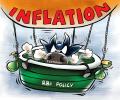
Inflation in food articles basket was 6.99 per cent In May, 2019, down from 7.37 per cent in April. However, onion prices spiked in May with inflation at 15.89 per cent, as against (-) 3.43 per cent in April.

Like everything else, the structure of banks may change, and banks may depend more on digital technologies and artificial intelligence for dealing with both their customers and employees.

Declining vegetable prices brought down the retail inflation to a 15-month low of 4.59 per cent in December and within the comfort zone of the Reserve Bank, government data showed on Tuesday. It is for the first time during the current fiscal that the Consumer Price Index (CPI) based inflation print is below 6 per cent or in the RBI's target range of 2 to 6 per cent. The central bank factors in the CPI-based inflation while arriving at its monetary policy. The inflation in December 2020 came down from 6.93 per cent in November, mainly on account of 10.41 per cent decline in vegetable prices over the year-ago period.

Mukesh Ambani-led company will squeeze market shares and margins of existing players

Reliance Infrastructure is fully geared to deliver the project in 60 months from the appointed date of June 24, 2019, as per the contract, Reliance Infrastructure said in a BSE filing.

After unseasonal rains, supply disruptions and pandemic-induced woes pushed retail inflation well over the Reserve Bank's comfort zone in 2020, the scenario is likely to stay that way at least in the short term as economic recovery slowly gains foothold. For most part of this year, pricier food items pushed the retail inflation, based on Consumer Price Index (CPI), higher in the range of 6.58-7.61 per cent, except for March when the reading was 5.91 per cent. Experts believe retail inflation is likely to average around 6.3 per cent this fiscal and mostly will remain sticky going forward owing to pick-up in demand across sectors.

From rising prescriptions to the pharma sales force back on the field with full vigour and companies finally finding their feet with the digital marketing strategies - Indian drug makers have shown that medicine sales is certainly a sunshine sector.

The incremental stress is mainly from sectors including power, infrastructure, constructions, hospitality, iron and steel, telecom, and realty.

As many as seven of eight core industries saw a contraction in output in September.

NSO has pegged economic growth at 5 per cent in 2019-20 in its second advance estimates.

In India, it is not easy to fight it out with the large banks which are nimble-footed and technology-savvy and are continuously innovating on the retail turf with newer products for customer acquisition.

India's economy recovered faster than expected in the September quarter as a pick-up in manufacturing helped GDP clock a lower contraction of 7.5 per cent and held out hopes for further improvement on better consumer demand. The gross domestic product (GDP) had contracted by a record 23.9 per cent in the first quarter of the 2020-21 fiscal (April 2020 to March 2021) as the coronavirus lockdown pummelled economic activity.

Among other segments, home broadband subscriptions have picked up and the virtual private network service, too, increased by around 15 per cent.

Stating that a weak fiscal position continues to constrain India's sovereign ratings, Fitch said the next government's medium-term fiscal policy will be of particular importance from a rating perspective.
Yes Bank was the top gainer in the Sensex pack rising 5.80 per cent, followed by Tata Motors, ICICI Bank, IndusInd Bank, Axis Bank, Kotak Bank and Tata Steel.

The addition of a million jobs as promised by Tejashwi Yadav would make a big impact. But the electorate needs to raise its expectations, notes Mahesh Vyas.
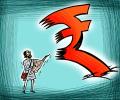
Historically, there has been no correlation between growth in bank credit to industry and lower benchmark interest rate
Fitch reaffirmed India's rating at 'BBB-' with a Stable Outlook saying the rating balances a still strong medium-term growth outlook compared with similar category peers and relative external resilience stemming from solid foreign-reserve buffers against high public debt, a weak financial sector and some lagging structural factors, including governance indicators and GDP per capita.

While most economies contracted in the second quarter of 2020, the Chinese economy grew by 3.2 per cent.

Axis Bank and ICICI Bank consumed 37-59 per cent of their operating profit for COVID-19 provisioning, while the figure is 24 per cent in case of Kotak Mahindra Bank and 10-12 per cent for IndusInd Bank and HDFC Bank.

Chief Economic Advisor Krishnamurthy Subramanian said India's economy will witness a decline in the current fiscal, but the drop will be limited if there is an economic recovery in the October-March period.

Demand bounces back but uncertainty over GST rate for jewellery casts a shadow over future.

If the fiscal deficit for the year can be maintained at Rs 7.04 trillion, the deficit as a percentage of GDP will slip to 3.44 per cent

During the first quarter ended June, gross tax collections fell 31 per cent driven down by a massive 76 per cent plunge in advance tax mop-up, as the country was in a full lockdown due to the pandemic.

RTGS is used to transfer large sums, the minimum amount being Rs 2 lakh. This mode is used primarily to facilitate trade and market transactions. The primary beneficiary would be the capital markets.
