
The Department of Space (DoS) plans to realise entirely-built rockets -- GSLV-Mk III and SSLV -- from Indian industry partners, in addition to PSLV, according to a top official of its commercial arm NSIL.

Weighing 6,100 kg, the communication satellite would be the heaviest payload to be placed into the Low Earth Orbit (LEO) in LVM3 launch history from Indian soil.

The satellite, weighing about 4,410 kg will be the heaviest to be launched from the Indian soil and into a Geosynchronous Transfer Orbit (GTO), the space agency said. The satellite will travel onboard a LVM3-M5 rocket, dubbed as 'Bahubali' for its heavylift capability.

ISRO is set to launch its communication satellite CMS-03 from Sriharikota. The satellite, weighing 4,410 kg, will be the heaviest launched from Indian soil into a Geosynchronous Transfer Orbit (GTO).

The Chandrayaan-2 mission has made the first-ever observation of the effects of the Sun's Coronal Mass Ejection (CME) on the Moon using its onboard scientific instruments. This observation would help understand the lunar exosphere and the impact of space weather on its surface.
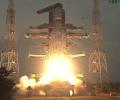
The heaviest communication satellite to be launched from the Indian soil onboard a new generation, homegrown 'Bahubali' rocket was successfully placed into the intended orbit on Sunday, the Indian Space Research Organisation said.
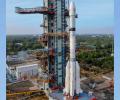
At 6.23 am on 29.1.2025, the 50.9 metre tall and weighing 420.7 ton Geosynchronous Satellite Launch Vehicle-F15 (GSLV-F15) is slated to blast off from the second launch pad carrying the 2,250 kg NVS-02 navigation satellite.
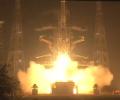
The Indian Space Research Organisation successfully launched its 100th mission on Wednesday, with a GSLV rocket carrying navigation satellite NVS-02.

India's heavy-lift rocket GSLV MkIII, carrying communication satellite GSAT-19.
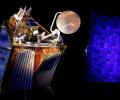
On Sunday, at 12.07 am in Sriharikota, off the coast of the Bay of Bengal, it was almost like an early Diwali, with the sky lit up by the launch of 36 OneWeb satellites. The Indian Space Research Organisation (Isro) did the launch on a 43.5-metre-tall Geosynchronous Satellite Launch Vehicle Mark III (GSLV Mk III) rocket. After the countdown, which started 24 hours in advance, once the mega screen marked the launch, a select group of invitees at the gallery cheered by applauding the feat.

The 43.43 metre tall rocket lifted off at 5.28 pm from the second launch pad at the Satish Dhawan Space Centre in Sriharikota

The Indian space agency is all set to embark on its most complex mission.

The landing on the moon near the South Pole, an uncharted territory so far, would be on September 6 or 7, Sivan told reporters, as the Indian space agency is all set to embark on its most complex mission.

GSLV-MK III, which uses a homegrown cryogenic engine, has to do at least two more launches before it begins commercial operations, report Raghu Krishnan and T E Narasimhan.
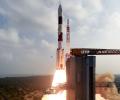
The Indian Space Research Organisation (ISRO) is all set to make its maiden commercial launch of 36 broadband communication satellites on board the space agency's heaviest rocket LVM3-M2, the countdown for which began early on Saturday at Sriharikota spaceport in Andhra Pradesh.
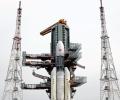
India's second mission to the moon will be launched on Monday at 2.43 pm after its initial launch on July 15 was called off owing to a "technical glitch."
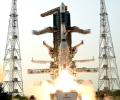
Over 32 missions -- satellites and rockets -- have been planned for the year.

India's heaviest rocket ever is expected to take to the sky next January on an experimental flight whose later versions could be used to send humans on space missions.

The 3,423 kg GSAT-29 carries Ka and Ku band high throughput transponders intended to meet the communication requirements of users, including in the North East and in Jammu and Kashmir.

Indian Space Research Organisation plans to undertake next month the first developmental flight of a "game-changer" rocket capable of launching four-ton class of satellites from Sriharikota spaceport, says its Chairman A S Kiran Kumar.
The Indian Space Research Organisation has released the first images of India's heaviest rocket, referred to as "Bahubali" days before it ferries India's Chandrayaan-2 into space. India's most ambitious space mission yet, Chandrayaan-2, which aims to place a robotic rover on the moon, will be launched on July 15 at 2:51 am. Here's all you need to know about the rocket.

'Today, when we talk of success of PSLV and GSLV Mk III, we owe it to important inputs that the Prof. Narasimha committee gave'

Join us in honouring the scientists for their latest achievement. Post your messages in the message board below.

ISRO Chairman K Sivan said there might by a postponement if the weather was not conducive.

Indian Space Research Organisation's (ISRO's) heaviest rocket LVM3 will launch British start-up OneWeb's 36 broadband satellites from the spaceport in Andhra Pradesh's Sriharikota on October 23, marking the launcher's entry into the global commercial launch service market.

The mission has three modules - Orbiter, Lander (Vikram) and Rover (Pragyan)
And the first Indian to go into space from 'Indian soil' could well be a woman.

The Indian Space Research Organisation (ISRO) on Thursday announced that its lunar mission Chandrayaan-3 will be launched on July 14 from the space port at Sriharikota in Andhra Pradesh.
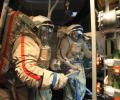
The Gaganyaan project has the objective of demonstrating human space flight capability to Low Earth Orbit with three crew members in orbit and safely recovering them after the mission.

Officials hint the visit could finally see a formal defence industrial road map being adopted by both nations.

Swapnila said they saw the GSLV Mk-III rocket that will launch the mission into space. "It was so huge," she added.
The earth observation satellite would provide real-time images of the country and also be able to quickly monitor natural disasters.

Scientists are working on conducting various tests for the ambitious Gaganyaan mission and the agency is coordinating with the Navy and others in this connection, he said.

India's premier Space Research Organisation is targetting up to 10 launches a year by 2016 , a top ISRO official said on Monday.
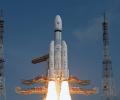
The mission is targeted for launch in the fourth quarter of 2024.

Bharti Group-backed OneWeb on Monday said it has entered an arrangement with the commercial arm of ISRO, NewSpace India Limited (NSIL), to launch its satellite in India from 2022.

The launch of the crewed space mission, Gaganyaan, is being planned before the next Independence Day and this will be proceeded by two uncrewed missions, Lok Sabha was informed on Wednesday.

It also carries equipment for meteorological data relay and satellite based search and rescue services being provided by earlier INSAT satellites.

Friday's mission is the fourth operational flight of LVM3 which aims to launch the Chandrayaan-3 spacecraft into a Geo Transfer Orbit.

The ISRO is aiming for a soft landing of the lander in the South Pole region of the moon where no country has gone so far.
 © 2026 Rediff.com - Investor Information - Advertise with us - Disclaimer - Privacy Policy - Sitemap - Feedback - About us - Terms of use - Grievances