
Aditya-L1 is meant to observe the corona, which are the outer layers of the Sun, extending to thousands of kilometres.

The Indian Space Research Organisation has resolved to alight its lander on the lunar surface with Chandrayaan-3 in addition to a maiden solar expedition in 2020.

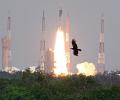
Four years after it broke many hearts, Indian Space Research Organisation's Chandrayaan is all set to soar towards the moon in its third expedition on Friday in an attempt to put the country in an elite club of nations that accomplished lunar missions with a soft landing.

The picture of Moon was taken by Chandrayaan-2's LI4 Camera from an altitude of about 2,650 km from the lunar surface.

Hours before Chandrayaan-2's 'Vikram' module's proposed soft landing on the Lunar surface, Indian Space Research Organisation chairman K Sivan said on Friday things are progressing as per plan for the much-awaited event.

On Sunday morning, in its mission to place an earth observation satellite and students satellite into the low earth orbit, the SSLV-D1/EOS-02 blasted off precisely at 9.18 am amid cloudy skies from the first launch pad at Satish Dhawan Space Centre in this spaceport.

According to sources in the Bengaluru-headquartered space agency, under the Department of Space, delivery of hardware by the industry was hit due to the lockdown imposed in several States to contain the pandemic in recent months.

Indian Space Research Organisation will announce a revised launch date later.
Officials of the Bengaluru-headquartered space agency said the first and second waves of the pandemic have "severely affected" the Gaganyaan programme.
Global analysts say a successful launch of operational GSLV MkII rocket will reduce dependency for ISRO on foreign launchers.

"It is going to be the most complex mission ever undertaken by ISRO. It is going to take place between July 9 and 16, this year," Sivan said, addressing scientists from the Mission Control Centre.
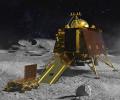
Most components of technology demonstration, including the launch, orbital critical maneuvers, lander separation, de-boost and rough braking phase were successfully accomplished.

A truly 'made in India' satellite that will empower a digital India.
ISRO chairman K Sivan said the proposed soft-landing was going to be a 'terrifying' moment.

With the launch of GSLV-MK III, slated for April, it will be able to cater to bigger satellites as well.

ISRO is focusing on more launches including that of a communication satellite from French Guiana next month.

Eminent rocket scientist S Somanath has been appointed as the chairman of the Indian Space Research Organisation as well as the space secretary, a personnel ministry order issued on Wednesday said.

India will be the fourth country after the United States, Russia and China to send humans to space.

Indian Space Research Organisation's second mission of the year to place an earth observation satellite by a GSLV rocket faced a setback as the mission could not be accomplished fully due to performance anomaly in the cryogenic stage of the rocket, the space agency said on Thursday.
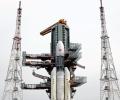
The Indian Space Research Organisation said that the countdown started at 6.51 am on Sunday.
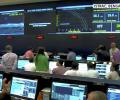
ISRO has said once the Lunar night falls, there would be no sunlight for the lander to generate power for its working and also it was not designed to operate in the heavy cold temperature of Moon during the phase.

According to ISRO officials, Earth bound orbit is a phase during which the spacecraft will remain in the Earth's sphere of influence.

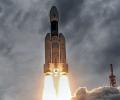
India on Monday successfully launched its second lunar mission Chandrayaan-2 onboard its powerful rocket GSLV-MkIII-M1 from the spaceport in Sriharikota to explore the unchartered south pole of the celestial body by landing a rover. Following the successful launch, leaders across the political spectrum congratulated the Indian Space Research Organisation for its hard work.
Asked if the lander was 'damaged' during the 'hard landing", Sivan said: "That we do not know".
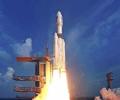
If successful, this would increase capacity to hurl small satellites into space, meeting both local demand and serving global customers.

Except Pakistan, seven SAARC countries are a part of the project.

The heaviest rocket of the Indian Space Research Organisation -- LVM3-M2/OneWeb India-1 -- blasted off from the Sriharikota spaceport on Sunday to place 36 broadband communication satellites into the Low Earth Orbit (LEO) for a UK-based customer.
The Vikram Moon Lander, named after the father of India's space mission Vikram Sarabhai on his birth centenary year, is scheduled to touch the lunar surface near its south pole on September 7 about 1.55 am.

All spacecraft parameters are normal, the Bengaluru headquartered space agency said after the maneuver on the spacecraft.
There will be two more orbit manoeuvres to make the spacecraft enter into its final orbit passing over the lunar poles at a distance of about 100 km from the Moon's surface.

All spacecraft parameters are normal, the Bengaluru headquartered space agency said after the maneuver.

Hit by inclement weather, the launch of India's latest communication satellite GSAT-16 was deferred for the second time after it was rescheduled to be put into space in the early hours on Saturday by Ariane 5 rocket from the space port of Kourou in French Guiana.

The ISRO had earlier said Chandrayaan-2 will be launched in a window from January-February 16, 2019.Sources said it is expected by the middle of next month but no date has been finalised.

Vikram (with rover 'Pragyan' housed inside) is expected to touch down on the lunar surface on September 7, between 1.30 am and 2.30 am.

Indian Space Research Organisation's plan to soft land Chandrayaan-2's Vikram module on the Lunar surface did not go as per script in the early hours of Saturday, with the lander losing communication with ground stations during its final descent.
The BJP hit back accusing the Congress of drawing the issue into political arena.
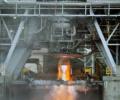
India's first indigenously designed and developed high-thrust cryogenic rocket engine generating a nominal thrust of 19 tonnes was successfully endurance hot-tested for 800 seconds.

The year ended with the launch of the PSLV's 50th mission.

'All possible efforts are being made to establish communication with (the) lander,' the ISRO further said in a tweet.
"The duration of manoeuvre was 1,738 seconds. With this, Chandrayaan-2 was successfully inserted into a Lunar orbit," Indian Space Research Organisation said.
 © 2026 Rediff.com - Investor Information - Advertise with us - Disclaimer - Privacy Policy - Sitemap - Feedback - About us - Terms of use - Grievances