
The Ghazi Attack tells the story about one of the 'last unsolved greatest mysteries of the 1971 war.'

Much of Bangladesh was paralysed on Monday by the latest strike called by Jamaat-e-Islami, with two powerful explosions rocking Shahbag Square, the epicentre of a massive campaign demanding toughest punishment for leaders of the fundamentalist party for war crimes during the 1971 war.

'Civilian casualties are something that could change the mood overnight, and therefore should be avoided by every means.'

'There are many able, good, police officers in Bengal who are capable of handling this situation, but without Mamata Banerjee nothing moves.'

There is a great danger of the government getting stampeded into actions in Kashmir that could result in long lasting damage, warns Colonel Anil A Athale (retd).

'If a bloodbath of this nature can occur in a high security area like Gulshan, I shudder to think how vulnerable other parts of this country are.'
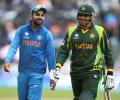
What does Pakistan mean for a young Indian? Devanik Saha attempts an answer.

Hein Kiessling has the kind of access in Pakistan that journalists (and spies) would die for, says Kanika Datta.
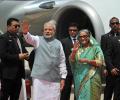
'When we have a terrorist outfit in a neighbouring nation, we need to do whatever we can to neutralise that threat,' says Ramananda Sengupta.

The magnitude of atrocities inflicted by the Pakistani establishment on the Baloch people is unimaginable, says Dr Abhay Jere.

Against the backdrop of the West Indies team's withdrawal from its tour of India, Rediff.com takes a look at instances when cricket tours have been called off midway through a series.

It is mischievous to imply that the proposed bill to grant citizenship to persecuted Hindus, Sikhs, Jains and Buddhists from other nations implies that Muslims and Christians are not Indians, says Sanjeev Nayyar.
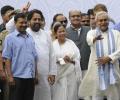
The elections in two eastern Indian states were keenly observed in Bangladesh for two major contentious issues, writes Prakash Bhandari from Dhaka.
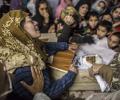
'Pakistan is paying the price for ignoring secularism. In seeking to be ever more Muslim to define its nationhood, it has become a terrorist haven.'

Prime Minister Narendra Modi has done the seemingly impossible by finalising the long-pending Land Boundary Agreement ahead of his Bangladesh visit, writes Prakash Bhandari.

'In her insecurity, she destroyed the institutions of democracy.' 'She packed Parliament with her supporters with loyalty being more important than ability; she superseded judges; she corrupted the civil service.' 'She knew how to use people against each other and was quite a master of that.' 'She would do this with calculated skill and in the bargain cause enmity between brothers, split up families.'

'Will the new government, largely of the BJP, whose manifesto proclaimed "India shall remain a natural home for persecuted Hindus and they shall be welcome to seek refuge here" and whose patrons never tire of the glories of our civilisation in antiquity, stand up for these long-lost cousins, the Yazidis in Iraq?'
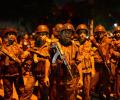
'I have noticed how a certain country wants to establish the presence of ISIS in Bangladesh.' 'Are these terrorists working under some religious inspiration or they are being lured by an obnoxious amount of money?' 'For some mysterious reasons, no action is taken by the government against suspicious organisations.'

Journalist-turned-activist Teesta Setalvad in her new book 'Foot Soldier of the Constitution: A Memoir' has spoken of the rise of communalism and the aftermath of the '02 Godhra riots. In this interview with Rediff.com's Syed Firdaus Ashraf, she discusses her book, the cases against her and the state of secularism in the country.

Bhutan's recognition of Bangladesh without waiting for Indian advice was a clever move, but if it did it even before India did, it was a calculated gamble to assert its independence, says T P Sreenivasan.

The parliamentary clearance to the Land Boundary Agreement Bill has ensured that Prime Minister Narendra Modi gets the same tumultuous welcome which late Indira Gandhi received when she first visited Bangladesh after the liberation war in 1972

'It would not be incorrect to say that the Chinese-Pakistani strategy of containing India began in the aftermath of the 1965 war.'
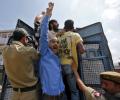
'The nation State can thrive if all communities believe they have a stake in it; that their interests will be safeguarded; that there will be no discrimination; that there will be justice.' 'The political leadership of this country needs to decide whether it wants to mitigate these challenges to the nation by making necessary correction or whether it wants to ignore these questions that Yakub's noose has left behind,' says Ankur Bhardwaj.
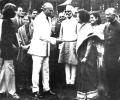
'Indira Gandhi, it appears, did not to consult her Cabinet colleagues, or diplomats, or civil servants when she decided to sign the agreement in Shimla.' 'We ruefully recall Bhutto's perfidy and the Indian prime minister's gullibility,' says Lieutenant General Ashok Joshi (retd).

'The biggest advantage for India was its seasoned and experienced political leadership who had spent decades struggling against the Raj and had spent years behind bars.' 'Not a single prominent leader of the Muslim League spent one day in jail.' 'Gandhiji, Nehru and Sardar Patel were intelligent, shrewd men with their hands on the popular pulse.'
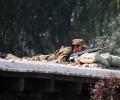
Pakistan faces a challenge largely of its own creation and only political processes can correct it, argues Raza Rumi.
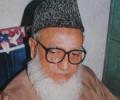
A 91-year-old top leader of the fundamentalist Jamaat-e-Islami was sentenced to 90 years in jail on Monday by a special Bangladeshi tribunal for masterminding atrocities during the 1971 war of independence against Pakistan.

Pranab Mukherjee's book The Dramatic Decade: The Indira Gandhi Years takes the readers through the economic and social unrest of the period leading up to the emergency, rise and fall of leaders, many splits within the Congress, while promising to offer more in the next two volumes of the trilogy, says Nivedita Mookerji.

'If you look at peacekeeping right now, it is fraught with accusations of sexual abuse or peacekeepers involved in deals that are outside their purview, human trafficking.' 'When a contingent of women walk through a camp, the women in the camp and the children respond to them, talk to them. Women are more open to talking about sexual violence and domestic violence to other women.'

'Pakistan's recent utterances and tendency to use pinpricks to try our patience appear reminiscent of 1965. We are a strong nation, emerging stronger,' says Lieutenant General Syed Ata Hasnain (retd).

Much of the negative perceptions of the north-east diaspora owe their origin and existence to the perverse policies of the central government toward the region and its people. This realisation must be the beginning of an earnest endeavour to address the issue, says R N Ravi.

Manobi Bandyopadhyay, India's first transgender principal of a college, speaks of her struggles in a moving interview.

'India was in no position to wage another war in 1965, having suffered a morale-shattering defeat in 1962. The three services were in the middle of a modernisation and expansion phase and therefore not fully trained or battle-ready.'
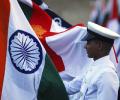
'Admiral D K Joshi's resignation is certainly an example worthy of emulation by anybody who is in a leadership role. Unfortunately, over the last 30, 40 years, I can think of very few politicians or bureaucrats who could be termed real "Leaders". Without leaders, where will there be leadership?' asks Vice Admiral P J Jacob (retd), former Vice Chief of the Naval Staff.

'He was believed to finish his own work in an hour and spend the remainder of the time walking from one office to another, sitting down with the harried junior staff and helping them sort out the problems they were working on.'

'In her insecurity, she destroyed the institutions of democracy,' says Khushwant Singh.
 © 2026 Rediff.com - Investor Information - Advertise with us - Disclaimer - Privacy Policy - Sitemap - Feedback - About us - Terms of use - Grievances