
Indirect emissions account for a major chunk of emissions by Indian IT firms. Business travel and commutation, together, are a key reason for it. If travel and daily commuting go down, so does carbon emissions.
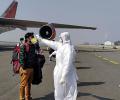
The domestic passenger traffic in July 2021 was 51 lakh, ICRA said in a release. Domestic passenger traffic on a year-on-year basis, however, spiked around 131 per cent over August 2020 traffic of 28.3 lakh, it said. The ratings agency said despite the continued recovery in the previous month, there is continued stress on demand, driven largely by the second wave of the pandemic, limiting travel to only necessary travel.

Mumbai Indians all-rounder Hardik Pandya relaxes with son Agastya.
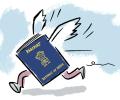
Travel companies are expecting a heavy rush to the US following the withdrawal of curbs on fully vaccinated travellers from select countries, including India, on November 8. The move will benefit those holding long-term tourist, business, and work visas. Also, new and extra flights by Air India and American Airlines are expected to provide better travel options.

On a cloudy Monday this month, Mohammed Irshad flew from Kochi to Gurugram to attend an exclusive investor networking event. Among a handful of founders selected for the event, Irshad was to pitch his peer-to-peer learning start-up Notespaedia for funding in front of top venture capital investors such as AngelBay, Elevation Capital, and Inflection Point Ventures. He failed to woo them, but the feisty entrepreneur was determined to continue his hunt.
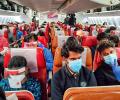
Domestic air passenger traffic jumped 57 per cent to around 49 lakh in July, reflecting a significant sequential as well as year-on-year growth amid a decline in coronavirus infections, according to a report. Recording continued recovery, traffic rose 56-57 per cent to 48-49 lakh in July compared to June this year when it was about 31.1 lakh. As against June 2020, the growth is 132 per cent, rating agency Icra said in the report on Thursday.
The domestic aviation industry is expected to report a net loss of Rs 25,000-26,000 crore this fiscal with elevated jet fuel prices and fare caps continuing to pose a major challenge for the airlines' profitability, domestic rating agency ICRA Ltd said on Thursday. The domestic airlines, however, are likely to post a reduced net loss of Rs 14,000-16,000 crore in the next financial year on the back of a "notable recovery" in air passenger traffic and lower level of debt, ICRA said. The ratings agency also estimates that the industry will require an additional funding in the range of Rs 20,000-22,000 crore during FY22-FY24.
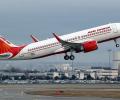
Tata Sons has started the process of due diligence of state-owned Air India and its subsidiary Air India Express. Sources said the group has appointed Bain and Company and Seabury Group for this purpose. Once complete, a financial bid will be submitted and a deal to take over the airline is likely to fructify by end of this year or even earlier, people involved in the process said. Simultaneously, the group has brought in veterans in the aviation business from Delta and United Airlines to prepare a plan for post-merger integration of Air India with its existing airline ventures. Tata Sons operates Vistara - a 51:49 percent joint venture with Singapore Airlines and Air Asia India, in which Tatas hold 83.67 per cent stakes.

Japan will temporarily suspend exemptions allowing foreign athletes to train in the country ahead of the Summer Olympics, Kyodo News reported, as it closes its borders to contain a surge in COVID-19 cases just six months before the Games.
The two sides are also expected to explore ways to deepen defence collaboration, including exercises, defence transfers and technologies ahead of the next edition of the 2+2 defence and foreign ministerial dialogue to be held in the US later this year, they said.

Victoria Premier Daniel Andrews said his government will not apply for travel permits to allow unvaccinated tennis players to compete at the Australian Open in the state after Prime Minister Scott Morrison indicated they would be allowed into the country.
With a surge in domestic air passenger traffic, the airfares have risen by 30 per cent to 100 per cent of the pre-pandemic levels amid the festive season, a top Thomas Cook executive has said. The domestic air passenger traffic increased around 67 per cent year-on-year in October. Thomas Cook, however, expects the airfares to be levelled off going forward, as the domestic carriers operate with 100 per cent capacity.

Mandarin Oriental New York, the premium luxury hotel a subsidiary of Reliance Industries is acquiring, is known for its much-in-demand ballroom, five-star spa and eating and drinking venues, including MO Lounge. Liam Neeson and Lucy Liu are among regular guests. Set up in 2003, 248-rooms-and-suites hotel towering over Central Park is an iconic luxury hotel located at 80 Columbus Circle, directly adjacent to the pristine Central Park and Columbus Circle.

Twitter said in a statement that it has announced a new policy permitting all of its employees to work from home not only through the current coronavirus pandemic but also indefinitely afterwards if they want to.

From small restaurants to mighty software companies, it is businesses, not the government, that create jobs. Yet, in a cruel irony, they have to fight extortive and brutal State power every step of the way, says Debashis Basu.
Apart from IT and pharma, the lead spenders in travel are construction, automobile and metals and mining companies and together these sectors accounted for 82 per cent of business travel spend in India in 2015, up from 78 per cent in 2013.

The hospitality sector has been hit very hard by the pandemic. In the past 18 months, it has lost business, first because of the harsh lockdowns and after that because of lack of demand due to the ensuing economic slowdown. Most hospitality businesses have sustained low revenues and losses since April 2020. Is this the classic case of a beaten-down cyclical sector that may be close to bottoming out?
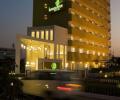
The mood at the Hotel Investment Conference South Asia (HICSA), the annual hospitality industry conference was rather upbeat. But hotel brand operators and owners remain cautiously optimistic of the outlook and are living on a hope that a third wave of the pandemic doesn't become a reality. Having just survived the unprecedented zero revenue situation, the two day confrence organised by consulting firm Hotelivate, was dotted with anecdotes and best practices adopted by the hotels of all hues.

After a better-than-expected Dussehra weekend, hospitality firms are hopeful of ending the year on a positive note by doing good business over Christmas and the New Year. Typically, year-end bookings kick in two to four weeks before the season begins. Owing to pandemic-related uncertainties, hotels are seeing a significant reduction in the booking window, with travellers waiting till the last minute to make hotel reservations.

With the dizzying rise in the number of Covid-19 cases in the country, India Inc has transitioned from a wait-and-watch policy to full-on emergency mode, bringing back remote and flexi work, stringent safety protocols, and allowing only essential travel. Companies - especially in metros like Delhi, Mumbai and Kolkata - that had adopted a hybrid work model during the last few months when the caseload remained low, are either switching back entirely to work-from-home (WFH), or calling skeletal staff to office on select days. Take the case of cigarettes-to-hotels major, ITC, which had been on a hybrid work model over the last few months.

From free salons to discounted room rates, hotels are offering it all.

Workers of tomorrow will have to figure out how to help themselves transition to different career pathways, predicts Sandeep Goyal.
The second wave of the coronavirus pandemic is likely to delay recovery in air passenger traffic with an 80-85 per cent growth year-on-year this fiscal against the earlier estimate of 130-135 per cent, ratings agency ICRA said on Monday. The domestic passenger traffic, which witnessed a steady ramp-up after resumption of airport operations since May 25 last year and reached 64 per cent of the previous year levels in February, has again suffered a setback, the ratings agency said in a report. The spike in coronavirus infections towards March-end and April has resulted in several state governments implementing fresh restrictions, resulting in a marginal 0.7 per cent de-growth sequentially in traffic in March.
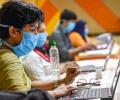
'During the course of these two years, as new people have joined, we have no mental picture to associate with them and hence, have little connection with them.'
The company has also issued a ban on all non-essential domestic and international business travel, and is encouraging employees who may have returned from international travel to work from home for 14 days.

Sources at Mumbai airport said seat occupancy has declined from around 70-72 per cent to 60-64 per cent in last three-four days as passengers are postponing or cancelling trips.
Domestic air passenger traffic was back to the growth trajectory in June amid the falling number of COVID-19 cases in the country with around three million passengers flying on local routes in the previous month as against around two million in May, a report said on Tuesday. Though there is some recovery observed in June, stress on demand continues, driven largely by the second wave of the pandemic, limiting travel to only necessary travel, credit rating agency ICRA said in its report. On a sequential basis, domestic passenger traffic was up 41-42 per cent in June over May.
In December, over 1.7 million people have checked in over the weekends.

Dhruv Shringi, co-founder and chief executive officer (CEO) at Yatra, tells Ajay Modi that Indian online travel market is definitely moving into a duopoly situation.
People have said they would be inclined to travel for leisure during the festival and year-end season.

Modi also hailed the contribution of doctors, nurses and healthcare workers in fighting the virus and said the country will always cherish their contribution.

Thomas Cook India's internal data had highlighted Lucknow region as a high potential source market for holiday business.

'We need to retell this history from many different perspectives.'
Over 50 per cent of all traffic to Jeddah consists pilgrims headed to Mecca and Medina.

As Japan expands state of emergency, calls grow to cancel Games. Japan has repeatedly insisted it will hold the Games despite opinion polls showing a majority of respondents want them postponed again or cancelled.

The year gone by has also forced all airlines to turn the lens sharply on their own costs, workings and internal dynamics, opening their eyes to their vulnerabilities. Fewer, leaner, nimbler players will emerge from the carnage.

Apart from such advisory, IT biggies such as TCS, Infosys and HCL Tech among others have been pursuing 'remote working' model to overcome the situation.

The magnitude of the economic losses will depend on how the outbreak evolves, which remains highly uncertain.
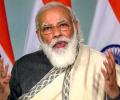
Human memory about policy issues is short. That alone can explain why many are deliriously happy with his latest slogans and ignore seven years of poor 'doing business' climate, taxtortion, extortionate oil prices, and high dependence on babus and the big State that has kept the enterprise system stifled, observes Debashis Basu.
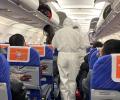
Vistara started allowing passengers to book an extra seat from Tuesday. IndiGo and SpiceJet, too, are in the final stages of designing such a product to be sold as an add-on.
 © 2026 Rediff.com - Investor Information - Advertise with us - Disclaimer - Privacy Policy - Sitemap - Feedback - About us - Terms of use - Grievances