
Indication of a potential US Federal Reserve rate cut may trigger optimism in the domestic equity market, with investors' attention shifting to the looming deadline for additional US tariffs on Indian goods in a holiday-shortened week ahead, analysts said.
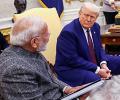
To those who ask, "Is all this really worth it? Why can't domestic demand fill the gap?", it is important to remind them that only 13 economies since the Second World War have grown at 7 per cent or more for 25 years -- like India needs to. They all had one thing in common: Strong export growth underpinned by strong global engagement, explains Sajjid Z Chinoy.

Businesses are testing new markets, tapping into domestic demand, and pushing the government for relief.

The White House has claimed that India has begun 'scaling back' its oil purchases from Russia at the 'request' of President Donald Trump.

For kids in the United States, the tariff imposed by the Donald Trump administration on countries like China may no longer be a child's play, as toy prices are predicted to touch record highs this Christmas season. However, for India's toy export industry, which was ready to take giant strides in the sector by bagging heavy orders from the US retail giants like Walmart, Amazon, and Target Corporation, gaining from the China-Plus-One policy, the US tariffs came as a heavy jolt.

Credit quality of Indian corporate is expected to be stable in the second half of the current financial year (H2FY26), supported by easing monetary cycle, and declining inflation, coupled with income-tax relief and rationalisation of the goods and service tax (GST) rates, among others.
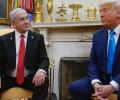
The United Nations Security Council has adopted a draft resolution endorsing United States President Donald Trump's Gaza peace plan and authorising the establishment of an international stabilisation force in the enclave, with the American leader describing it as a 'moment of true historic proportion'.

Noting that recent uncertainties created by global tariffs have not impacted the Indian economy severely, Anuradha Thakur, secretary, Department of Economic Affairs, said the central government is hopeful that the recent goods and services tax (GST) rationalisation will ignite the much needed animal spirits in the financial sector.
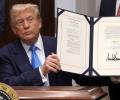
For India, the challenge is to strike a balance between tactical necessity and economic priorities, point out Pravin Krishna and Monil Sharma.

Prime Minister Narendra Modi on Saturday met United States Ambassador-designate to India Sergio Gor and said he was confident that India-US ties will further strengthen during his tenure.

Recent developments - proposed changes to the goods and services tax (GST) rates and S&P Global Ratings' upgrade of India's long-term sovereign credit rating to BBB, with a stable outlook, - may not be enough to bring foreign investors back to Indian markets in a rush, feel analysts.
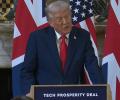
During a visit to the UK, former US President Donald Trump reiterated his claim of intervening to resolve a conflict between India and Pakistan, linking it to trade negotiations. He also discussed tariffs on India for buying Russian oil and the Russia-Ukraine conflict.
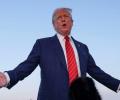
United States President Donald Trump on Tuesday said India has not been a good trading partner and announced that he will raise the tariffs on New Delhi 'very substantially' over the next 24 hours because it is buying Russian oil.

With the India-US trade talks moving in the right direction, Commerce and Industry Minister Piyush Goyal is expected to visit Washington soon, sources said.

India's manufacturing sector activity eased in September, as new orders, output and input buying rose at the slowest rates in four months, while job creation retreated to one-year low, a monthly survey said on Wednesday.

United States President Donald Trump has said there will be no trade negotiations with India until a dispute over tariffs is resolved, following his administration's decision to double tariffs on Indian imports.
'A deal will only be possible if India stops buying Russian oil -- but even then, New Delhi must not compromise its core red lines.'

Stock markets will be driven by RBI's interest rate decision, tariff-related developments, global trends and trading activity of foreign investors in this holiday-shortened week, analysts said.

Global rating Moody's on Monday affirmed India's long-term local and foreign-currency issuer ratings and the local-currency senior unsecured rating at 'Baa3' with a 'stable' outlook on the back of robust economic growth and sound external position. The rating agency also affirmed India's other short-term local-currency rating at P-3.

Reliance Jio's major subscriber losses continued for the third straight month with 7.96 million users leaving the telecom operator in September, even as the state-owned BSNL stood out as the lone gainer, data from the Telecom Regulatory Authority of India (Trai) showed on Thursday. Market leader Jio's subscriber loss has continued since July when the three private telecom operators - Jio, Bharti Airtel, and Vodafone Idea (Vi) - brought in a broad-based hike in tariffs.

Among Sensex firms, Tata Motors, Infosys, Hindustan Unilever, Power Grid, Bharat Electronics, ITC, UltraTech Cement and Tata Consultancy Services were the major laggards. However, Adani Ports, Bajaj Finance, Bajaj Finserv and Axis Bank were among the gainers.

India stares at the risk of an influx of Chinese products as US tariffs on a range of Chinese goods, including solar panels, electric vehicles, lithium-ion batteries, syringes, and steel, are set to take effect from September 27. With higher tariffs reducing China's access to the US market, there is concern that China may divert its exports to other markets, including India, which could lead to potential dumping of goods. This situation could challenge Indian industries, particularly in sectors where competition with Chinese products is already fierce.

Gold prices are likely to remain in a consolidation phase in the near term, but the overall bias will continue to stay positive amid heightened expectations of a US Federal Reserve rate cut in its September policy meeting, analysts said. Traders will closely track US macroeconomic data, such as Q2 GDP, PCE inflation, and speeches from Fed officials, which will provide more insights into the monetary policy stance of the Federal Reserve and the trajectory of the bullion sentiment, they added.

'We currently have new proposals worth Rs 1.48 trillion in the pipeline.'

India is hopeful of resuming negotiations on the proposed bilateral trade agreement (BTA) with the US soon and addressing the issue of high tariffs imposed by Washington on Indian goods will be key to striking the deal, a government official said on Thursday.
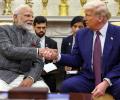
A US lawmaker and former officials warn that President Trump's policies are damaging the strategic partnership between the United States and India, potentially driving India closer to China and Russia.

'Don't look at Russia only as a place to earn quickly and then leave.' 'Try to build experience in serious companies, skills and certifications that will serve you anywhere in the world.'
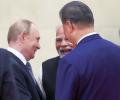
Navarro's remarks came after the public display of bonhomie by the three leaders on the sidelines of the Shanghai Cooperation Organisation (SCO) summit in Tianjin on Monday.

If India caves in to US pressure as Trump hopes it will, he will further try to blackmail it into submission, points out Ramesh Menon.

New Delhi 'will have to take a call which supply source suits us the best,' the finance minister said, pointing out that crude oil accounts for the bulk of India's foreign exchange spend.

Losing subscribers for the fourth straight month, Reliance Jio witnessed 3.76 million users leave the telecom operator in October, data from the Telecom Regulatory Authority of India (Trai) showed on Monday. Meanwhile, Bharti Airtel reversed three months of decline, and added 1.92 million users, indicating it has overcome the impact of the broad-based tariff hikes imposed by private sector telcos in July.

Foreign investors have pulled out nearly Rs 18,000 crore from Indian equities so far this month, weighed down by escalating US-India trade tensions, disappointing first-quarter corporate earnings, and a weakening Indian rupee. With this, the total outflow by Foreign Portfolio Investors (FPIs) in equities has reached Rs 1.13 lakh crore so far in 2025, according to data from the depositories.

Finance Minister Nirmala Sitharaman on Friday said the world is facing "profound imbalances" in trade and energy security, and is undergoing a structural transformation, with India standing out as a 'stabilising force' that can withstand external shocks.

K Krithivasan -- the chief executive and managing director of TCS -- believes that the tariff moves-induced uncertainty impacting the sector will be "short-lived" and expects it to get resolved within "months".

European Union (EU) companies operating in India want New Delhi to streamline or remove non-tariff barriers such as Quality Control Orders (QCOs), complex Customs procedures; simplify labelling, testing, and import procedures; and facilitate cross-border digital transactions without data localisation constraints. These are results of a Business Sentiment Survey, 2025 conducted by the Federation of European Business in India (FEBI) ahead of resumption of negotiations for a free trade agreement (FTA) between both the sides scheduled to be concluded by year-end.
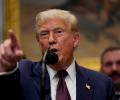
On Friday, during the weekly media briefing, MEA spokesperson Randhir Jaiswal, when asked about media reports that some Indian oil companies have stopped taking oil from Russia, had said India has made clear its approach on the issue.

A Chinese firm this week began trial production of flying cars stated to be the next-generation in the world of transportation, ahead of US firm Tesla and others plans to launch the same shortly.

Retail inflation slipped to 1.54 per cent in September from 2.07 per cent in the preceding month mainly due to subdued prices of food items, including vegetables and pulses, according to government data released on Monday. The consumer price index (CPI) based inflation was 5.49 per cent in September 2024.

Tata Steel, Maruti, Tata Motors, Infosys, Bharti Airtel and Tech Mahindra were also among the laggards. However, Trent, Asian Paints, Hindustan Unilever, ITC, Kotak Mahindra Bank, and Reliance Industries were the gainers.
Among Sensex shares, Sun Pharmaceutical, Tata Steel, Trent, Bajaj Finance, Mahindra & Mahindra, Bajaj Finserv, Reliance Industries, Axis Bank, Tech Mahindra, Adani Ports, Titan, BEL, and Larsen & Toubro were the major laggards. However, Hindustan Unilever, Maruti Suzuki India, ITC, Tata Consultancy Services and UltraTech Cement were the gainers.
