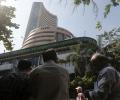
The market breadth, indicating the overall health of the market turned negative from positive
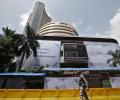
The breadth, indicating the overall health of the market, was slightly positive

Over the past one-and-half years, the number of stocks trading below their respective face value has increased 29 per cent after a sharp correction in stocks of small-cap companies.

Skittish investors snapped up gold and other safe-haven assets amid fears of a global economic slowdown

Dr Reddy's was the top gainer in the Sensex pack, rising over 3 per cent, followed by PowerGrid, TCS, HCL Tech, Infosys and Reliance Industries. On the other hand, L&T, IndusInd Bank, Bajaj Finserv and Bharti Airtel were among the laggards.

Global cues lift Sensex 364 points; Nifty ends above 8,650.

The Nasdaq Composite hit a high of 5,143.316.
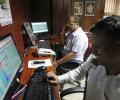
In the broader market, the S&P BSE Midcap and the S&P BSE Smallcap indices added 0.6% and 1.3%, respectively to touch their fresh lifetime highs.

The current up move, according to analysts, closely resembles the rally post the global financial crisis in 2008-09, not just in quantum and speed, but also the way small-and mid-cap indices outperformed large-cap peers.

So far, there seems to be limited debate about their activities in India, where virtually all FAANG companies have teamed up in different ways with India's most powerful businessman, observes T N Ninan.

BSE Smallcap index outperformed the frontline indices to rise 0.6%, while the BSE Midcap was flat

In terms of stock selection, India continues to benefit from two phenomena - the big getting bigger and availability of quality stocks in relative abundance compared with its Asian peers.

The S&P BSE Sensex closed 318 points at 24,455 and the Nifty50 shed 99 points to end at 7,438.

Just as very high oil prices looked an anomaly in a sluggish world, so now do record high equities.

Investors turn their attention to export-driven sectors.

The FPI holding in India's top 100 companies, which are part of the Nifty 100 index, declined to 24.23 per cent on average at the end of March this year, from a high of 27.5 per cent at the end of March 2021. This is the lowest FPI holdings in India's top listed companies in at least three years. A general sell-off by FPIs has weighed on stock prices and the benchmark S&P BSE Sensex is down 8.5 per cent, from its 52-week high made in October 2021. Most analysts expect FPI flows to remain weak in FY23 as well, given rising bond yields in the US and an expected earnings slowdown in India due to high inflation and commodity prices.

HCL Tech and ONGC were the top gainers in the Sensex, rising up to 3.40 per cent.

Sensex lost 184 points to trade at 23,878 and the Nifty has dropped 55 points to quote at 7,254.

The S&P BSE Sensex surged 364 points to end at 24,607 and the Nifty50 soared 107 points to close at 7,476.

The S&P BSE Sensex slipped 305 points to end at 25,400 and the Nifty50 dropped 87 points at 7,783.

BSE Bankex and Telecom indices led the fall.

Gains were led by HUL on better-than-expected margins in March quarter and capital goods shares.

BSE Midcap and BSE Smallcap indices settled the day 0.7% and 0.9% higher
Bank shares were the top losers after sharp gains last week.

ICICI Bank, HDFC Bank, IndusInd Bank down between 0.2%-1.4% each.

The S&P BSE Sensex ended up 129 points at 26,843 and the Nifty50 ended up 39 points at 8,220.
The S&P BSE Sensex dropped 1 points to end at 26,396 and the Nifty50 slipped 2 points to end at 8,109.

Financials were among the top losers along with Sun Pharma and index heavyweight Reliance Industries
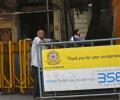
Nearly 400 stocks hit their 52-week low on BSE on Thursday.
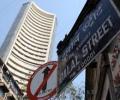
S&P upgraded India's credit outlook to 'stable' from 'negative' earlier.

The markets have been unable to sustain at higher levels as a rise in bond yields globally, especially in the US have dented sentiment. Surging commodity prices, especially crude oil that have now hit $70 a barrel (Brent) coupled with inflation woes and fear of sporadic lockdown across major economic hubs back home as Covid cases rise have chased the bulls away. In the short-term, analysts expect the markets to remain volatile as they react to news flow - both from overseas and developments back home. Investors, they say, need to keep a tab on how the US treasury yields move, which in turn will have a ripple effect on how big money moves across developed (DMs) and emerging markets (EMs), including India.

Despite the large economic impact of the Covid-19 pandemic, the markets have recovered sharply even though the performance among individual stocks has been quite polarised.

Multiple triggers such as asset sales, pickup in energy cash flows, increased traction in omni-channel retail, and rise in ARPUs could further drive the stock.

The fall in metal and mining stocks comes on the back of weak Chinese trade data

Shares of RIL ended 2.4% higher as it pips TCS to become most valued firm

While analysts remains overweight on financials, property, discretionary, industrials and materials, they maintain a neutral stance on pharma, telecom and energy; and underweight on staples, utilities, and IT services.
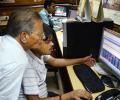
Rise in crude oil price and rally in global equities aided the sentiment

Broader markets outperformed with BSE Midcap and BSE Smallcap adding 0.23% and 0.45%, respectively

Among major Sensex gainers, ITC rose the most by 2.32 per cent, followed by TCS, M&M, SBI and Bharti Airtel.
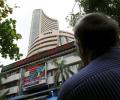
SBI, PNB, Bank of Baroda, Canara Bank, Dena Bank, Central Bank of India ended down 3%-12% each.
 © 2026 Rediff.com - Investor Information - Advertise with us - Disclaimer - Privacy Policy - Sitemap - Feedback - About us - Terms of use - Grievances