
Liquidity stress in smallcap funds has fallen to its lowest level since February 2024, with the average time to liquidate 50% of portfolios dropping to 27 days in June from a peak of 44.2 days in January 2026, driven by a sharp recovery in smallcap stocks and increased trading volumes.

The Supreme Court has directed the Central Bureau of Investigation (CBI) to examine all six allegations of financial irregularities levelled by the Enforcement Directorate against Sameer Gehlaut, former chairperson of Indiabulls Housing Finance (IHFL), and five corporate groups, following repeated criticism of investigating agencies for lack of progress.

Shiprocket plans to allocate a significant portion of its IPO proceeds towards artificial intelligence (AI), aiming to evolve its e-commerce enablement platform into a comprehensive operating system for merchants, enabling conversational commands and reducing manual tasks.

Indian benchmark indices, Sensex and Nifty, experienced declines in early trade due to a surge in crude oil prices and significant selling pressure on bank stocks, impacting overall investor sentiment. Track Sensex, Nifty on July 22.

Long-duration bonds allow investors to match investment tenure with long-term liabilities and also stabilise their long-duration portfolios.

Asian Football Confederation president Sheikh Salman bin Ebrahim Al-Khalifa has strongly criticised FIFA's plan to sell stakes in the World Cup to private investors, calling the lack of consultation "totally unacceptable". He stated that FIFA's unilateral actions undermine continental football and urged member federations to await further discussions before approving the $20 billion proposal.

Australia's players union has joined global criticism of FIFA's proposal to bring private investors into the World Cup and other events, citing a lack of transparency and pressure on member associations to approve the $20 billion plan.

India's balance of payments (BoP) recorded an $8.1 billion deficit in the first quarter of 2026-27 (Q1FY27), a significant increase from a $4.5 billion surplus in the corresponding period of the previous year, primarily driven by a sharp reversal in portfolio flows.

Indian benchmark indices, Sensex and Nifty, closed lower due to significant selling in HDFC Bank and Axis Bank shares, driven by margin-related concerns and escalating US-Iran tensions, which also pushed crude oil prices higher.

Gold and silver prices are expected to remain range-bound this week as investors await crucial US economic data, including the non-farm payrolls report, and further signals from the Federal Reserve regarding its interest rate policy.
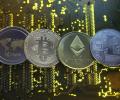
Indian crypto exchanges and companies have expressed strong support for the Central Board of Direct Taxes' (CBDT) new Crypto Asset Reporting Framework (CARF), which mandates reporting and due-diligence obligations for crypto service providers on all transactions starting 2026.

Hybrid mutual fund schemes attracted significant inflows of Rs 1.55 lakh crore in FY26, a 29 per cent increase, as investors increasingly opted for diversified investment strategies to navigate volatile market conditions and geopolitical tensions.

'I don't see fear becoming a dominant factor for retail investors.'

SBI Funds Management Ltd. is set to list on stock exchanges next week following its Rs 11,692 crore Initial Public Offering (IPO), which involves an Offer for Sale (OFS) of a 10 per cent stake by SBI and Amundi.

The initial public offer (IPO) of SBI Funds Management Ltd was fully subscribed on the second day of bidding, receiving bids for 1.17 times the shares on offer, with strong interest from non-institutional investors and anchor investors.

Six Arab football federations, including 2030 World Cup co-host Morocco and Qatar, have publicly declared their "full support" and "confidence" in FIFA President Gianni Infantino. This backing comes as Infantino faces significant backlash and withdrawals of support from European and Oceania federations over his failed $20 billion private investment plan for the World Cup, highlighting a growing schism within global football governance.

An Indian Parliamentary standing committee has demanded an apology from Meta chief Mark Zuckerberg within three days for the temporary removal of Prime Minister Narendra Modi's video from Facebook, threatening to withdraw immunity under the IT Act if he fails to comply. The committee also pushed for government action against Google India regarding financial fraud.

Indian benchmark indices Sensex and Nifty saw gains in early trade, driven by a decline in crude oil prices due to easing geopolitical tensions in West Asia and strong buying interest in the IT sector.

Indian benchmark indices Sensex and Nifty recorded their third consecutive day of gains, primarily driven by an over 8 per cent surge in Bajaj Finance following strong Q1 FY27 results, coupled with significant foreign fund inflows and a dip in crude oil prices.

West Bengal BJP president Samik Bhattacharya advocated a new land policy to facilitate large-scale industrialisation and assured investors of a 'fearless' environment in the state.

Foreign investors have largely been exiting one part of the market while domestic investors have been enthusiastically accumulating another, points out Debashis Basu.

Bajaj Finance reported a strong Q1 FY27 performance with 24 per cent year-on-year AUM growth and a 28 per cent rise in consolidated profit after tax, driven by significant increases in consumer financing, gold loans, and commercial vehicle loans, alongside a strategic focus on digital transformation and AI.

Descendants of a Madhya Pradesh businessman are seeking repayment from the UK government for a Rs 35,000 loan made during World War I. The UK Debt Management Office has responded, asking for further documentation to examine the claim, which the family estimates to be worth crores today with interest.

FPIs have already withdrawn Rs 2.6 trillion from Indian equities in 2026, exceeding the outflows recorded in any previous full calendar year.

Indian stock markets this week will be primarily influenced by a series of corporate Q1 earnings, the evolving geopolitical situation in West Asia, and fluctuations in crude oil prices, according to market analysts.

Indian investors have seen their wealth erode by a staggering Rs 16.77 lakh crore over four trading sessions, as the markets faced deep losses driven by elevated crude oil prices, geopolitical tensions, persistent foreign fund outflows, and a record-low rupee.

A new report by Motilal Oswal Financial Services Ltd (MOFSL) indicates that inflation, interest rates, and monetary policy have become more significant drivers of gold prices than traditional geopolitical conflicts, with markets increasingly focusing on these economic factors.

Carlos Cordeiro, senior advisor to FIFA president Gianni Infantino, has resigned with immediate effect, protesting a proposal to sell a stake in the World Cup, which he labelled 'a bad deal for football'.

Indian stock markets ended a five-day losing streak, with the Sensex surging 776 points and the Nifty gaining 228 points, driven by a significant drop in crude oil prices and easing geopolitical tensions in West Asia.
Indian benchmark indices, Sensex and Nifty, extended their losses for a second consecutive day, primarily due to HDFC Bank's disappointing quarterly earnings and escalating tensions in West Asia, coupled with persistent foreign fund outflows.

The Reserve Bank of India (RBI) maintained its key policy rates for the fourth consecutive time, keeping the repo rate at 5.25 per cent, while the benchmark BSE Sensex closed 152 points higher in a volatile session, recovering from an intraday dip.

Indian benchmark indices, Sensex and Nifty, closed almost unchanged due to profit-taking in blue-chip stocks, geopolitical uncertainties, fluctuating oil prices, and weak Asian market trends, despite cooling US inflation offering some support.

'At the end of the day, it is just another technology produced by the human mind.'

Bengaluru-based electric air taxi startup Sarla Aviation has received Design Organisation Approval (DOA) from the Directorate General of Civil Aviation (DGCA), a crucial step towards commercial production of its indigenous electric vertical take-off and landing (eVTOL) aircraft. The company also inaugurated its new headquarters and announced partnerships, highlighting India's growing capabilities in advanced aerospace technology.

Analysts predict that the US-Iran geopolitical conflict, upcoming quarterly earnings announcements, and fluctuations in crude oil prices will be the primary drivers of investor sentiment in the Indian equity markets.

'Mark Mobius's life was dedicated to investing.'
Indian benchmark indices Sensex and Nifty saw a significant rebound in early trade, driven by a sharp decline in crude oil prices and easing geopolitical tensions in the West Asia, which improved market sentiment and reduced inflation fears. Track Sensex, Nifty on July 27.

Alphabet has announced a significant leadership reshuffle within its artificial intelligence division, appointing Google DeepMind co-founder Demis Hassabis as Chief Scientist to intensify its focus on artificial general intelligence (AGI). Koray Kavukcuoglu will become Senior Vice President of Google DeepMind, overseeing Gemini development and frontier AI research. Additionally, Google veterans Jeff Dean and Sanjay Ghemawat are launching a new public benefit corporation for ML and science discoveries, supported by Google.

UEFA, the Asian Football Confederation (AFC), and CONCACAF have jointly criticised FIFA President Gianni Infantino for his handling of a proposed sale of commercial rights to the World Cup, accusing him of 'deception' and calling for an independent review.
Indian benchmark indices Sensex and Nifty experienced a significant tumble in early trade, primarily driven by heavy selling in HDFC Bank following its quarterly earnings and a sharp spike in Brent crude oil prices due to escalating tensions between the US and Iran. Track Sensex, Nifty
