
India successfully test-fired two Pralay missiles in quick succession off the coast of Odisha, paving the way for its induction into the military. The missile is indigenously developed and features a state-of-the-art navigation system.

India successfully test-fired the newly-developed tactical missile Pralay, capable of carrying conventional warheads, from APJ Abdul Kalam island off the coast of Odisha. The missile, developed by DRDO, has a range of 150 to 500 km and a payload capacity of 500-1,000 kg.

The Enhanced Pinaka has demonstrated a range of 75 km and an ability to strike within 10 metres of where it is aimed. This allows a Pinaka battery to destroy a terrorist camp, or an enemy post, logistics dump or headquarters, without sending soldiers across the border.

Tata Steel UK is reformatting its operations in Port Talbot by investing 1.25 billion in an electric arc furnace facility with the UK government contributing 500 million. The project will take around three years to complete, if all the regulatory clearances come through. The facility will use scrap and be classified as green since it will utilise renewable power and cut carbon emissions considerably.

The Defence Research and Development Organisation on Friday successfully flight-tested a propulsion system that enables a missile to intercept aerial threats at very long range at supersonic speeds.

The ministry said the rocket system has been upgraded with advanced technologies enhancing the range to meet the emerging requirements.
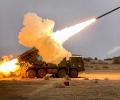
The rocket systems that were tested at Pokharan field firing ranges were manufactured by a private industry following transfer of technology by the Defence Research and Development Organisation.

It said the ATGM has been developed with a capability to launch from multiple platforms and is currently undergoing technical evaluation trials from 120 mm rifled gun of MBT Arjun.

The laser-guided anti-tank guided missile is likely to significantly enhance the fire-power capability of the Indian Army particularly along the frontiers with Pakistan and China, the officials said.

The army has long been deficient in artillery, the modern battlefield's most lethal killer, says Ajai Shukla.

DRDO's Air Independent Propulsion system will allow Indian Navy submarines to operate for up to two weeks without having to surface to recharge its batteries.

A supervisor's response to an employee's suggestions can impact whether or not the employee opens up in the future.

A salvo from a Pinaka battery brings down on the enemy more than seven tonnes of high explosive in just 44 seconds.

Amit Mistry, an alumnus of Rice University, has been selected as the Materials Research Society/Optical Society of America Congressional Science and Engineering Fellow for 2008-2009.
India has signed an agreement with the Canadian Light Source and the University of Saskatchewan to promote synchrotron research, a high tech area of nuclear research.
The National Knowledge Commission is setting up an online network that will enable college students to access study material and connect with institutions and faculty members from around the world by the year 2008.

The conversion facilitated range enhancement and improvement in Pinaka's accuracy.

A top Indian American scientist who heads the prestigious Carnegie Mellon University, will be inducted into the Institute of Medicine in recognition of his research into cell mechanics related to malaria, blood diseases and certain types of cancer.

Mumbai-born Veena Sahajwalla has developed a microfactory in Australia to upcycle electronic waste.

Subra Suresh is one of the only 16 living Americans to be elected to all three national academies, the IOM, the National Academy of Sciences and the National Academy of Engineering.

The IP & Science business of Thomson Reuters has announced its 2013 "Nobel-class" Citation Laureates on Wednesday, which names 28 researchers representing 22 distinct academic and research organisations, and six different countries.

Research and teaching have remained Professor Chintamani Nagesa Ramachandra Rao's first priority and first love, and that is what sets him apart, says Dinesh C Sharma

Professor Chintamani Nagesa Ramachandra Rao is the third scientist to be awarded the highest civilian award -- Bharat Ratna, a crowning glory of his inexorable list of outstanding achievements.

Rajkumar Hirani, who rules critics' hearts as much as he rules the box office, is back after five years. Sonil Dedhia listens in as the filmmaker talks about PK (without dropping the cloak of secrecy of course).

'No PM has said no to anything we have proposed. I am not a politician and I cannot give speeches about things, but a lot of good things have been done in science by previous governments.' 'Under Dr Manmohan Singh, we could do a few important things. I used to meet him once in 6, 8 weeks. He often said, 'Professor Rao, you assume that you have my approval and carry on.' He was shy and decent. He is a real gentleman.' 'Science keeps me going at 80. I feel young.' Professor C N R Rao, the eminent scientist who was honoured with the Bharat Ratna, on the state of science in India.
 © 2026 Rediff.com - Advertise with us - Disclaimer - Privacy Policy - Sitemap - Feedback - About us - Terms of use - Grievances