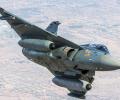
HAL's order book amounts to Rs 2.45 trillion by end of Q2FY26, implying a book-to-bill ratio of 32 times based on FY25 revenue.
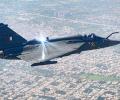
'The aircraft is expected to be ready for rollout between January and March 2026, and to fly by the end of the year.'
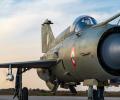
The Indian Air Force (IAF) is set to retire its MiG-21 aircraft in September after over six decades of service. The last of the MiG-21 jets will be given a farewell at a ceremony in Chandigarh.
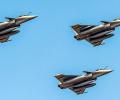
The Indian Air Force (IAF) has seen a reduction in fighter squadrons due to the phasing out of ageing MiG-21, MiG-23 and MiG-27 aircraft. The Parliamentary Standing Committee on Defence acknowledged the "shortage" and highlighted the multi-pronged approach being taken to address it. This includes the induction of indigenous Tejas fighters and the procurement of additional LCA Mk-1A aircraft. The report also addresses concerns over "incidences of spying" within the IAF and details the action taken against those involved.

The slippage in the delivery schedule for the LCA Mk-1A variant of the jet had become a major issue with Chief of Air Staff Air Chief Marshal A P Singh raising the matter publicly.

The performance of Hindustan Aeronautics Limited (HAL) for 2024-25 (FY25) was driven by improved margins and lower provisions. The order book as of March was of Rs 1.8 trillion, with inflows of Rs 1 trillion during FY25.
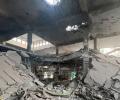
'This operation was a culmination of such long (period) of efforts, and gives us satisfaction that whatever we have been doing, we have been doing correctly'
'Our production capacity ramp-up initiatives are expected to meet the critical requirements of our armed forces.'
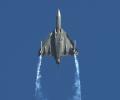
The pact is significant as India has been sourcing its military jets from Russia and European consortia.

Here are list of some of the big ticket announcements.
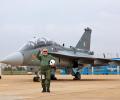
"The experience was incredibly enriching, significantly bolstering my confidence in our country's indigenous capabilities, and leaving me with a renewed sense of pride and optimism about our national potential," he said.

China on Monday said cooperation between countries should not undermine regional peace and stability and target any third party, as it reacted to a host of defence and commercial pacts recently signed between India and the US including joint production of jet engines in India to power military aircraft and a deal on armed drones.

United States President Joe Biden and Prime Minister Narendra Modi are expected to make meaningful advancements on the GE jet engine deal and civil nuclear technology during their bilateral talks, National Security Advisor Jake Sullivan was cited in a Reuters report.

Prime Minister Modi's visit saw India and the US signing several major deals to boost cooperation in key areas such as defence, space and trade.

The two-day State Visit to Egypt at the invitation of President Abdel Fattah El-Sisi is also the first bilateral visit by an Indian prime minister since 1997.

This is the first time since Independence that a new operational branch is being created, Chaudhari said in his speech on the occasion of 90th anniversary celebrations of the IAF.
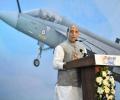
Defence Minister Rajnath Singh said on Tuesday that India cannot remain dependent on other countries for its defence and that the indigenously developed Tejas was better than its foreign equivalents on several parameters and also comparatively cheaper.
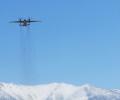
Amid a big push for the Aatmanirbhar Bharat scheme of Prime Minister Narendra Modi-led government, the Indian Air Force is planning to acquire 114 fighter jets of which 96 would be built in India, and rest 18 would be imported from the foreign vendor chosen for the project.
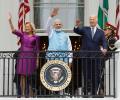
The constitution of both countries begins with the "three words -- We the People -- as President Biden just mentioned", said Modi, who is on his first state visit to the US.
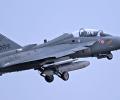
Air Chief Marshal B S Dhanoa calling the FOC a 'major milestone'.

According to Madhavan, the delivery of the Tejas LCA to the IAF under the Rs 48,000-crore deal will begin from March 2024 and around 16 aircraft will be rolled out annually till the completion of the total supply of 83 jets.

According to officials, the list of 101 items includes towed artillery guns, short range surface to air missiles, cruise missiles, offshore patrol vessels, electronic warfare systems, next generation missile vessels, floating dock, anti-submarine rocket launchers and short range maritime reconnaissance aircraft.
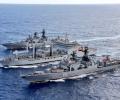
'The Indian Navy has sufficient combat power in areas of interest to India that can quickly scale up operations if the need arises.' 'This includes all the choke points leading into the Indian Ocean as also areas within.'

'The range of purchases throw a light on India's threat perception as also its perceived role of being a stabilising influence in the region,' says Brigadier S K Chatterji (retd).

'IAF is expanding at a rapid pace'
 © 2026 Rediff.com - Advertise with us - Disclaimer - Privacy Policy - Sitemap - Feedback - About us - Terms of use - Grievances