
The latest report by Congressional Research Service -- a research wing of the US Congress that prepares reports for Congressmen - has confirmed the recent statements and media reports that Pakistan was expanding its nuclear arsenal.
"Pakistan's jump from an estimated 60 to 110 nuclear weapons is unlikely to shift the balance of power vis a vis India," said Alexander H Rothman and Lawrence J Korb from the Centre for American Progress in their analysis of the recent news reports that Pakistan's nuclear arsenal.
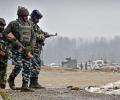
Each Bhabha Kavach has four hard armour plates, which protect the wearer from the front, back, and either side. It can protect CAPF personnel from 7.62 mm bullets fired from AK-47 rifles -- the chosen weapon of terrorists from Kashmir to Bastar.

In its 28-page report, the CRS noted that Pakistan's nuclear arsenal is widely regarded as designed to dissuade India from taking military action against it, but Islamabad's expansion of its nuclear arsenal, development of new types of nuclear weapons and adoption of a doctrine called "full spectrum deterrence" have led some observers to express concern about an increased risk of nuclear conflict between Pakistan and India, which also continues to expand its nuclear arsenal.
Pakistan has approximately 60 nuclear warheads in its arsenal, although the figure could be higher, according to a report by the Congressional Research Service.The report states that Pakistan "continues to produce fissile material for weapons and appears to be augmenting its weapons production facilities, as well as deploying additional delivery vehicles -- steps that will enable both quantitative and qualitative improvements in Islamabad's nuclear arsenal."

The Prithvi-II missile is capable of carrying 500 kg to 1,000 kg of warheads and is thrusted by liquid propulsion twin engines.
Pakistan on Tuesday fired the nuclear-capable Ghauri ballistic missile with a range of 1,300 kilometres that can hit targets in India.

Powering the Agni-1P will be the cutting-edge technologies developed for the Agni-4 and Agni-5 missiles.
India on Thursday successfully test-fired the 290-km range BrahMos cruise missile from the Integrated Test Range at Chandipur off the Orissa coast. The supersonic cruise missile with precision strike capability was test-fired from a mobile launcher at 11 am from launch pad no 3 of the ITR, defence sources said. "The trial was successful," they said. The missile, which can fly at 2.8 times the speed of sound, is capable of carrying conventional warheads up to 300 kg.

Pakistan on Monday successfully test-fired a nuclear capable ballistic missile with a range of 900 kilometers, days after testing a similar missile capable of hitting targets as far as 1,500 kilometers, bringing many Indian cities under its range.
'In the absence of any further testing of nuclear warheads, it is essential to focus upon the associated structures of nuclear defence.'

The study also said that the war would plunge the world into a "nuclear winter" that could lead to global climate catastrophe.
Pakistan on Saturday test fired two short-range ballistic missiles capable of carrying nuclear and conventional warheads and striking Indian cities, with Premier Yousuf Raza Gilani saying it was time for the world to recognise his country as an atomic power.The armed forces conducted 'training launches' of the Shaheen-I missile with a range of 650 km and the Ghaznavi missile with a range of 290 km at the conclusion of an annual field training exercise.
India on Sunday successfully test fired its nuclear-capable ballistic missile 'Dhanush', with a range of 350 kilometers, from a naval ship off the Orissa coast.

'Once the military starts to draw up plans for using nuclear weapons, then nuclear weapons could be used earlier in a crisis than otherwise.'
While Pakistan is estimated to possess 70-90 nuclear weapons, India is believed to have 60-80, claims Robert S Norris and Hans M Kristensen in their latest article 'Nuclear Notebook: Worldwide deployments of nuclear weapons, 2009'.
While the Pakistani army and US troops continue to drive the Taliban out of their hideouts in South Waziristan, there is perhaps a dormant, but more dangerous, threat looming overhead.

The missiles were randomly chosen from the production stock and the entire launch activities were carried out by the specially formed strategic force command and monitored by the scientists of Defence Research and Development Organisation as part of training exercise, a defence scientist said.

Media reports said North Korea has successfully miniaturised a nuclear warhead that can fit inside its missiles.
The Pentagon has been unable to locate hundreds of sensitive nuclear missile components in the United States inventory, according to top officials familiar with a highly confidential report by the American defence department.The finding comes after the air force last year found that a bomber mistakenly flew across the US with six nuclear warheads onboard.Washington recently dismissed its top air force officials, including the Chief of Staff and Service.
Iran is also defying UN demands to suspend uranium enrichment and is producing more powerful centrifuges, the International Atomic Energy Agency said in a strongly worded report, which is bound to renew demands from the US and its western allies for tougher sanctions against Tehran. The report is yet to be released officially, but is said to accuse Iran of not providing all information, especially relating to 'high explosives testing' relating to nuclear programme.
In a first-ever such accident, a British and a French nuclear submarine, both carrying nuke warheads, collided in the Atlantic Ocean earlier this month, but there was no loss of life.
Pakistan on Saturday test-fired a long-range ballistic missile capable of carrying nuclear and conventional warheads and hitting targets within India. The test-firing of the Shaheen-II or Hatf-VI surface-to-surface ballistic missile the first missile test since Pakistan's new government assumed office last month was witnessed by Prime Minister Yousuf Raza Gillani.
Earlier, President Vladimir Putin and his likely successor Sergei Ivanov had clearly indicated that Moscow will take asymmetrical steps to annihilate US missile defence without getting involved in the arms race.

'Large-impact aerial weapons have no use against dictator regimes or terrorist entities,' says Group Captain Murli Menon (retd).
After a series of setbacks in recent years, Russia on Thursday successfully tested its next-generation submarine launched intercontinental ballistic missile with multiple nuclear warheads.
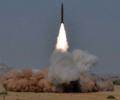
Pakistan on Thursday successfully test-fired a ballistic missile capable of carrying nuclear and conventional warheads to targets as far as 1,500 kilometres, bringing many Indian cities under its range.
Pakistan on Monday test-fired the Shaheen-II long-range ballistic missile for the second time in three days, which can carry nuclear and conventional warheads and hit targets within India. The Shaheen-II or Hatf-VI surface-to-surface ballistic missile, which has a range of 2,000 km, was launched for the first time during a field training exercise by the army's Strategic Forces Command, the military said in a statement.
We have only thought of acquiring a nuclear deterrence capability, but we have deluded ourselves into believing that we have already accomplished it.
The nuclear capable Haft-II Abdali missile has a range of 200 km.
He, however, said that India and Pakistan are proceeding with the composite dialogue process, which has led to reduction of tensions and resulted in several Confidence Building Measures.
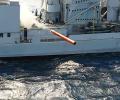
India has joined the list of eight countries having the capability to design and build such a system.

The first canister-based trial of the 5,000 km-plus nuclear capable Agni-V long range ballistic missile is likely to take place on January 31.

"Don't attack us, don't challenge our territorial integrity because we are not a small power, we're a major and nuclear power. Don't push us," Musharraf, 71, said.
The 5.6-m-long missile, weighing about 700 kg, was blasted off at 1410 IST from the ITR. It targeted a flying "para barrel" released from a fighter aircraft.
The missile also known as Hataf VI has a range of 200 km and can carry all types of warheads, state-run PTV reported.

'All the government needs to do is to identify clear political and strategic objectives and to give the military planners a free hand,' asserts Ajai Shukla.
For this, the President delivering a 'special address', said the country's sole Defence Research and Development Organisation had to be completely "reorganised" into a competitive environment.
'The new reactor could simply be a replacement for the existing one in Khushab,' the report said.

Here is how the two countries stack up militarily, according to a report in AlJazeera.com.
 © 2026 Rediff.com - Investor Information - Advertise with us - Disclaimer - Privacy Policy - Sitemap - Feedback - About us - Terms of use - Grievances