
The indigenously developed naval version of the Prithvi short-range ballistic missile has a strike range of up to 350 km and can carry 500 kg of conventional or nuclear warhead, a Defence Research and Development Organisation official said.

United States forces are poised to deploy pint-sized drones, small enough to fit into soldier's rucksack, but packed with tiny explosive warheads enough to blast targets with pinpoint accuracy.
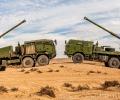
'We cannot understand why the government is facilitating the import of artillery when our indigenous guns are doing so well.'
The new generation Dongfeng-41 is estimated to have a strike distance of 12,000 to 14,000 kilometers and armed with single, 3, 6, or even 10 multiple independently targetable re-entry vehicle (MIRV) warheads.

Two days after a perfect trial of the highly advanced Agni-IV weapon system, India on Friday successfully test-fired its nuclear-capable Agni-III missile with a strike range of over 3000 km from the Wheeler Island off the Odisha coast.
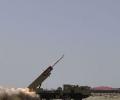
The military described the test of the "indigenously developed short range, surface-to-surface multi-tube missile Hatf-IX" or Nasr as successful.

Inducted into India's SFC in 2003, Prithvi II, the first missile to be developed by DRDO under India's prestigious Integrated Guided Missile Development Programme is now a proven technology

The armed forces have been pushing for adequate allocation of funds so that they are well prepared to deal with the possibility of a "two-front" war on both northern and western borders.
Pakistan has doubled its nuclear arms stockpile to 110 warheads, developing new weapons to deliver them and significantly accelerating production of uranium and plutonium for bombs to edge ahead of India.

Describing the trial a "complete success", sources said that all the mission objectives were met during the test.
Iran's military base, believed to house the country's missile research facility, was totally obliterated by a recent deadly explosion when the technicians were at the final stages of testing a long range missile, apparently capable of carrying nuclear warheads.

Pakistan on Monday test-fired the nuclear-capable Hatf-II short range surface-to-surface ballistic missile that can hit targets in India as part of the process of validating its land-based missile systems.
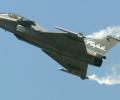
The Rafales could begin combat operations by September-October, reports Ajai Shukla.
Pakistan's secreted nuclear 'jewels' has hugely burdened the economy as billions of dollars of scarce resources were being expended on modernising and upgrading atomic warheads and delivery systems by the megalomaniacal and paranoid military, says Rahul Bedi
Yusuf Raza Gilani, despite being Pakistan's elected prime minister, has little or no control over the country's nuclear arsenal and the armed forces, explains Amir Mir
Pakistan on Friday test fired nuclear-capable Hatf-7 cruise missile with a range of 700 km that can hit targets in India. The test of the "indigenously developed multi-tube" cruise missile system was successful, said a statement issued by the military. The Hatf-7 or Babur missile has stealth capabilities and can carry nuclear and conventional warheads, the military said. The test was witnessed by Chairman Joint Chief of Staff Committee Khalid Shameem Wyne.
Pakistan has the world's fastest-growing nuclear stockpile and it could achieve 150-200 warheads in a decade despite the political instability in the country, two top American atomic experts have said.
The Indian army will have to wait four to five years to acquire Inter-Continental Ballistic Missile Agni-5, which was successfully tested on 19 April by the Defence Research and Development Organisation. Sheela Bhatt reports
Armour-piercing missiles have been making life miserable for most infantrymen, especially tankmen. Most modern Anti-Tank Guided Missiles have shaped charge high explosive warheads, designed specifically for penetrating armour.
The Taliban has said they have no plans to attack Pakistan's nuclear arsenal as their stepped-up violent campaign to avenge Osama bin Laden's death has renewed fears that the country's warheads could be vulnerable.
The 18-hour standoff between Pakistani security forces and handful of militants at the Karachi naval air base has revived fears about militant infiltration in the country's military and the safety of its nuclear warheads.
India on Friday test-fired the Brahmos supersonic cruise missile with certain new systems from the Integrated Test Range at Chandipur off Odisha coast. The test comes two days after defence scientists conducted a similar trial from the same site. "The missile was test-fired from a ground mobile launcher from launch complex-3 of the ITR at about 10 am," a senior official said.
India on Wednesday successfully test fired Brahmos supersonic cruise missile as part of a user trial by the Army from the test range at Chandipur off Odisha coast.
India's defence establishment is taking the new Chinese threat seriously, as also that posed by Pakistan's nuclear-tipped MRBMs -- like the Ghauri-2 and the Shaheen-2 -- which can strike targets 2300 kilometres away.
The indigenously developed low-flying stealth design missile, which can carry a nuclear or a conventional warhead, was tested at an undisclosed location.

The new missile could deliver 2,000 to 3,500 kilograms of payload to any point in the continental US, notes Rajaram Panda.
India on Thursday successfully conducted the first test-fire of its indigenously developed short-range, quick reaction, tactical missile Prahar from the Integrated Test Range off Orissa coast. "The test launch was fully successful as the surface-to-surface, sleek missile mounted on a road mobile launcher roared into an overcast sky, seconds within its blast off," defence sources said. The sophisticated missile was test fired from ITR's launch pad-3 at approximately 8:15 am.
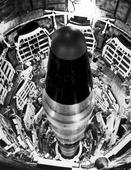
While the international community has long suspected that the US has warheads remaining in Europe, the locations of the bombs have never been revealed -- until now.

The test, conducted at an undisclosed location, was witnessed by the Joint Chiefs of Staff Committee Chairman Gen Shamim Hyder Wyyne.

Prithvi-II is capable of carrying 500-1,000 kilogram of warheads and is thrusted by liquid propulsion twin engines.
Hours after a US study warned of a "very real possibility" that deadly warheads could be stolen by extremists singling out Pakistan as a likely source, Prime Minister Yusuf Raza Gilani said on Tuesday that his country's "nuclear weapons are safe and well-guarded".
"The United States and Chinas Asian neighbours remain concerned about the pace and scope of Chinas current military modernisation efforts, including its quantitative and qualitative modernisation of its nuclear capabilities," the Obama administration said in its Nuclear Posture Review report released by it on Tuesday.

Striking the airfield's runway precisely with one bomb is more economical than using traditional free-fall bombs.
India on Thursday test-fired the indigenously developed nuclear-capable Prithvi-II ballistic missile from the Integrated Test Range at Chandipur in Orissa as part of the user trial by the Army. "The missile mounted on a mobile launcher was test-fired from the launch complex-3 in the ITR at around 0905 hours," defence officials said.With a maximum striking range of 350 km, the missile is capable of carrying a pay-load of 500-1000 kg warhead.

Indian Mujahideen co-founder Yasin Bhatkal sought the help of Nepal-based Maoists for procuring arms and ammunition but it did not fructify as they quoted very high rates, the National Investigation Agency has said in its charge sheet filed in a Delhi court.
Harsh V Pant says leakage of Pakistan's nukes is a bigger worry than the number of warheads in its arsenal.

BWith a distracted president brooding in the White House, Pompeo seems to think his day has come. He seems to be pushing a personal agenda before a target audience in America, observes Ambassador M K Bhadrakumar.

The move of the Vinson strike group is in response to recent North Korean provocations.

The new treaty will require the United States and Russia to reduce -- by 30 per cent below the levels in a treaty signed in 2002 -- the number of nuclear warheads they have deployed on intercontinental ballistic missiles, submarine-based ballistic missiles, and bombers.
According to the Washington Post, American military officials say the intercontinental ballistic missiles, known as Prompt Global Strike weapons, are a necessary new form of deterrence against terrorist networks and other adversaries.
 © 2026 Rediff.com - Investor Information - Advertise with us - Disclaimer - Privacy Policy - Sitemap - Feedback - About us - Terms of use - Grievances